Cinema
Marriage Story, and the Machinery That Takes Over
Two people agree to separate decently and without lawyers. A year later there are four attorneys, two states, a court-appointed evaluator in the living room, and a custody split neither of them asked for. The usual reading of that arc is character. Noah Baumbach’s film is making a structural argument instead: once the process is entered it has its own logic, asks its own questions, and rewards behaviour neither party wanted to exhibit. The antagonist is not a person.
A couple sits in a mediator’s office in New York. Each has been asked to write down what they value in the other and to read it aloud. Both have done the homework. One of them will not read hers, and the session ends there. Nothing cruel has happened. No accusation has been made. Two people who have already agreed to separate decently have simply discovered that the first exercise designed to help them do it is unbearable, and they leave.
Everything that follows in Noah Baumbach’s Marriage Story happens to people who wanted the other outcome. They said out loud, to each other, that they would do this without lawyers, and they meant it at the time. Within a year they have four attorneys between them across two states, a court-appointed evaluator sitting in a rented living room with a notepad, a hearing in which each is described by a stranger in terms neither recognises, and a custody arrangement that neither of them asked for and neither can fully explain.
The comfortable reading of that arc is character. He was self-absorbed and assumed the marriage would keep accommodating him. She was indirect and let a decade of small resentments compound before she moved, and then moved all at once. Both descriptions have something in them, and the film supplies the evidence for both, which is part of why audiences argue about it.
But the film is not primarily making that argument. It is making a structural one, and the structural one is harder to hold in mind because it does not resolve into a verdict on anybody. Once the process is entered, the process has a logic of its own. It admits certain kinds of fact and not others. It converts an account of a shared life into a set of allegations, because allegations are what it can act on. It makes restraint expensive and aggression cheap. And it rewards behaviour that neither person wanted to exhibit, from either of them, at the start.
This is a reading of the film as a study of that machinery. It is not a reading of a marriage, and it is not about anybody’s marriage in particular.
The record, stated precisely
Marriage Story was written and directed by Noah Baumbach and produced by Baumbach with David Heyman for Heyday Films. It had its world premiere in competition at the 76th Venice International Film Festival on 29 August 2019, went out in limited theatrical release on 6 November 2019, and arrived on Netflix on 6 December 2019. In Japan it played in cinemas from 29 November 2019 and reached Netflix Japan on 6 December 2019 as マリッジ・ストーリー. Sources give the running time as either 136 or 137 minutes.
Scarlett Johansson plays Nicole Barber and Adam Driver plays Charlie Barber. Laura Dern plays Nora Fanshaw, the lawyer Nicole retains in Los Angeles. Alan Alda plays Bert Spitz, the first lawyer Charlie engages, and Ray Liotta plays Jay Marotta, the second. Azhy Robertson plays their son Henry, and Martha Kelly plays the court-appointed evaluator.
At the 92nd Academy Awards the film received six nominations: Best Picture, Actor in a Leading Role for Driver, Actress in a Leading Role for Johansson, Actress in a Supporting Role for Dern, Original Screenplay for Baumbach, and Original Score for Randy Newman. It won exactly one, Dern’s. Driver and Johansson were nominated in the lead categories and did not win, and the film did not win Best Picture, Original Screenplay or Original Score.
On how the film was researched, the record is what Baumbach has said in published interviews rather than anything independently verified. He has described speaking with divorce lawyers, judges, mediators and evaluators, and separately with divorced people and with couples who had stayed married a long time, and has said he found the second group as useful as the first. In an interview around the American release he described the divorce process as frightening, shocking and confusing for the people going through it, and described private lives running into professional and commercial structures that make resolution harder rather than easier. That is a filmmaker’s account of his own intentions. What a film intends and what a film does are separate questions, and this essay is answering only the second.
What Nicole lost was proportion, not affection
The film’s clearest statement of what has actually gone wrong is not the argument everybody remembers. It is the long scene, early, in which Nicole sits in her new lawyer’s office and is asked how it started, and then talks without being interrupted for a very long time.
What is striking about the account is what is missing from it. There is no cruelty in it. There is no incident. Nothing she describes would survive being read out as a charge. She describes meeting him, and being seen by him at a moment when she badly wanted to be seen. She describes a career she had, in film, that was hers before he existed. She describes moving to New York, which was reasonable, because the theatre company was there. She describes the company becoming the centre of both their lives, which was also reasonable, because it was good and it was working. She describes contributing ideas that were absorbed into it without ever being hers in a way anybody would have needed to acknowledge. She describes raising the possibility of a year in Los Angeles and finding that it had been heard as a mood rather than a proposal.
Not one of those items is an offence. Every one of them was agreed at the time, most of them by her, several of them enthusiastically. And the sum of them is that a woman who arrived in the marriage at one size is now a smaller size, and cannot point to the afternoon on which that was decided, because there was no such afternoon.
That is the loss the film is actually about, and it is worth naming exactly. She has not stopped being loved. There is no scene in the film that suggests she has. What she has lost is proportion: the share of a shared life that is hers to direct, the assumption that her preferences set the agenda as often as his, the sense that her wants arrive in the room already counting as reasons. Affection survived all of that intact, which is precisely why it is so hard to explain, and why the explanation is so easily met with a sincere and baffled protest that nothing bad ever happened.
The scene also does something structural that is easy to miss. It is the only place in the entire film where either of them gets to put the whole account down at once, at length, to a person whose job in that hour is to listen to it. And that room is a lawyer’s office. She is paying for the hour. The listening is real, and it is also the intake stage of a legal process that will now convert what she has said into a strategy. Nothing she describes is usable in the form she describes it. To become usable it will have to be reduced to acts with dates, which is to say it will have to be turned into something other than what she came in to say.
That is the film’s cruellest structural joke and it is played almost silently. The one place where the truth can be spoken in full is the place that exists to translate it into something else.
A grievance you can state, and a grievance that is distributed
It is worth separating two kinds of complaint, because almost everything difficult about this film sits in the gap between them, and because the distinction is usable well beyond the film.
The first kind can be stated. It is an act, or a breach, or an omission, and it has a date. He did this on that night. She said this and then did the opposite. Money was moved. A promise was made and not kept. A complaint of this kind has enormous advantages, and they are advantages of form rather than of content. It can be named in one sentence. It can be denied or admitted. It can be apologised for, and the apology has a clear object. It can be brought into a room where somebody has authority, and that somebody can rule on it.
The second kind is distributed. It is not one thing. It is several hundred small accommodations spread across a decade, each of them minor, each of them defensible on the day it happened, and most of them agreed to by the person who is now injured by their sum. This kind of complaint has no date, no single actor and no discrete content. It has only a shape, visible from the end, invisible at every point along the way.
And it has a brutal property: it cannot be said out loud without sounding trivial. Take any one item out of the sequence and it collapses. We moved to his city. And? I stopped auditioning for a while. And? He gave me notes on my performances. And? Each answer is a fair question, and answering it honestly makes the speaker sound petty, which is why people carrying this kind of injury so often wait — sometimes for years — until they can attach it to something of the first kind, something with a date, and lead with that instead. The film shows exactly this happening.
This Library has circled the territory before and it is worth saying where, because this essay is standing on that work rather than repeating it. The essay on Anatomy of a Fall described what happens when the private ledger a couple keeps is read aloud by strangers with the power to rule on it. The essay on Force Majeure described the opposite problem: an injury between two people about which they cannot even agree on the description, with no neutral party and no procedure anywhere. The essay on 45 Years described damage done by something that was never said, which therefore has no date and cannot be apologised for. The journal piece on distance argued that the distance which damages a couple is the one that arrived by default, unset by either of them.
What Marriage Story adds is the combination that none of those had. Here the injury has no date, and a procedure exists, and the procedure requires a date. The machinery is available, it is expensive, it is powerful, and it can do nothing whatever with the actual complaint. So the actual complaint is discarded at the door and replaced with the nearest statable substitutes: absence, a suspected affair, drinking, an email account. Those become the case. They were never the injury.
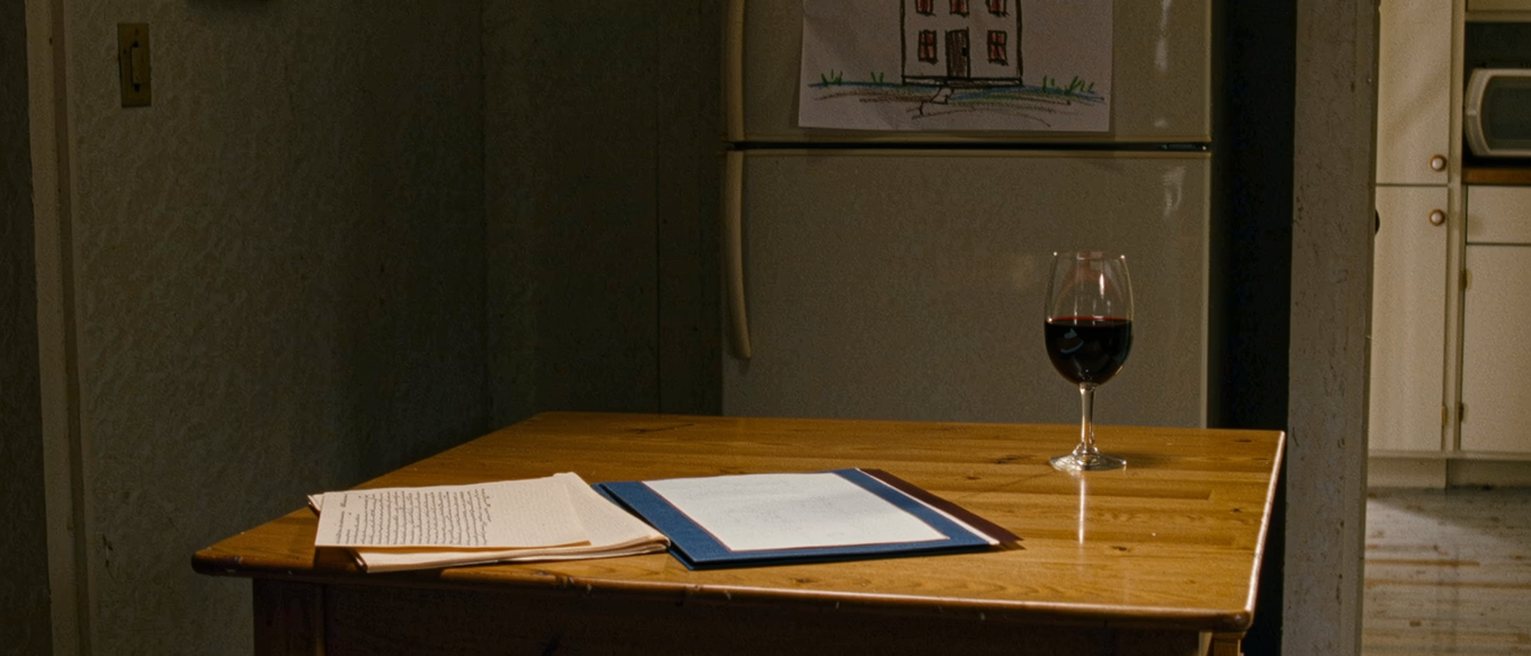
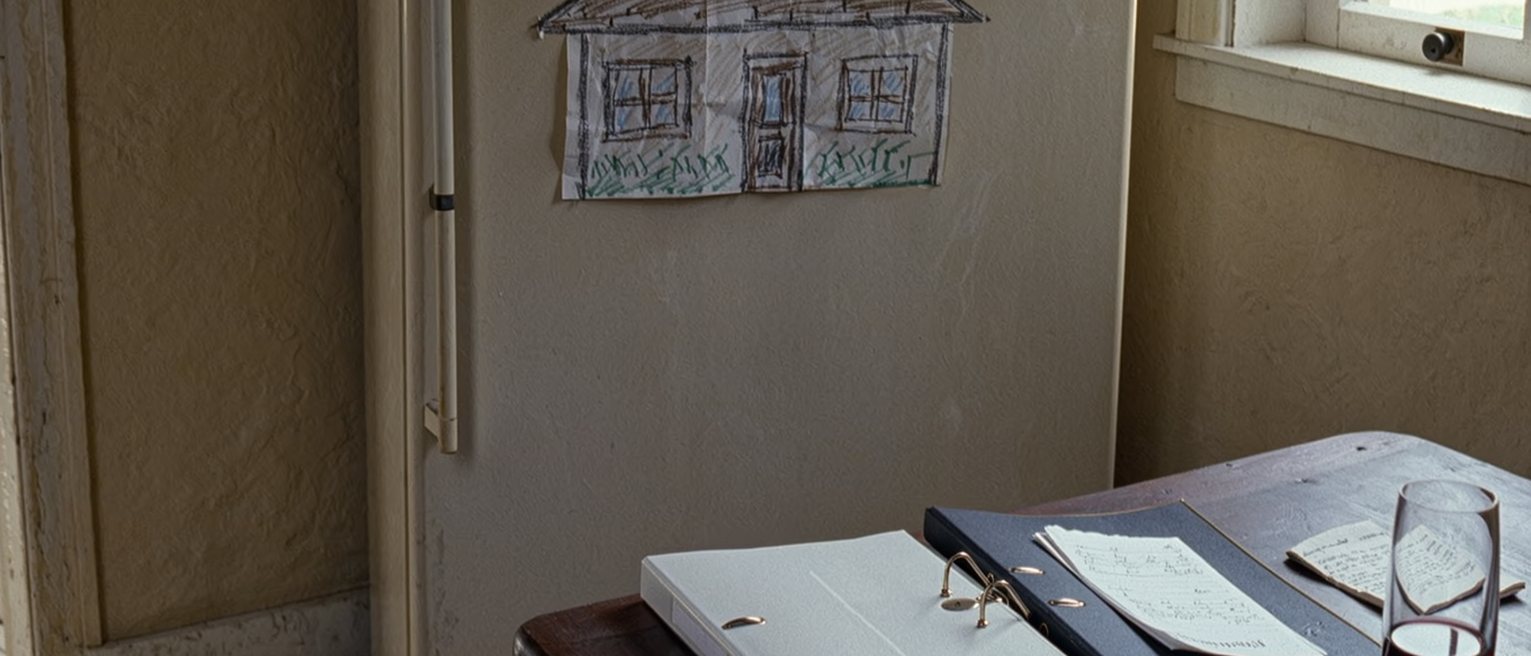
An agreement not to use lawyers cannot be kept by one person
They agree, sincerely and specifically, to do this without lawyers. It is the one promise in the film that both of them make and both of them mean. It does not survive the first act.
The reason is not that either of them is dishonest. The reason is that the agreement has no enforcement and is catastrophically asymmetric under defection. Two people can hold it only for as long as both hold it. The moment one side retains counsel, the other side’s continued restraint stops being decency and becomes exposure, because the represented party now has an advocate who is obliged to pursue advantage and the unrepresented party has nobody. Charlie’s first instinct is to refuse, and his refusal is the correct expression of what they agreed. He is then told, in effect, what that refusal will cost him, and he stops refusing. Nothing in that sequence requires either party to be acting in bad faith.
The film is careful about how Nicole arrives at her lawyer, and the care is the point. Nora Fanshaw’s first scene is not aggression. It is hospitality: an office arranged to be comfortable, a person who sits down and listens properly, food offered, no hurry. Baumbach has described it in interview as a seduction scene, and it plays as one. What is being offered is not litigation. What is being offered is the experience of being taken seriously at length, which is the thing Nicole has been short of for years, and which happens to be available here for a fee.
Charlie’s two lawyers make the same argument from the other direction. Bert Spitz is decent, calm and comparatively cheap, counsels moderation, and warns against the escalation that a more aggressive representative will produce. Within the world of the film he is also insufficient, and Charlie leaves him for Jay Marotta, who is expensive, quick and effective. The film puts the choice in front of the audience with unusual clarity: the decent option and the effective option are different options, and choosing the decent one is a unilateral disarmament that the other side has not matched.
The detail that closes the argument is the money. Charlie receives a MacArthur Fellowship, an award given for creative work and intended to free the recipient to do more of it, and the fellowship money goes into legal fees. A grant designed to buy a man time to make things buys him an attorney instead. Nothing about that is a moral failure. It is what the machine is for, and what it costs to use.
Jurisdiction decides the question before the question is asked
The most consequential turn in the case has nothing to do with either of them, and this is the part of the film that audiences discuss least and lawyers discuss most.
The family is a New York family. Nicole has taken the job in Los Angeles and taken their son with her, with Charlie’s agreement, on an understanding both parties describe as temporary. The legal question that then arrives is not who is the better parent, or who did what to whom, or what either of them intended. It is which state’s courts will hear the matter at all. Writing about the film in December 2019, a family lawyer at an English firm noted that the three thousand miles between New York and California produce exactly this kind of jurisdictional fight, and observed that such fights are unusually stressful to litigate because the outcome is binary: one forum wins and the other does not.
What that means in practice is that the decisive ruling in the case is made on grounds that are essentially logistical. Where has the child been living. For how long. Whose conduct established that. The merits, such as they are, are argued afterwards, inside a frame that has already been set by facts about removals, addresses and months.
The film then does something quietly savage with this. Charlie, advised, rents an apartment in Los Angeles. He does not want to live in Los Angeles. He is not moving there because his life is there. He is acquiring a residence as a legal argument, and then having to live inside the argument, in rooms chosen for what they will look like to a court. The machinery has now determined not only how he will speak about his marriage but which city he sleeps in.
And the same logic runs through the smaller decisions. Which parent is present on which nights becomes a matter of evidence rather than of preference, so both of them begin behaving with one eye on how the behaviour will be characterised later. That is the mechanism the whole film is describing, stated in its most ordinary form: it is not that the process makes people cruel. It is that the process makes people strategic, and strategy in a domestic setting is indistinguishable from coldness at close range.
Being observed is not the same as being seen
Then the evaluator arrives, and the film reaches the sequence that makes its structural argument most exactly.
The category is real. In California, a court-ordered child custody evaluation is defined by the Rules of Court as an expert investigation and analysis of the health, safety, welfare and best interest of children with regard to disputed custody and visitation issues, conducted under provisions including Family Code section 3111, and the courts order them to assist in determining those matters. The rule governing them, rule 5.220, sets out qualifications, training and conduct requirements for evaluators. Nothing in what follows is a claim about how any real evaluation is conducted, or about any real evaluator. It is a reading of a scene.
What the scene shows is a man who must be a father for an hour while knowing that he is being scored on it. He tidies. He arranges the rented apartment to look like somewhere a child lives. He performs ease, and the performance of ease is immediately legible as performance. His son, meanwhile, is behaving exactly as a child behaves, which is to say helpfully and disastrously, and volunteers that his father can do a trick with a knife. The trick goes wrong. Charlie cuts himself badly, bleeds, and spends the rest of the visit trying to conceal the wound while continuing to be assessed.
It would be easy to read that as humiliation, and it is humiliating, but the humiliation is not the point. The point is a measurement problem. The instrument alters the thing it measures. A parent who knows he is being observed cannot produce unobserved behaviour, and unobserved behaviour is what the observation is for. The version of Charlie that matters — the one who exists on an ordinary Tuesday, tired, unwatched, adequate — is by construction unavailable to the process that has been convened to find him.
So the evaluation is not a window. It is a stage, and both parents know it is a stage, and the only thing it can reliably record is how well each of them performs under conditions of being recorded. That is a skill. It is not the skill at issue. And there is no version of the exercise that escapes the problem, which is why the scene is a structural observation rather than a complaint about an individual.
The settlement nobody chose
By the hearing, the conversion is complete. Each of them sits in a room while a hired advocate describes the other in terms that are technically supportable and substantially false: an absence recharacterised as abandonment, a private difficulty recharacterised as a pattern, an email account recharacterised as a criminal matter. Both of them flinch. Both of them had agreed, in good faith, not to do this. Neither of them said the words being said on their behalf, and both of them are paying for them.
It is after that hearing that the film gives them the scene everyone remembers: the two of them alone, no lawyers, trying to have the conversation directly. It is worth being exact about what that scene demonstrates. It does not show the couple recovering their own voices once the professionals leave the room. It shows the opposite. By that point the vocabulary available to them is the vocabulary the process installed, and what comes out is the worst thing either has ever said to the other, delivered by a man who apologises for it immediately and cannot take it back. Removing the lawyers does not restore the couple, because the damage is not the lawyers’ presence. It is what the months have taught both of them to reach for.
Then comes the settlement, and the settlement is the thesis in a number. The two of them have arrived, exhausted, at an even split of their son’s time. It is the arrangement both of them can live with and neither of them contests. What is filed is not that. Nicole’s lawyer adjusts it, to a small majority in Nicole’s favour, without Nicole having asked for it and without the client’s agreement being sought for the change.
Nobody in the film wants that outcome. Nicole does not want it. Charlie plainly does not want it. It benefits neither child nor parent in any way anybody in the story can articulate. It exists because an office whose function is to obtain margins obtained one, at the end, because it could. The final disposition of a family is a rounding decision taken by a third party for reasons internal to the third party’s profession.
And then the film’s last movement, which is not a reconciliation and should not be read as one. A year on, Charlie is living in Los Angeles. Their son finds the letter Nicole wrote in the mediator’s office at the beginning and reads it aloud, and it turns out to have been true all along and to have changed nothing. At the door, Nicole notices Charlie’s shoelace is undone and kneels and ties it. That is the film’s final position on the subject: the affection was never what failed. It survived the entire apparatus intact and was never at any point the thing under examination.
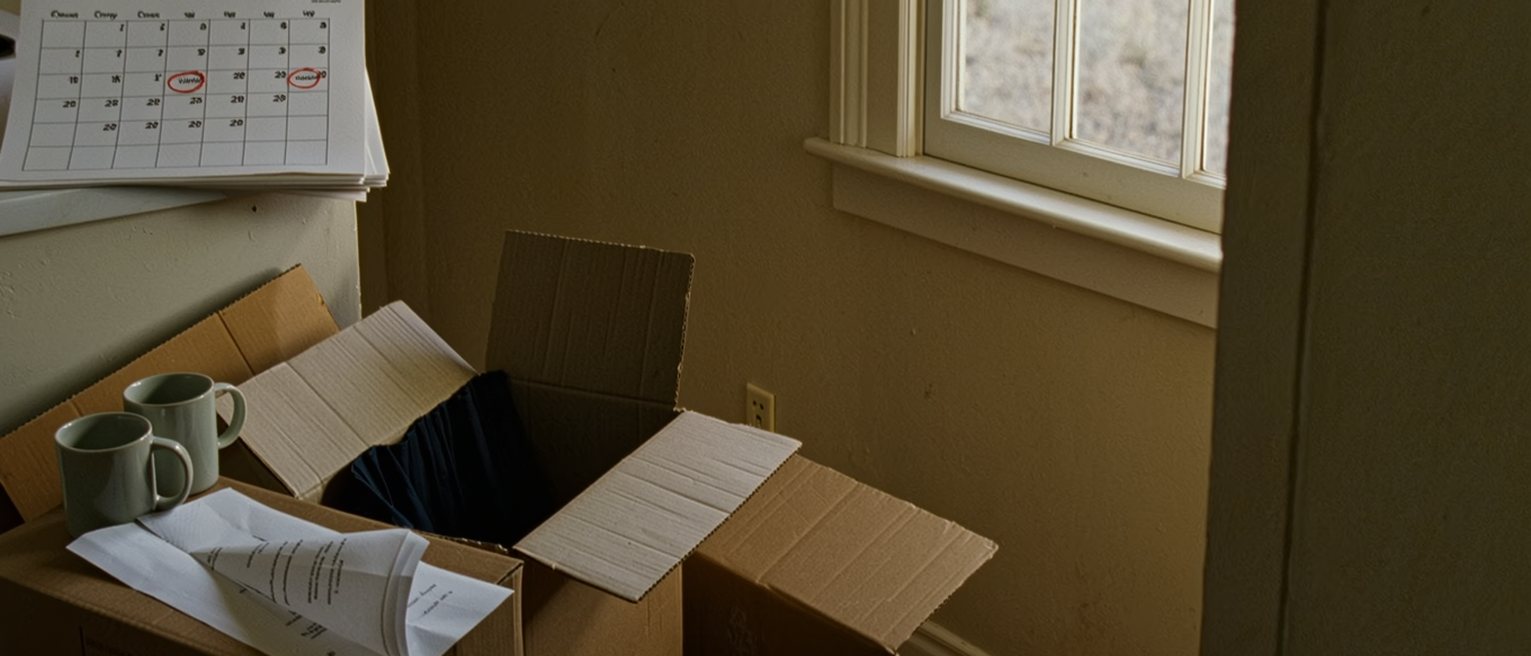
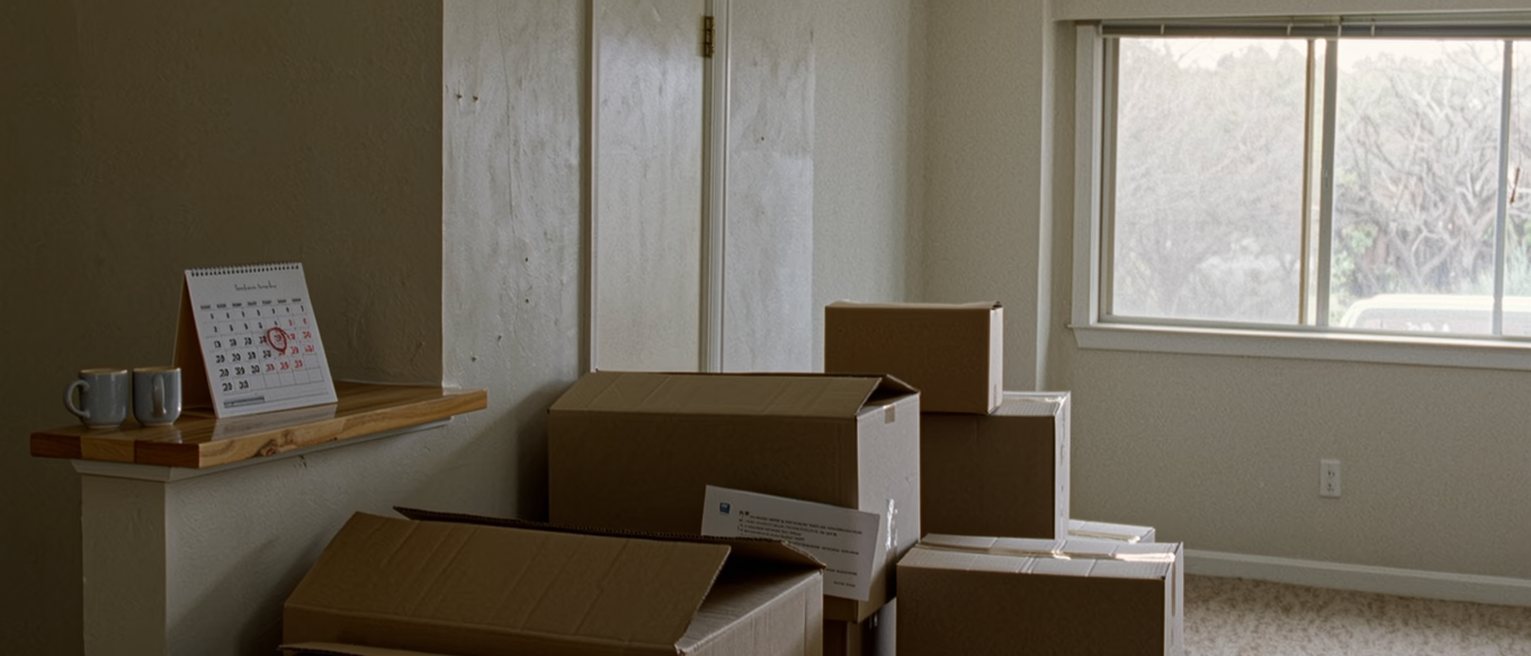
Japan, where the default road is a different one
A reader in Japan is watching a machine that is not, in most cases, the machine on offer here, and the difference is worth stating precisely because it cuts both ways.
In Japan the ordinary route is 協議離婚, divorce by agreement: the parties agree, complete a form and file it at a municipal office. There is no hearing, no court, no requirement that either party be represented, and no external party who examines anything. According to the Ministry of Health, Labour and Welfare’s special report on divorce statistics, 協議離婚 accounted for 88.3 per cent of divorces in 2020, a share that has been above eighty per cent for the whole post-war period and stood above ninety per cent for much of it. Judicial routes — conciliation, adjudication, settlement, judgment — account for the remainder.
The first consequence is obvious and favourable. Almost nothing depicted in this film can happen on that road. There is no jurisdictional fight, no evaluator in the living room, no hearing in which a stranger characterises you, no fee structure that rewards escalation. A great deal of the damage the film records is damage the machinery does, and a process that does almost nothing cannot do that.
The second consequence is less comfortable and follows from the same fact. A procedure that asks for nothing produces no record. Nothing is examined, so nothing is established. And the kind of grievance this essay has been describing — the distributed one, the one with no date — is not merely hard to litigate on that road. It has nowhere to be said at all. There is not even a lawyer’s office in which a person is paid to listen to the whole account for an hour before turning it into something else. The account simply goes unspoken, and the paperwork records a mutual agreement that both parties signed.
One thing has changed recently and is worth stating as fact rather than as commentary. The Act partially amending the Civil Code and other laws, 令和6年法律第33号, was promulgated on 24 May 2024 and came into force on 1 April 2026. Among other changes it makes joint parental authority after divorce possible in Japan for the first time, with the parents deciding by agreement where they can and the family court deciding where they cannot, and it revises provisions on child support and on contact between parent and child. This Library makes no prediction about what that will do. It is too early, and predicting it is not this essay’s business. The narrow observation is only that a question which Japanese practice has for a long time settled by default now has a route into a forum, and that everything above about what forums do to accounts of a shared life becomes, from this year, more relevant here than it was.
The strongest case against the film, and against this essay
Four objections, taken at full strength rather than noted and dismissed.
The first is the serious one. Marriage Story is structurally symmetrical — two letters, two lawyers, two cities, two households, a case put for each — and it is very widely read as tilting toward Charlie anyway. The observation is not fringe: it was made in the trade press during the film’s release, and the argument over whose side the film is on has followed it ever since. The grounds are concrete. Charlie has more screen time. The film’s emotional climax is his collapse, not hers. The song at the end is his. The last act follows him into his diminishment, while Nicole’s arc resolves comparatively neatly into work, family and a new relationship. And there is a sharper form of the objection: a film whose subject is a woman’s loss of proportion inside a marriage, and whose most devastating final movement belongs to the man, has arguably reproduced the very asymmetry it set out to examine.
That lands, and the honest response is not a rebuttal. Begin by conceding the distribution, which is real and measurable and not a matter of interpretation. Then notice the shape of it. Nicole’s account is given once, early, at length, and is essentially never returned to. Charlie’s is distributed across the whole running time in fragments, none of which would carry much weight alone. That is precisely the asymmetry this essay has been describing between a statable case and a distributed one — and here it is operating on the audience rather than on a court. Whether the film knows that about itself is genuinely unclear. It is either a serious flaw or the most honest thing in it, and this essay does not claim to know which. What this essay can be held to is that it has deliberately given Nicole’s scene the weight the film’s running time does not, which is a corrective, and a corrective is a thumb on the scale, and it is better declared than hidden.
The second objection concerns the argument scene. It has detached from the film. It circulates as a clip, as a meme format, as an audition piece and as a parody template, watched and performed by very large numbers of people who have not seen the surrounding two hours. And a scene that works that well as spectacle is suspect as evidence. It is the most written scene in the picture, the most actorly, the one constructed to be played — and an essay that treated it as a document of how two people speak under legal pressure would be treating a set piece as testimony. That objection is substantially correct, which is why this reading leans on that scene least of all and treats the lawyer’s office, the rented apartment and the evaluator’s visit as the load-bearing material instead.
The third objection goes to the framing itself. Calling the process an antagonist can absolve two adults of choices they actually made. Nicole chose Nora, in a room where nobody compelled her. Charlie chose Marotta over Spitz, with the decent alternative physically present and available, and paid for the choice out of a prize. Describing all of that as machinery treats grown people as weather, and it is a description that will be gratefully received by any reader who would prefer to believe that what happened in their own separation was done to them. The narrowing is this. Nothing here claims the alternatives were unavailable, and nothing here says either party is beyond criticism. What is claimed is narrower: the choices were made under conditions neither of them set, on an option set where restraint carried an unbounded downside and escalation carried a bounded one. That is a description of the option set, not an amnesty. A reader can accept every word of it and still hold both of them responsible for what they picked.
The fourth objection is ours and it is correct. This house sells uncomplicated hours. An essay arguing at length that shared lives accumulate a complexity which cannot be stated, cannot be litigated and cannot be undone is an essay whose conclusion happens to be the case for our product. That is not a coincidence and there is no argument that removes it. What can be done about it is done in the next section, and it is not much.
What this house sells, and what it cannot claim
The interest is stated here rather than left for a reader to work out at the end.
This house sells private companionship: paid, bounded, scheduled evenings in which a person is listened to with attention. An evening here has no shared property, no jurisdiction, no custody question and no decade of accumulated accommodations to settle. It is uncomplicated by construction. Every step of the argument above therefore runs in our commercial favour, and it would be difficult to design an essay more flattering to what we happen to sell.
So the constraints, stated as refusals rather than as a disclaimer. We give no legal advice and none is contained above; a person facing a separation should be talking to a lawyer, in their own jurisdiction, about their own facts. We offer no mediation, no counselling and no couples work of any kind, we are not qualified to and we do not pretend otherwise. Nothing said to anyone in this house is privileged or confidential in the sense that a lawyer or a clinician is bound, and it should not be treated as though it were.
And we will not blur the line this film makes unusually easy to blur. An evening without accumulated history is not an achievement. It is an absence. There is no ledger between us because there has been no decade, no shared child, no career deferred, no city moved to. The uncomplicatedness is not a solved version of what Nicole and Charlie had. It is the state of not having had it. A relationship with nothing to divide is not a better relationship; it is a shorter one, and anybody selling the first as the second is selling something they cannot deliver.
Nor do we claim that watching this film, or reading this, tells a reader anything about their own arrangement. It does not. This essay makes no assertion about the reader’s marriage, if there is one, and offers no guidance about it.
What this does not claim
This is a reading of one film. It is not legal analysis, not legal advice, not therapy, not couples guidance and not a diagnosis of anybody.
Nicole Barber and Charlie Barber are characters in a screenplay by Noah Baumbach. They are not real people, and nothing above assigns a psychological condition, a motive or an inner state to either of them beyond what the film depicts. Baumbach has said in published interviews that he had a personal connection to the material, and press coverage has connected the film to his own divorce. This essay makes no claim about any real person’s marriage, treats the film as a work of fiction rather than as a record, and does not comment on any real separation.
The account of how the film was researched is what Baumbach is quoted as saying in published interviews. It is his description of his own process and has not been independently verified here, and it is reported as a filmmaker’s statement of intention rather than as evidence about what the film accomplishes.
The legal material is limited and is stated as categories. That a court-ordered child custody evaluation is a defined category in California, conducted under provisions including Family Code section 3111 and governed by rule 5.220 of the California Rules of Court, is taken from the published rule. Nothing above is a claim about how any actual evaluation is conducted, about the conduct of any real evaluator, or about outcomes in any real case. The observation about jurisdiction between two distant states is a description of what the film depicts, together with a commentary on the film published by a family lawyer at an English firm, and is not a statement of American law.
The Japanese material is official and is stated without extrapolation. The figure of 88.3 per cent for 協議離婚 refers to divorces in 2020 as published in the Ministry of Health, Labour and Welfare’s special report on divorce statistics issued in 2022; it is a national proportion and describes no individual. The dates and content of 令和6年法律第33号 are taken from the Ministry of Justice’s own publication of the amending Act. No prediction is made about the effects of that Act, and nothing above is a statement about Japanese people, Japanese families, Japanese marriages or national character of any kind.
The division among critics over whose side the film takes is reported as a division that exists in published commentary. It is not adjudicated here, and the concession made to it is a concession about how the film distributes its running time, not a finding about the filmmaker’s intentions.
No dialogue from the film is reproduced anywhere in this essay. Scenes, including the mediator’s exercise, the account given in the lawyer’s office, the evaluator’s visit, the hearing and the argument, are described rather than transcribed, and the contents of the letter read at the end are not set down.
No filmmaker, performer, producer, distributor, festival, academy, publication, law firm, government ministry or agency named above is connected to this house, knows of it, or endorses it.