Cinema
The Handmaiden and Reclaiming a Story From Desire, Performance and Control
An heiress has been trained since childhood to read erotic books aloud to rooms of male collectors — fluently, beautifully, in a language not her own, from texts she did not write. The film’s liberation is therefore not about her acquiring speech. She has more speech than anybody in it. It is about the difference between being made to speak and getting to say.
A young Korean thief is placed as a handmaiden in an isolated estate, as part of a scheme run by a con man posing as an aristocrat. The plan is that her mistress — a Japanese heiress living under the control of her uncle — will fall in love with the impostor, marry him, be declared insane, and lose her fortune to him, with the handmaiden paid for her part in the arrangement.
That is the first third of the film. The second third tells the same events again from the heiress’s side and establishes that almost nothing in the first third was what it appeared to be. The last third is neither woman’s account but both.
And underneath the machinery there is a fact about the heiress that organises everything. Since childhood she has been trained to read aloud — erotic books, from her uncle’s collection, performed to assemblies of male collectors who pay to hear a young woman recite them. She is extremely good at it. Her aunt did it before her.
The month’s theme is silence, language and touch, and the sentence underneath it is: not everything needs words, and the important things should not be left unclear.
Which is the cleanest statement of what this chamber has been arguing for a year, and this film is the most extreme case of it available.
A woman made to speak is not a woman who gets to say
The obvious reading of a woman in her position is that she has been silenced. It is wrong, and correcting it is the whole essay.
She has not been silenced. She has been made into a voice. She speaks constantly, in public, at length, on the subject of desire, with technical fluency and trained expression — and every word of it is somebody else’s. The texts are her uncle’s. The audience is his. The language she performs in is the language of the occupying power. The subject matter is a male collector’s idea of what a woman’s desire sounds like.
So she has enormous verbal facility and no authorship whatsoever, and the two are not on a spectrum. They are different things. Facility is the ability to produce language well. Authorship is the ability to put your own content into it, and the second can be absent while the first is exceptional.
Which means the film’s liberation cannot be about acquiring speech. She already has more speech than anybody in the story. What she acquires is the other thing: the capacity to say something that originates with her, to somebody she chose, about a matter that is hers.
And that distinction is not exotic. A great many articulate, accomplished women are in a milder version of it — fluent in every register the day requires, capable of talking for an hour on demand, and unable to locate a single sentence in the day that originated with them rather than being produced for somebody. Facility is not evidence of authorship, and it is frequently mistaken for it by everybody including its owner.
Why destroying the library is the liberating act
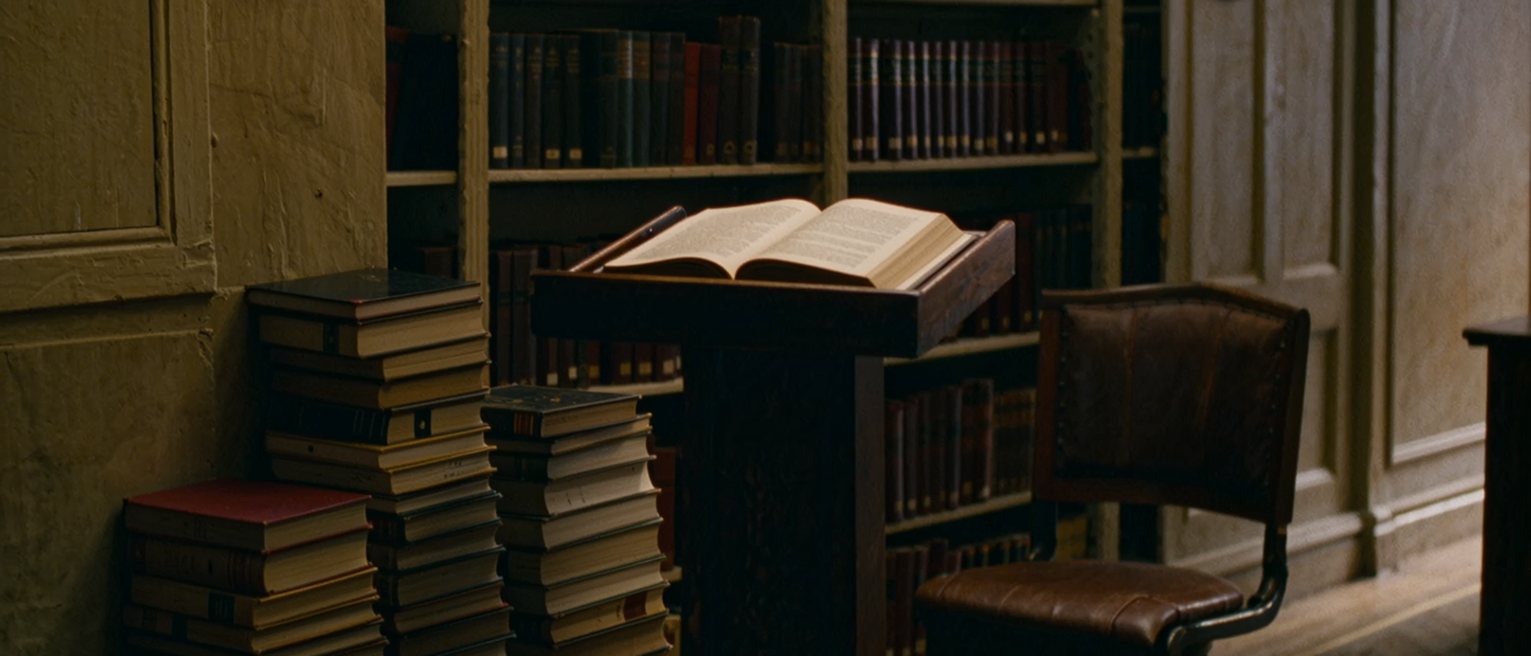
The film’s climax is two women destroying books — tearing them out of their bindings, throwing them down, flooding them. It is staged as the most cathartic moment in the film, and it is worth asking why that rather than simply leaving.
Because the books are the script. They are the physical form of the language she was made to produce: the corpus she was the voice of, the thing that organised the rooms she performed in, the evidence of what she had been for.
So the destruction is not anti-literature and it is not vandalism as emotional release. It is the removal of a text she did not write from a position where it determined what came out of her mouth.
And the detail that makes it an argument rather than a spectacle is what does not follow. She does not write a replacement. The film does not end with her authoring her own book, publishing, or producing a corrected account of desire. There is no new text.
What there is instead is the absence of one, and the film treats that as the victory. Which is the month’s first clause earned rather than asserted: not everything needs words. For somebody whose entire history is compelled fluency, the first free condition is not better words. It is the silence where the script used to be.
Three parts, and the insufficiency of one narration
The structure is doing argumentative work and it is easy to enjoy as a trick instead.
The first part is narrated by the handmaiden and is coherent, satisfying and apparently complete. Nothing in it signals that it is partial. Then the second part runs the same period from the heiress’s position and the first account turns out to have been wrong about almost every motive in it.
Which establishes something this chamber has reached from other directions: a confident narration is indistinguishable from an accurate one. The first third does not feel like a limited perspective. It feels like the story, and it feels that way because narration is persuasive by construction — the account you have is always the complete account until another one arrives.
And the film sharpens it by making both women think they are running the scheme. Each has a plan that requires the other to be deceived. Each is, in her own account, the agent and the other the instrument. Neither is lying to herself.
So the film is not about one of them being right. It is about two people holding incompatible complete stories about the same events, which is the ordinary condition of two people in anything, and which no amount of sincerity resolves.

The con ends when the concealment ends
The turn of the entire plot is a disclosure, and it is worth identifying precisely because it is this chamber’s session-long finding arriving inside a thriller.
At the point where each woman knows the other is being used, the scheme could continue. Both have strong material reasons to let it: the plans are advanced, the money is real, and each could complete her version at the other’s expense.
What ends it is that they tell each other. Not a change of heart in the abstract — an act of disclosure, made at cost, which converts two competing concealed plans into one shared arrangement. From that moment they are working together, and everything after it succeeds.
Which is the finding this chamber has now reached from a written marriage contract, a declared portrait, a quartet that admits everyone is lying, and an identical act performed twice with only the telling changed. A concealed arrangement and a declared one are different objects, and the declaration is the operation that converts them.
And the film adds something the other cases did not. Here the concealment was not protecting anybody’s feelings. It was the mechanism of the plot — the thing that made both women instruments of men who had written their scripts. Which makes the disclosure not merely more honest but strategically decisive: it is the move that takes the narration away from the people who had been supplying it.
A script for touch is not touch
The film is explicit, and this essay will describe what the explicitness is doing rather than what it shows.
The structure stages a contrast. On one side, the books — a corpus of erotic writing assembled by male collectors, performed aloud by a young woman to an audience of men, depicting what they take a woman’s desire to be. On the other side, what actually happens between the two women, which the film shoots differently, shapes differently, and pointedly does not arrange to resemble the recitations.
The argument is that a script for touch is not touch. The books are extremely detailed and extremely wrong; detail is not accuracy, and a corpus assembled by people with no access to the experience can be both comprehensive and useless.
This chamber reached the same finding from a book arguing that arousal is produced by meaning rather than by technique — that the visible account of sex is a poor guide to the thing, because the mechanism runs in a place with no external features. This film is that argument in its strongest available form, because here the script is not a metaphor. It is a physical object, kept in a room, read from, and then destroyed.
And the useful extraction for a reader is narrower than the politics. A person who has learned about her own desire primarily from depictions has learned somebody else’s account of it. Not a worse version of the truth — a different object, compiled by people who were not present.
Whose language, and what it costs
The film is set in Korea under Japanese occupation and every relationship in it is mediated by which language somebody is speaking, so an essay that treats this as backdrop has removed a working part.
The heiress is Japanese, in Korea, in the 1930s. The handmaiden is Korean. The uncle is a Korean who has remade himself as Japanese and who requires the household to speak it. The impostor is a Korean performing Japanese aristocracy. The film’s original presentation distinguished the two languages for the audience, because which one is being spoken at any moment is plot-bearing rather than atmospheric.
Which means the heiress’s fluency is also a collaboration. Her trained Japanese is the instrument of her captivity and the mark of her privilege at once — she is both the occupier’s daughter-figure in a colonised country and a girl locked in a house being made to recite.
And this chamber owes a note about itself here. This Library publishes in Japanese, for a substantially Japanese readership, and in this film Japanese is the language of the occupying power and the language a woman is forced to perform in. That is not a comfortable fact to pass over, and passing over it would be the kind of smoothing this chamber has criticised elsewhere. A Korean film about Japanese colonial rule is not available to be read as a neutral story about two women; the national material is load-bearing, and a Japanese reader encountering it should encounter it rather than have it removed.
Which also strengthens the essay’s main point rather than complicating it. The question of whose language you are fluent in, and at what cost, and for whose benefit, is the same question as whose words are coming out of your mouth.


What this essay refuses
It is not reading the film as a simple liberation narrative. The ending is a genre ending: satisfying, symmetrical, with the bad men destroying each other in a basement. Satisfying structures are suspect, and this one delivers a catharsis that real situations do not supply.
It is not treating the relationship between the two women as the film’s thesis. It is the film’s best material and the film is a thriller built around a con, and a reading that makes it primarily a love story has to ignore how much of the machinery is about narration and property.
It is not endorsing the destruction as a model of anything. Tearing up a collection is available to somebody at the end of a two-hour film with nothing left to lose. The equivalent move in an ordinary life is rarely available and frequently expensive, and this essay is not recommending a gesture.
And it is not claiming the women are free at the end in any sense broader than the one the film shows. They have escaped a house and a script. The colonial situation, the money, the law and the country are all exactly as they were.
What to do with the month’s sentence
Not everything needs words. The important things should not be left unclear.
That sentence is the synthesis of everything this chamber has argued, and the film supplies three things to do with it.
First, distinguish facility from authorship in your own week. Count the hours you spend producing language — meetings, messages, managing people, being pleasant, explaining. Then ask how many sentences in the week originated with you rather than being produced for somebody. For a great many capable women the first number is enormous and the second is zero, and the first is routinely taken as evidence against the second.
Second, notice where you are fluent in somebody else’s register, and what it costs. Not as a grievance. As information: a register you perform well is a register you will keep being asked for, and competence in it is the reason nobody will ever ask for anything else.
Third, apply the second clause narrowly. Not everything needs words is a genuine permission and it is not a licence for the one thing that does. The important things should not be left unclear means a very short list: what you want, what you will not do, and whether somebody can rely on what you said. Everything else can stay wordless. Those three cannot, and this chamber has spent a year establishing what happens when they do.
And the film’s own instruction, which is the hardest: the silence that follows destroying a script is not emptiness. It is the first condition in which anything of your own can be said.
Limits
The film is from 2016, directed by Park Chan-wook and co-written with Chung Seo-kyung, adapted from Sarah Waters’s novel Fingersmith and relocated from Victorian England to Korea under Japanese colonial rule. Credits, cast, the novel’s publication details and current availability should be verified at the publication gate, per the atlas entry’s note on external works.
The plot is described in outline across its three parts, and no dialogue is quoted. Characters are referred to chiefly by role — the handmaiden, the heiress, the uncle, the impostor — and performers are not named.
The film’s erotic material is described only by its structural function, as a contrast with the recitations. No scene is described for its content.
The basement sequence and the violence are referred to in outline without detail.
The central reading — that the heiress has facility without authorship, and that the film’s liberation is the acquisition of authorship rather than of speech — is this essay’s interpretation. The film dramatises it and does not state it.
The treatment of the colonial material is given in outline and this essay makes no historical claims beyond the setting. The note about this Library’s own position is included deliberately rather than as a disclaimer.
And nothing here is a claim about the novel, which this essay has not examined, or about the relationship between adaptation and source beyond the fact of the relocation.
The silence after the script
What stays from this film is not the con and not the escape. It is the image of a young woman standing in a room of men, reading beautifully from a book she did not write, about a subject nobody has ever asked her anything about.
She is the most articulate person in the film and she has never said anything. Which is a distinction almost nobody makes, because fluency reads as presence — a person who can talk well is assumed to be somebody whose words are her own, and the assumption is so automatic that the actual question never gets asked.
And the question is available to anybody. Not whether you can speak. Whether anything you have said this month started with you.
What the film offers in place of an answer is the ending: two women, a destroyed library, no replacement text, and a silence that is the first thing in the story that belongs to either of them.
That is what an evening at Moonlight is arranged to be, and this month is the reason to state it in these terms. Not more words. A stated number of hours with a beginning and an end, terms set in advance and set by you, in which nothing is being performed — no register to maintain, no audience to satisfy, nobody expecting the fluency you are known for. Nothing is inferred from your silence, because the silence is not a failure to produce. It is the condition in which the short list can be said: what you want, what you will not do, and nothing else that you do not choose to add.