Cinema
Petite Maman, and Meeting Your Mother as an Equal
An eight-year-old goes into the woods behind her grandmother’s house and meets a girl her own age who is her mother. The film offers no mechanism, no rules and no reveal, and it runs seventy-two minutes. Its proposal is that the entire distance between a daughter and her mother is the age gap. What that makes briefly visible is not a secret being kept. It is a position nobody can occupy: the mother as a person for whom nothing had yet been settled.
An eight-year-old girl is emptying a room in a care home. She says goodbye to the other residents one at a time, along the corridor, and then gets into the car with her parents and is driven to the house where her mother grew up, which now also has to be emptied. Her grandmother has died. A few days into the work her mother leaves, without much explanation, and the girl stays on with her father among the boxes.
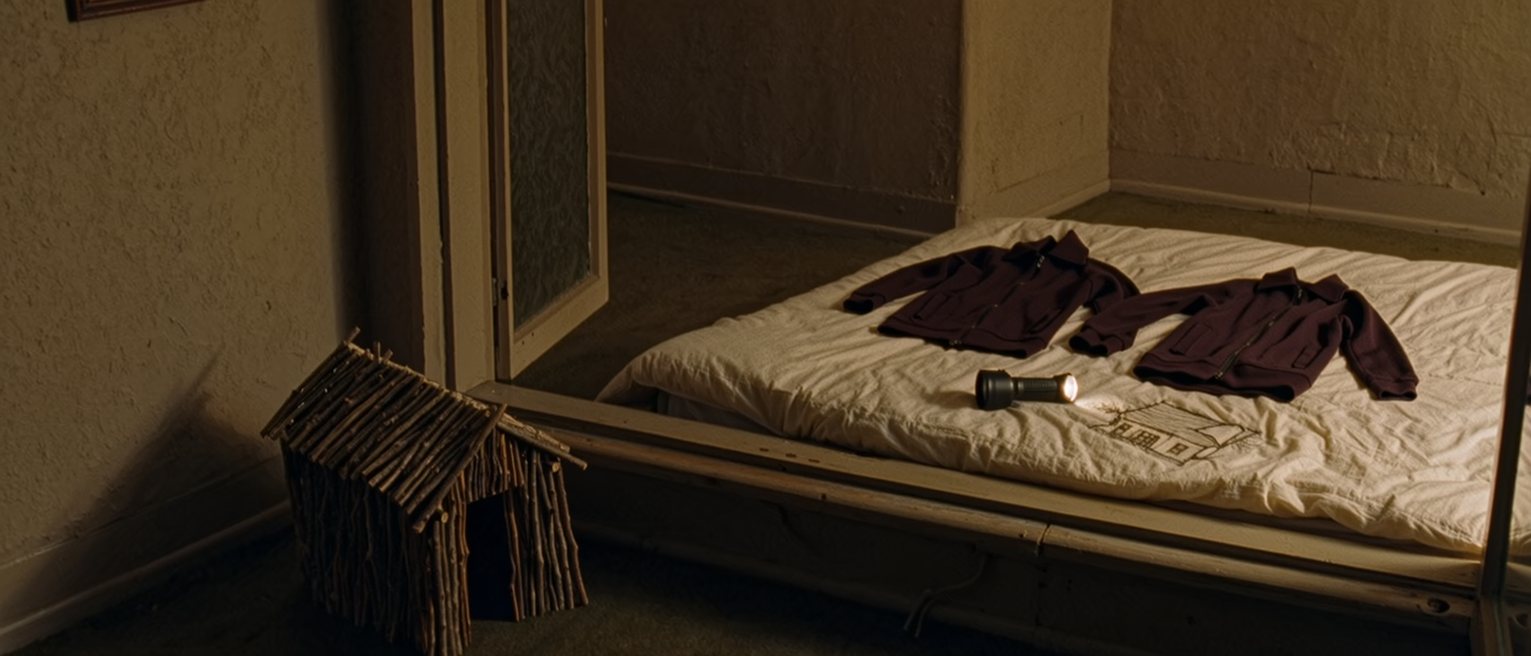
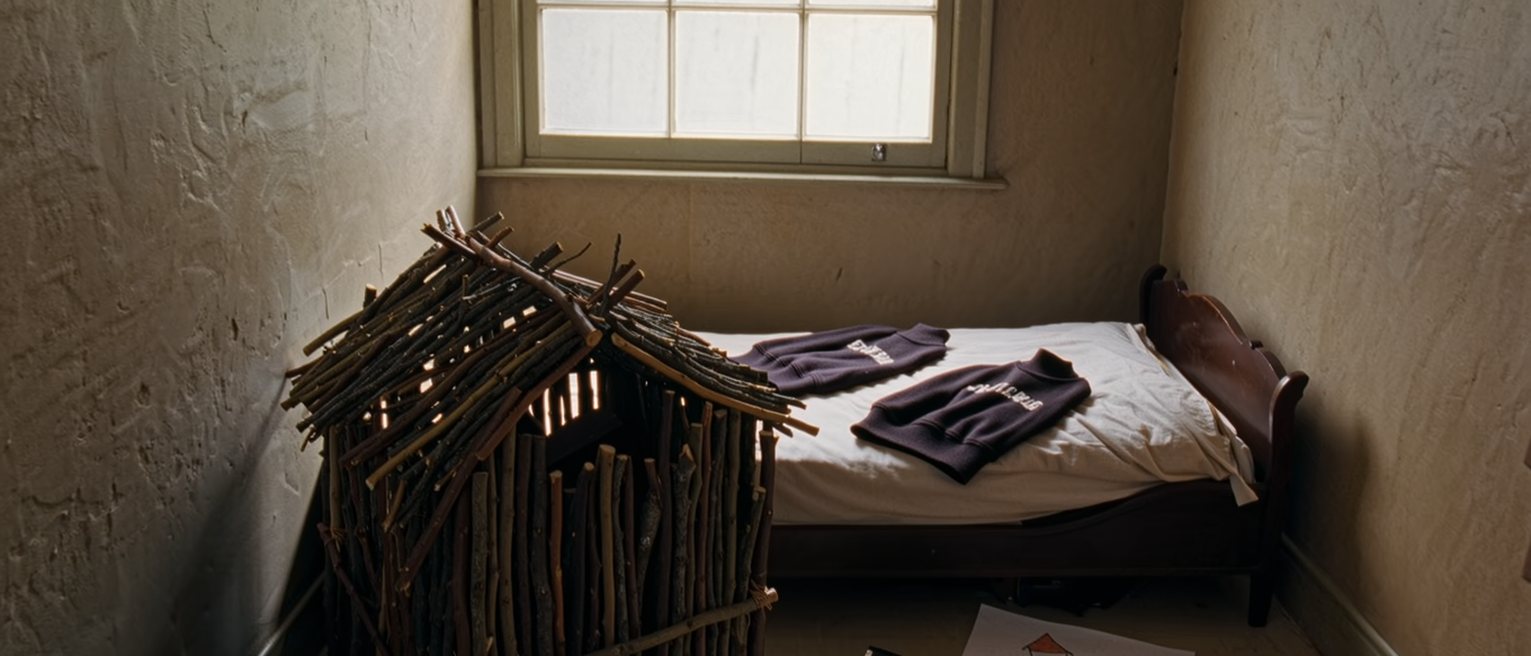
She goes into the woods behind the house, where her mother once built a hut out of branches, and meets a girl of about her own age dragging a branch through the trees. The girl invites her back. The house is the same house. The woman inside it is the girl’s mother, and she is the grandmother who has just died, at an age at which she was not yet anybody’s grandmother. The girl in the woods is called Marion, which is the name of the woman who drove away. The film does not stage any of this as a revelation. It lets the two children work it out between them and then get on with the afternoon.
Nothing accounts for it. There is no device, no ritual, no threshold that has to be crossed in a particular way, no rule about how long you may stay or what you must not say, no older character who knows what is going on, and no closing scene in which somebody names the mechanism. The woods are woods. The film runs seventy-two minutes and then stops.
What follows is not a summary. It is an argument about what that premise is for, and about the one thing it makes briefly available that no daughter has. The short version is the film’s own: that the whole distance between a daughter and her mother is the age gap, and that if you removed the gap what would be left is two people who would probably like each other. The longer version, which is what this essay is actually about, is that the thing a daughter cannot reach is not her mother’s secrets. It is her mother’s contemporaneity — the fact that the woman was once a person the same size as her, with no children, no record, nothing settled and no verdict passed on how her life turned out. The film makes that available for about an hour, proposes that grief and inheritance would both be different if it were available in general, and then declines to pretend that it is.
The record, stated plainly
Petite Maman was written and directed by Céline Sciamma and produced by Bénédicte Couvreur for Lilies Films. It was photographed by Claire Mathon, edited by Julien Lacheray, and has music by Para One. It runs seventy-two minutes, which is short enough that a certain kind of viewer will have finished it before deciding what they think of it. Joséphine Sanz plays Nelly and Gabrielle Sanz plays Marion. Nina Meurisse plays the mother, Stéphane Varupenne the father, and Margo Abascal the grandmother.
It had its world premiere on 3 March 2021 in the Competition of the 71st Berlin International Film Festival. That edition of the festival was unlike any before it. Berlin split 2021 into two stages: an online event for the industry from 1 to 5 March, at which the Competition jury saw the films and announced the prizes, and a public Summer Special with cinema and open-air screenings from 9 to 20 June. So this film, whose entire method depends on two children being in a room together, premiered into a competition with no audience in the room.
It was nominated for the Golden Bear and it did not win it, and that distinction is worth holding to. The Golden Bear went to Radu Jude for Bad Luck Banging or Loony Porn. The Silver Bear Grand Jury Prize went to Ryusuke Hamaguchi for Wheel of Fortune and Fantasy, a film this Library has written about elsewhere. Petite Maman left Berlin with nothing at all.
What it collected came later and came from audiences and critics rather than juries. It opened in France on 2 June 2021 through Pyramide Distribution. It won the audience award at the San Sebastián International Film Festival that September. The Los Angeles Film Critics Association named it best foreign language film of 2021. At the British Academy Film Awards it was nominated for film not in the English language and lost to Drive My Car, which this Library has also written about. It reached Japan on 23 September 2022 under a title that translates as something like beyond the secret forest, and Japanese listings give its running time as seventy-three minutes rather than seventy-two. The Criterion Collection announced it for release in 2023.
The film declines to have a mechanism
A story in which somebody meets a person from another time is almost always, at bottom, a piece of engineering. There are rules, and the rules generate the plot: you must not be seen by yourself, you must return before a certain hour, if you alter this then that will follow, here is the cost of staying. The machinery is what produces jeopardy, and jeopardy is what most such films are actually about.
This one has no machinery. It has no rule that can be broken and therefore no suspense about breaking it. It does not even mark the crossing: a child walks into some trees and is in another year, and walks back out and is in her own, and the film shoots both directions the same way, with the same light, in the same woods. When the two girls eventually discuss what is happening, they do so briefly and practically, the way children settle the terms of a game, and then they go and do something else.
The consequence is easy to state and easy to underrate. With no rules, there is nothing to solve. Attention has nowhere to go except the two people in front of it. The standard version of this story would have been about the danger of the encounter — the paradox, the damage, the price of interference — and every minute spent on that danger is a minute not spent on what two children are like together when one of them is the other’s mother. Removing the apparatus does not simplify the film. It removes the wrong question so that the right one has room.
The same discipline runs through everything else. There is almost no score: the music is largely absent, and the one extended passage of it arrives late, over a sequence on the water, which means that when it comes it registers as an event rather than as upholstery. There is no adult who explains. There is essentially one location and its surrounding trees. The costumes and the interiors are kept vague enough in period that it is not easy to date either half of the film, which quietly removes another thing the audience could have been busy with.
Restraint is a compliment critics hand out cheaply, and it usually means that a film failed to do very much. Here it is structural rather than temperamental. A film that explained itself would have become a film about its explanation. Its subject would have shifted from what the age gap does to how time works, and the argument this Library is interested in would have been the first thing lost.
What a daughter cannot reach is not a secret
The usual way this subject gets handled, in films and in novels and in the conversations people actually have, runs on an information model. A child discovers something about a parent: a lover before the marriage, a grief that was never mentioned, a war, a decision, a letter in a box at the back of a wardrobe. Something was withheld; it comes out; the relation is re-set in the light of it. The implicit theory is that the distance between the two people was made of missing facts, and that facts, supplied, would close it.
Petite Maman is not that film, and the difference is not a matter of degree. Nelly does learn things. She learns what her mother was afraid of at eight, she learns about an operation that is coming, she finds out who built the hut. But the film does not treat any of that as the payload. All of it could have been told to her by an adult across a kitchen table in twenty minutes, and it is worth being precise about what such a telling would and would not have done. It would have transferred the content. It would not have altered the position the content was being told from.
And the position is the thing that cannot be transferred. A mother is met, always and only, as a person who already has a child. She is encountered after her decisions, living inside them, with a settled account of how her life went and a settled account of herself, being observed from below by somebody whose existence is one of the fixed facts of that account. A daughter cannot get behind that. Not because it is being hidden from her — the hiding theory is the comfortable one, because it implies a door — but because she is the thing that closed it. She is standing on the far side of the event she wants to see past.
So what the film supplies is the one thing that no amount of disclosure can supply: simultaneity. Two people of the same age, in the same year, in the same house, neither of whom has any information about the other’s future and neither of whom is the consequence of the other. That is a different good from candour, and it is not obtainable by asking better questions.
This is not a decorated way of saying that the girl gets to see her mother as a person. That formulation is everywhere and it means almost nothing, because a daughter already knows in the abstract that her mother is a person. What is specific here, and what makes the film worth an essay rather than a recommendation, is that she gets to meet her as a person for whom nothing had yet been decided — before there was an outcome to defend, a life to account for, or a daughter to be the mother of.
The verdict the age gap installs
A relation between two people separated by thirty years has a structure whether either of them wants it or not, and the structure is judicial. One party is finished and the other is assessing. Over time the roles rotate, but they never disappear.
A child assesses a parent continuously, from the beginning, with enormous attention and very poor instruments. The parent arrives already complete: this is who she is, this is what she is like, this is what she did and did not do. The assessment gets refined for decades — it acquires sympathy, context, an adult’s sense of constraint — but it does not stop being an assessment, and it is never made of anything except observation of a person who was fully formed before the observer arrived. Then the direction reverses, and the ageing parent is assessed by an adult child with a great deal more evidence and no less certainty.
What the ordinary relation cannot produce, at any point in its whole length, is an encounter before the verdict could have been formed. Two eight-year-olds have no standing to pass verdicts on one another. Neither has a record. Neither is anybody’s outcome. What they have instead is negotiation: who is playing which part in the game, whether to make crepes, whether to take the boat out, whether the hut is finished. They are in a flat relation, and flatness of that kind between a parent and a child is not rare so much as structurally unavailable.
This is what the film is actually depicting in the passages that get called gentle. The gentleness is not sweetness of tone. It is the absence of hierarchy, and an absence of hierarchy between these two particular people is a thing the world does not otherwise contain. It is also why the film can be as quiet as it is. Nothing has to be dramatised, because the interesting event is a permanent structure briefly switched off.
It is worth noticing what the film had to spend to get there, since it spends a great deal. To remove the verdict it has to remove the mother’s adulthood entirely. There is no version of this scene between two grown women. The film does not claim there is, but it does not examine the point either, and a reader should notice that a proposition has been demonstrated under conditions that cannot occur.
Twin sisters, and why the casting is an argument
Nelly and Marion are played by Joséphine and Gabrielle Sanz, who are sisters and twins, and for whom this was a first film. Sciamma has said publicly that she looked for siblings for the parts, and has described the Sanz sisters as not thinking of themselves as twins but as sisters born on the same day, and has said that what mattered was their equality rather than their resemblance. That is her formulation of her own process and it is reported here as that.
The structural work the casting does is easy to miss because it consists of things the film never has to do. Resemblance is simply given. No make-up establishes it, no lighting insists on it, no line of dialogue points at it, no shot is composed to make the audience notice a shared feature. A film obliged to persuade us that these two faces belong to the same person at two ages would have spent a serious fraction of seventy-two minutes on persuasion, and persuasion of that kind is dull and it is also beside the point.
What the casting buys instead is the thing the film is about. Two performers of the same age and the same size, neither of whom is directing the other, neither of whom has authority in the frame. When they build the hut, they build it together and badly. When they cook, neither supervises. The equality is not acted; it is a fact about who is standing there, and the film simply photographs it.
One caution belongs here, and this Library would rather state it than be admired for the omission. What reads on screen as naturalness in children is a manufactured effect. It is produced by a director, a casting process, a camera operator, a schedule built around what children can do, and an editor selecting from many takes. Praising a child performance as though it were unmediated behaviour misdescribes the labour of everyone involved, including the children, who were working. The performances here are very good. They are also constructed, and the construction is part of what is being admired.
What this Library has already written, and what this is not
This Library has published an essay on Sciamma before, on Portrait of a Lady on Fire, under the slug portrait-gaze-without-possession. Its argument was specific and it is not the argument being made here. It held that the film’s real subject is not whether looking at somebody is permissible but what covert looking costs you as an observer: that a secret gaze gets a pose while a declared gaze gets a collaborator who will correct your work, and that consent is therefore what converts observation into something that produces better information rather than worse. That essay is about the ethics and the epistemics of looking.
None of that is this film’s problem, and repeating it here would be a waste of a film. There is no asymmetry of looking between the two girls. Nobody in the woods is observing anybody covertly, nobody is posing, and nothing is being extracted. The asymmetry that Petite Maman removes is not a difference in who is permitted to look. It is a difference in position in time, which is a distinct thing and is not fixable by consent, because both parties can be perfectly willing and the gap remains exactly where it was.
Sciamma has connected the two films in her own public remarks, describing this one as a film made after Portrait that she could not have made in this way before. That is her account of her own working method and it is left as that. This essay draws no conclusion from it about what the earlier film means.
Two other pieces in this Library stand next to this one and are worth naming so that the difference is visible. The essay on Aftersun, under the slug aftersun-what-a-child-could-not-have-seen, argued that proximity is not access: that watching somebody closely, loving them, living beside them, does not deliver their interior. Petite Maman is the counterfactual to that essay rather than a restatement of it. Aftersun says the interior is not reachable from where a child stands. This film asks what would have to be removed for it to be reachable at all, and answers that it is not the love or the attention that would have to change. It is the years.
And the essay on The Lost Daughter, under the slug the-lost-daughter-a-mother-who-left, argued that the thing a mother most lacks is a socially available sentence in which ambivalence about her own motherhood can be said at all. Petite Maman touches that from the opposite side. What Marion tells Nelly about her fears, she tells before she is anybody’s mother — which is the only position from which saying such things costs nothing, because there is not yet a child in the room to be wounded by them. The two films agree about where the difficulty lives. They disagree about whether anything can be done, and only one of them cheats in order to get an answer.
Grief, and the part inheritance cannot hand over
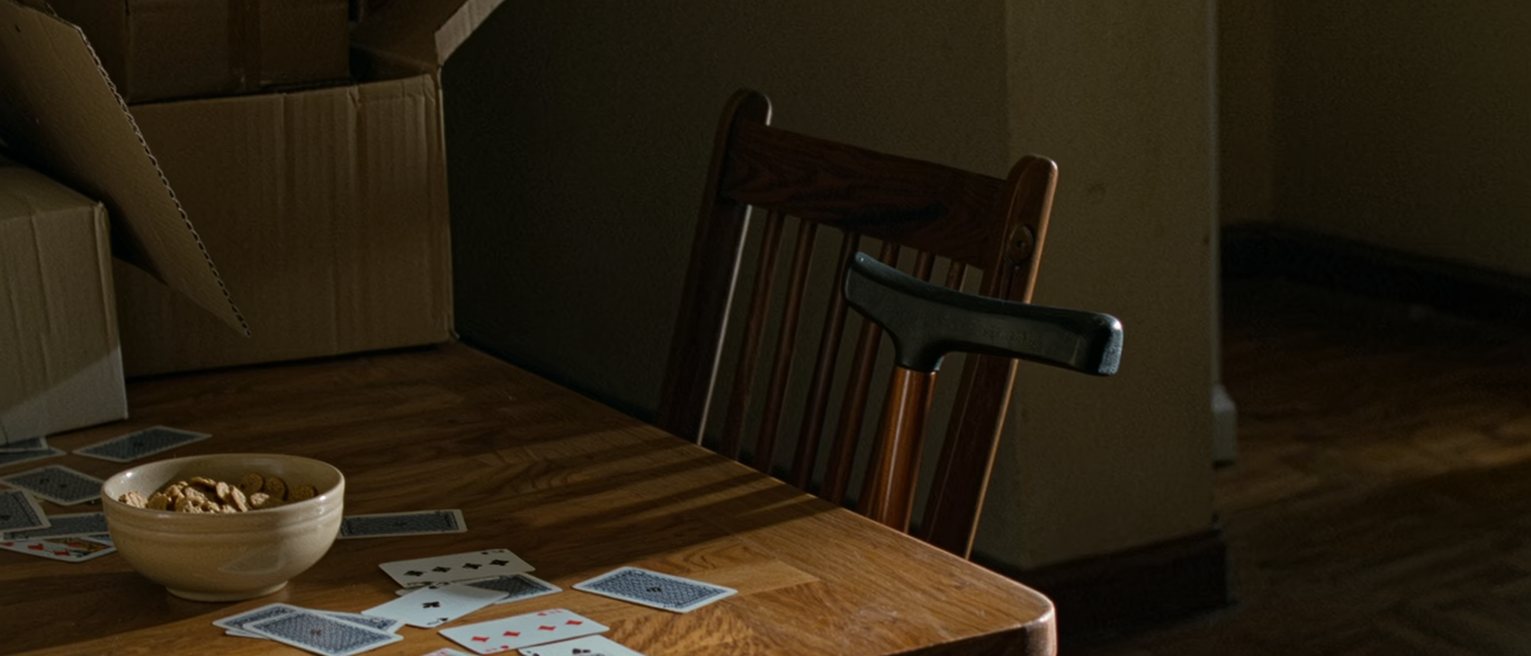
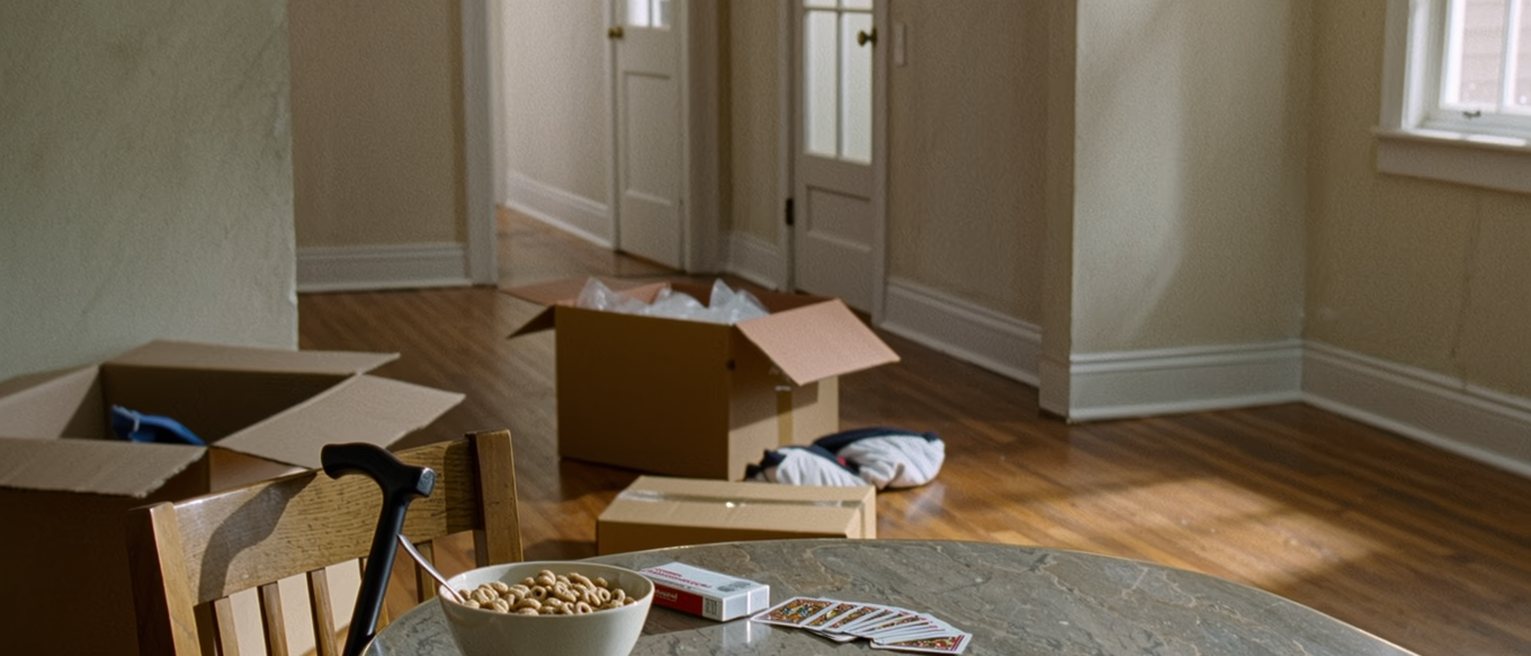
The occasion for everything in this film is a death, and the film is honest about the form grief actually takes in the days after one. It takes the form of administration. A room is cleared. A walking frame is folded. Drawers are gone through, objects are sorted into what goes and what is kept, and somebody has to decide about the furniture. The film gives this a great deal of screen time and no pathos, which is the correct ratio.
An inheritance transmits two things. It transmits objects, which are the residue of a life and are mostly illegible to the person receiving them. And it transmits information: dates, anecdotes, photographs, the names of people who are also dead. What it never transmits, and cannot, is the person at an age when she was not yet the origin of you. What you inherit is the outcome. You are one of the terms of the outcome, which is precisely why the earlier person is out of reach.
The film’s proposal is that grief for a parent would be a different thing if that were available. Not lighter, and the film does not claim lighter. Different. A great deal of mourning for a parent is mourning for somebody you never met, a person whose existence you can infer from photographs and from things other people say, and whose absence from your acquaintance is not anybody’s fault and cannot be repaired by remembering harder.
The most exposed material in the film sits here. The girl in the woods is facing an operation, and the condition it concerns is one her own mother lives with. The film supplies no clinical name for it and no prognosis, and this essay supplies none either, because the film’s reticence is not squeamishness — the point is that a child is frightened, and that her fear is about her mother and about her own body at once. Nelly is present for that fear at the only moment in the whole span of two lives at which she could meet it as a peer rather than as its consequence. She cannot fix it. She responds to it the way an eight-year-old responds to another eight-year-old, which is with company.
And then the film declines. Nelly goes back. Nothing in the present is repaired by the visit: her mother returns, and the film ends without asserting that anything has been settled, resolved or healed. The proposal is made and then not cashed. This is the most honest thing in the film and it is the reason the argument can be taken seriously at all. A version that came back with the relation fixed would have been advertising.
A description, kept from becoming an instruction
There is an obvious next move here and this Library is not going to make it. Having said that a daughter cannot reach her mother’s contemporaneity, the next paragraph in most publications tells the reader what to do about it: ask her about her twenties, record the conversations before it is too late, visit more, ask better questions while you still can.
That is refused for two reasons, and the second one matters more than the first. The first is that it would be advice about a particular relationship that this publication knows nothing whatever about, offered to a reader whose circumstances, history and reasons are entirely unknown here. Nothing in this essay is an assessment of anybody’s family and nothing in it is a recommendation about anybody’s mother.
The second is that the advice would contradict the argument. If the unreachable thing were a body of facts, then interviewing would retrieve it, and the essay would have been an elaborate way of saying that people should talk to their parents. But the claim is that the unreachable thing is a position rather than a body of facts. A person can learn every fact about her mother’s youth — the jobs, the flats, the men, the fears, the year she nearly did something else — and still be meeting only the woman who has already had her, telling it from the far side. The facts arrive; the vantage does not.
What is left is a description, and a description is worth something on its own terms. It relocates a difficulty. Somebody who has been reading the distance from a parent as a failure of candour on one side or a failure of effort on the other is working with a model in which somebody is at fault, and that model generates a particular kind of low-grade resentment in both directions. If the distance is structural, then nobody is at fault, and what is left is a fact about how the relation is built rather than a charge against either person in it.
The symmetry is worth stating too, since the film has it. A mother cannot be met as a contemporary by her child, and equally she cannot meet her child as one. She encounters a person whose whole existence postdates her decisions, who arrived after the account was settled, and who will be assessing her from a position she cannot occupy either. Nobody in the arrangement has what the woods gave them for an afternoon. That is an observation and it is left as one.
What this house sells, and what that does to this argument
This belongs in the body rather than in a footnote, and it is stated against our own interest before anything is made of it.
This house sells bounded private companionship: hours agreed in advance, terms set by the person booking, an evening in which somebody is attended to. Read the argument above with that in mind and the convenience is immediate. An essay claiming that what people lack is a relation with somebody who has no verdict on them, no accumulated record of them, and no stake in how their life has turned out, is an essay that makes a paid evening with a stranger look like the answer to a structural problem. It would be difficult to build a reading of this film more flattering to our position.
So the declaration comes with limits on what may be taken from it, and they are listed rather than implied.
We do not claim to supply what the woods supply. An arrangement bought for an evening is not a relation without a verdict. It is a relation in which judgement has been suspended by payment and by a clock, which is a different thing and a lesser one, and anybody who has been in both knows the difference immediately. The film’s subject is two people who have no future information about each other and no power over each other. A commercial arrangement has an explicit asymmetry in it: one party is working.
We do not offer advice about anybody’s mother, anybody’s family or anybody’s grief, and the previous section says at length why. We do not claim any outcome. Nothing here says that attention bought from us relieves loneliness, eases mourning, or improves any relationship with any relative, and nothing here should be read as implying it.
And we do not claim any association with the film. Céline Sciamma, her cast, her producers and her distributors have no connection to this house, have not been consulted, and would have no reason to agree with a word of this.
The strongest case against this essay, and against the film
Four objections are worth putting at full strength. Two of them land outright, one lands in part, and one is answerable only by narrowing what was claimed.
The first is against the film and it is the hardest to test, which is the objection. Petite Maman is gentle, brief and beautifully made, and gentleness of that kind is very difficult to argue with. Metacritic, read on 17 September 2026, gives the film a score of 93 from thirty-seven critic reviews, of which thirty-seven are positive, none are mixed and none are negative. A film that no professional viewer in that sample found even partly unsuccessful is not thereby a great film; it is a film that made disagreement socially awkward. Saying a bad word about a small tender story of a child and her dead grandmother positions the speaker as the kind of person who says bad words about such things, and that is a real advantage which has nothing to do with the quality of the work. This objection lands, and the only honest response is to notice that the present essay is itself part of the pattern it has just described.
The second is also against the film and it is the serious one. The film resolves its central difficulty by fiat rather than examining it. The difficulty is that a daughter cannot meet her mother as an equal. The film’s response is to arrange for her to do so, by means it declines to specify, and then to show how well it goes. That is not an investigation of the problem; it is a suspension of it, and the fact that the suspension is charming does not make it an argument. A sceptic can say, with justice, that anything can be demonstrated under conditions that cannot obtain, and that what the film establishes is only that the filmmaker could imagine the encounter going well. This one lands almost completely. The narrow thing that survives is that the fiat is doing a different job than it looks like: what the film removes is precisely and only the age difference, holding everything else constant, which makes it something closer to a controlled hypothetical than a wish. But a hypothetical is not evidence, and an essay that leans on it should say so, as this one now has.
The third is also against the film and it is uncomfortable because it concerns the thing the film is praised for. This is a seventy-two minute film about a mother’s interiority which gives that mother remarkably little to do. The adult Marion is present for a short stretch at the beginning, leaves, and is largely absent until the end; the child Marion is mostly seen doing things with Nelly rather than having an inner life of her own on screen; and the grandmother, the third woman, is given less still. On this reading the film is not really about a mother at all. It is about a daughter’s access to a mother, filmed entirely from the daughter’s side, with the mother available in the quantity and at the moments the daughter requires. This objection lands in part. The partial defence is that the film’s subject genuinely is the daughter’s position, and that a film which had opened up the mother’s interior directly would have been asserting the very access it exists to say is unavailable. But the defence does not dispose of the count. A viewer who finishes the film feeling she has been told very little about Marion is describing something real.
The fourth is against this essay, and it is the one this Library is least comfortable with. Petite Maman is a fairy tale. It is short, it is simple, it does not explain itself, and its director has described the premise in terms of myth and of something timeless rather than in terms of structure. An essay of several thousand words locating in it a claim about contemporaneity, verdicts and the architecture of the parent-child relation may simply be a commercial publication fitting a preferred thesis over a film that is content to be small. This is answerable, but only by shrinking the claim. The defensible version is not that the film argues what this essay has argued. It is that the film assembles a situation in which a particular unavailability becomes visible, and that the unavailability is real whether or not anyone involved in making the film had it in mind. That is a reading, produced by a publication with reasons of its own, and a reader who finds the film simply lovely and unburdened by any of this is not making a mistake.
What this does not claim
This is a reading of a film. It is not clinical guidance, it describes no condition, it promises no outcome, and it diagnoses nobody. Nothing here is an assessment of any reader’s circumstances, and nothing here is advice about any reader’s mother, family or grief.
No dialogue from the film is quoted anywhere in this essay, and no passage of any other work is reproduced. Descriptions of what happens on screen are descriptions. The film supplies no clinical name for the condition the grandmother and the mother live with, and this essay supplies none either; nothing here should be read as identifying, explaining or generalising about any medical condition.
Production and festival details are taken from published records rather than from any private source. Petite Maman premiered in Competition at the 71st Berlin International Film Festival on 3 March 2021, was nominated for the Golden Bear and won no prize there; the Golden Bear that year went to Radu Jude. The later prizes named above are named as wins or as nominations precisely, and the British Academy Film Awards appearance was a nomination that did not result in a win.
Remarks attributed to Céline Sciamma are her published remarks in interviews, reported as her formulations of her own process. They are not treated as the meaning of the film, and no claim is made about what she intended. Neither she nor anyone who worked on the film has any connection to this house or any knowledge of it, and nothing here implies endorsement by any named person, company or festival.
The central argument of this essay — that what is unavailable to a daughter is her mother’s contemporaneity rather than her mother’s secrets, and that the age gap installs a verdict that no candour can remove — is this Library’s interpretation. It is not a research finding, it is not a claim about all families, and it makes no assertion about any group of people. A reader who recognises none of it in her own life is not describing an exception.
The critical-reception figures cited in the counter-reading were read on one date from one aggregator and reflect the reviews that aggregator had indexed. They are cited to describe the shape of a reception, not to measure the quality of a film.