Cinema
Aristocrats, and the Two Tokyos That Share an Address
A woman from an old Tokyo family is moving toward a marriage arranged by proximity and expectation. A woman from Toyama came to the city for university, ran out of money, left the university and stayed. They are connected by the same man, and everything about the setup promises a rivalry. The film declines to stage it, and the refusal is the most interesting thing in Japanese cinema of that decade about how women are set against each other. What separates these two is not merit and not effort. It is the number of routes each of them had.
Two women live in Tokyo. They are a few years apart in age. They ride some of the same lines, walk some of the same blocks, and could pass each other on an ordinary Tuesday without either of them registering it. One was born into a household in which the question of what she would do with her life was never put in those words, because the shape of the answer had been settled in outline before she arrived. The other came in on a train with a place at a famous private university and a plan that ran out of money in the second year.
The film that puts these two in the same frame is Aristocrats, released in Japanese cinemas in February 2021, written and directed by Sode Yukiko from a novel by Yamauchi Mariko. It is, in this Library’s reading, the sharpest film made about class in contemporary Tokyo, and the reason is not that it indicts anybody. It is that it takes a fact everyone in the city already half knows and refuses to let it stay atmospheric: that Tokyo presents itself as one place while running several, and that which one you are in was largely decided before you had an opinion about it.
The two women are connected by the same man. He is engaged to one of them and has spent a decade in an undefined arrangement with the other. Every convention available to a film with that premise points in one direction. There is a confrontation to be had, a woman to be exposed, a woman to be pitied, and a man to be fought over. The audience knows the shape of the scene before it arrives.
What follows is an argument about what the film does with that scene instead, why the refusal is harder to build than it looks, and what the refusal is actually made of — because it is not made of virtue, and an essay that said it was would be flattering everybody involved, including the reader.
The record, stated once
The novel is Ano Ko wa Kizoku by Yamauchi Mariko, serialised in the literary monthly Shosetsu Subaru from October 2015 to July 2016 and published in volume by Shueisha on 25 November 2016, with a later paperback edition. Yamauchi was born in Toyama City in November 1980 and studied film at Osaka University of Arts before moving to Tokyo in her mid-twenties. That the novelist grew up in the prefecture she gives to one of her two protagonists is a matter of public record and is noted here as such, not as an interpretation of her intentions.
The film was written and directed by Sode Yukiko, born in Nagano City in 1983, a graduate of the economics faculty at Meiji Gakuin University who took a directing course at a Tokyo film school while a student; her earlier feature Good Stripes took the Shindo Kaneto Prize for 2015. Aristocrats had its world premiere on 5 November 2020 as a special invitation title at the 33rd Tokyo International Film Festival, opened in Japanese cinemas on 26 February 2021 at 124 minutes, and was selected for the Big Screen Competition at the International Film Festival Rotterdam in 2021. It was produced and distributed by Tokyo Theatres with Bandai Namco Arts.
Kadowaki Mugi plays Haibara Hanako, the youngest of three daughters in a Tokyo family whose money comes from a medical practice. Mizuhara Kiko plays Tokioka Miki, who came to Tokyo from Toyama. Kora Kengo plays Aoki Koichiro, a lawyer from a family whose position is older than either woman’s circumstances. Ishibashi Shizuka plays Sagara Itsuko, a violinist and Hanako’s friend, and Yamashita Rio plays Hirata Rie, who came from Toyama in the same year as Miki.
The awards record should be stated narrowly and it is short. The film won best film at the 13th TAMA Film Awards. Mizuhara won the best supporting performer award at the 35th Takasaki Film Festival. The producer Nishigaya Toshikazu took the producer award at the 26th Shindo Kaneto Prize. In the Kinema Junpo critics’ poll for 2021 the film placed sixth among Japanese films, which is a ranking rather than a prize and is reported here as one. Checked against the published list of Awards of Excellence at the 45th Japan Academy Film Prize, neither the film nor any of its personnel appears in the principal categories. Nothing above is a nomination being reported as a win.
One further item belongs in a record rather than in a sentence of praise. Sode’s next feature, adapted from a novel by Kawakami Mieko, was selected for Un Certain Regard at the 79th Cannes Film Festival and is scheduled to open in Japan on 13 November 2026. She continues to work.
Two routes, and how many of each there are
Begin with the arrangement each woman is inside, described as an arrangement rather than as a personality.
Hanako is not forced into anything. Nobody in her family raises a voice. What happens to her is softer and more efficient than force: she is introduced. The introductions come through relatives and through the friends of relatives, they are made to men whose families are legible to her family, and the whole apparatus is calibrated so that the outcome looks like a choice she made. Inside a narrow band her options are numerous — this man or that one, this spring or the following autumn. Outside the band there is nothing at all, and the nothing is never mentioned, because a route that is never described is not experienced as a route that was closed.
Miki’s arrangement is the mirror image. She got in. The examination is impersonal and she passed it, which is exactly the part of the system that is supposed to prove the system works. Then the money ran out. The route existed, it was real, and it was singular: there was one way through, it required continuous payment, and there was no second way through for somebody whose family could not keep paying. She left the university and stayed in the city, because the city was where the thing she had come for was, and going home would have meant conceding that the attempt had been a mistake rather than an expense.
Put the two together and the comparison the film is actually making becomes visible. It is not a comparison of characters. Hanako is not weaker than Miki and Miki is not tougher than Hanako; nothing in the film licenses either sentence. What differs is the number of available routes, and the direction in which a shortage of money bites. For one of them money determines whether she may continue. For the other, money has never once appeared as a condition on anything, which is a different thing from having a lot of it, and is the part of wealth that is hardest to see from outside it.
So, plainly, before anything is built on top of it: what separates these two women is not merit and not effort. It is structure — how many ways there were, who could stay on one without paying, and who found out mid-route that the route had a meter running.
The scene this essay exists for
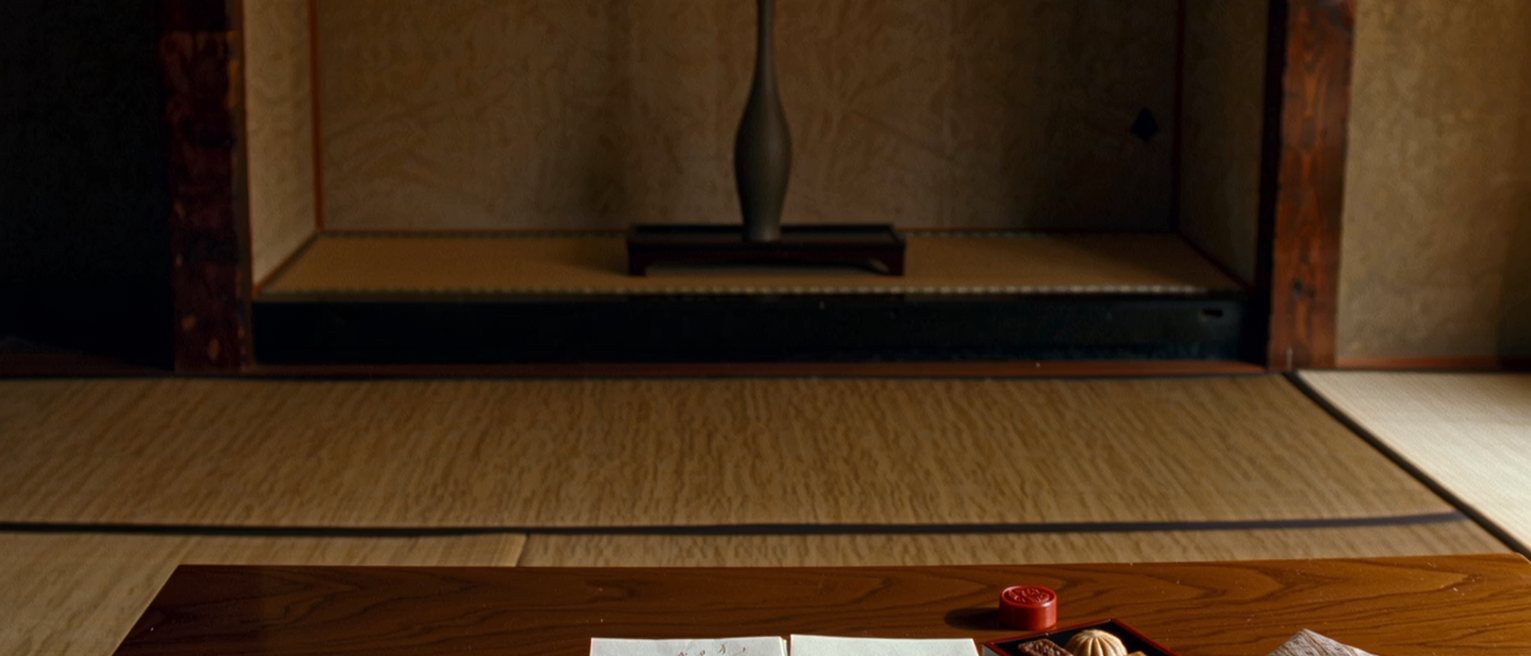
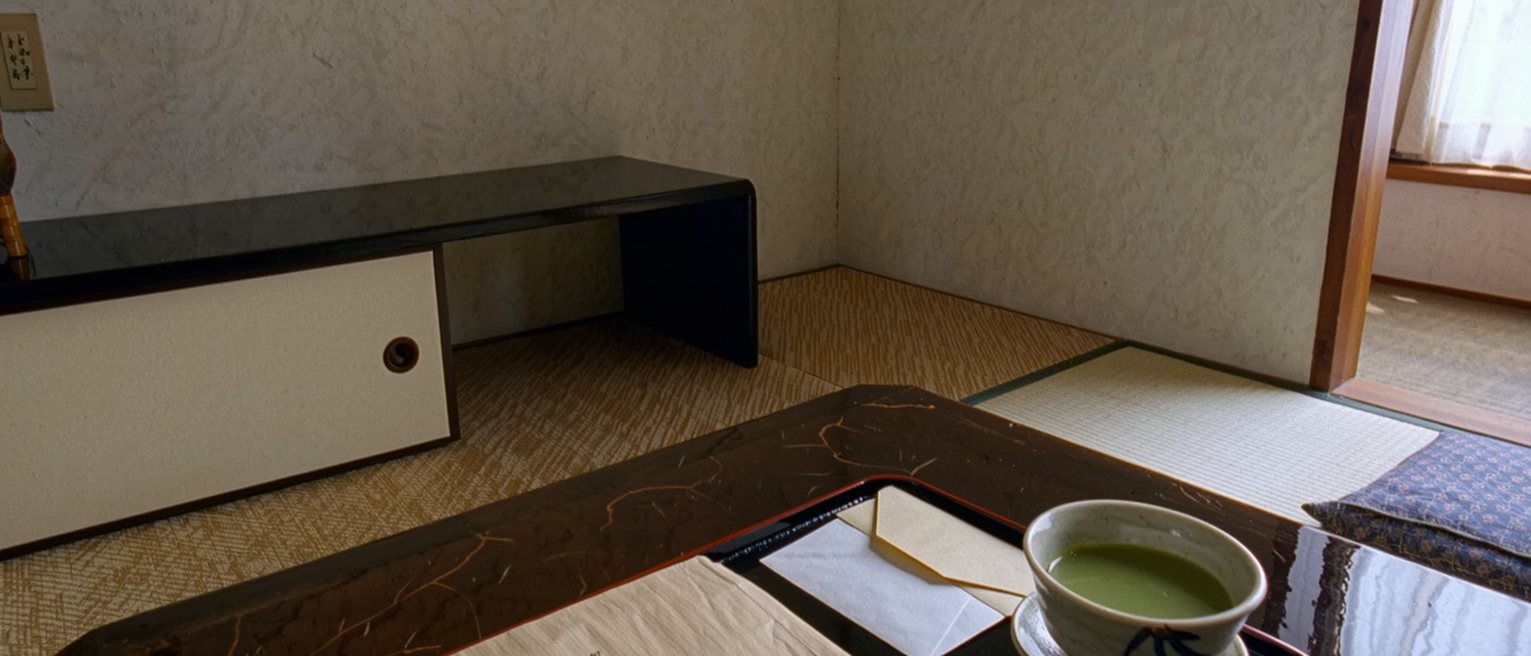
The two women meet once, in the daylight, in a hotel lounge high above the city. The meeting is arranged by Itsuko, Hanako’s friend, who has met Miki independently and who understands exactly what she is setting up. Hanako knows by then that the man she is attached to has a long-standing connection with the woman she is about to sit down with. Miki knows who Hanako is.
What the scene does not contain is the whole point. There is no accusation. There is no unmasking. Neither woman claims the man, neither renounces him for the benefit of the other, and neither delivers a speech about women supporting women. The film does not hand either of them a line that would let an audience file the encounter under reconciliation and move on.
What is there instead is recognition, and it arrives sideways. Two people sit in a room that one of them finds ordinary and the other finds expensive, and in the course of an unremarkable conversation each of them works out that the other is also inside an arrangement she did not design. That is the entire event. It is not friendship. It is not forgiveness. It is the much smaller and much rarer thing of two people declining to accept the roles the situation has assigned them.
This Library’s judgement, stated as a judgement and not as a measurement, is that this is the most important scene in Japanese cinema of that decade on the subject of how women are set against each other and what it takes not to be. The reason is precisely that it is undramatic. A confrontation would have been easier to write and far easier to praise. What the film does is harder: it withholds the confrontation while keeping every condition that would normally produce one, and it makes the withholding legible as a decision rather than as an omission.
The director has described the intention in her own published remarks, and her framing is worth keeping rather than warming up. Speaking to a public-interest publication around the release, Sode said that rather than easily setting women who live differently against one another, she chose to focus on what she called a loose solidarity between them, and that easy oppositions of that kind draw attention away from the underlying problem. That is a filmmaker’s account of her own method. It is not evidence about the film’s effect on anybody, and is not offered here as one.
What makes the refusal possible
It is easy to admire a refusal and hard to say what it is made of. Since admiration on its own is worth very little, here is an account of the mechanism, in four parts.
The first is that neither woman is in a position to award the other anything. In the standard version of this scene one woman holds the man and the other wants him, which makes the encounter a transfer: something can be surrendered, claimed or withheld. Here the man is attached to an engagement that his family and hers assembled, and he is also the person who has kept an undefined arrangement running for a decade. Neither woman can give him to the other, because neither is the one who decides, and a fight over an object that neither party controls is not a fight. It is a performance for an audience that assumed the object was in play.
The second is that each can see the other’s constraint without being told about it. This is the work the film’s first hour has been doing quietly. By the time they sit down, the audience has watched each of them inside her own apparatus, and so, crucially, has the other one — not in detail, but in enough outline to know that the woman across the table is also being moved by something she did not build. Recognition of that kind is not sympathy and does not require liking. It requires only the information.
The third is that the film does not ask them to become friends. This is the part most often misread by people who want the scene to be warmer than it is. Ceasing to be opponents and becoming allies are different operations with different costs, and the film performs only the first. The two women do not go on to share a life, rescue each other, or set up in business together. They simply stop being aimed at one another, and the film treats that as sufficient, which it is.
The fourth is the absence of the speech, and it is the load-bearing one. A speech would have converted the refusal into an achievement of character — proof that these two are unusually generous women. That would have been a disaster for the film’s argument, because it would have located the solution in personal virtue and left the arrangement untouched. By declining the speech, the film keeps the refusal where it belongs: as a decision about where to aim, available to anyone who can see the mechanism, and not a moral distinction earned by being nicer than average.
Say it as a formula and it survives outside the film. The refusal is possible when the prize is not in either party’s gift, when each can see the other’s constraint, when nobody is required to love anybody, and when no one is asked to be admirable. Remove any one of those and the fight comes back.
Where this parts from an earlier reading in these pages
This Library has recently published an essay on Elena Ferrante’s Neapolitan novels, arguing that envy between women who love each other is not a moral failing to be confessed and corrected but the predictable output of a structure in which one seat is offered to two people who both qualify. That argument is right about the case it describes, and this essay does not withdraw it. It does differ from it, and the difference is the reason both essays exist.
In Ferrante, two girls are aimed at the same opening. There is one school place, they are alike in every measurable way, and the scarcity is genuinely shared. Envy in that configuration is arithmetic before it is a fault, and no amount of understanding dissolves it, because the friend really is the daily form the scarcity takes.
Aristocrats is the other case, and it is the one the earlier essay could not reach. Hanako and Miki are not in the same queue. There is no single seat they are both standing in line for. Hanako cannot take Miki’s route — she has no reason to and no equipment for it — and Miki cannot take Hanako’s, because Hanako’s route is not a route at all but an inheritance, and inheritances are not applied for. The two women are not competing. They are being presented with a competition, by a man, by a plot shape and by an audience that arrived expecting one.
That is why the refusal is available here and was not available there. You cannot decline a competition you are genuinely in; you can only lose it, win it, or lie about it. You can decline a competition that has been manufactured around you, and declining it costs nothing except the willingness to look at where the offer came from. This essay’s contribution, stated as narrowly as it deserves, is that distinction: the difference between a scarcity that is real and a rivalry that has been supplied.
The honest addition is that the harder case is the earlier one. A reader standing in an actual single-seat queue will find less usable material in this film than in those novels, and should be told so rather than handed a scene of two women being decent to each other and left to feel that she has failed at something. The Library has also read Hamaguchi Ryusuke’s Happy Hour in these pages, on what four women discover they have never said to one another; that essay was about disclosure inside a friendship. This one is about two people who are not friends and never become friends, which is a smaller relation and, for this particular purpose, a more portable one.
The man is the hinge, not the subject
Koichiro is the mechanism by which the two women are brought into contact, and he is also the film’s most conventionally judged character. He is a lawyer from a family whose standing long predates his own efforts. He is engaged to a woman his circle selected. He has maintained, for something over a decade, an arrangement with a woman from outside that circle which was never named and never had to be, because the asymmetry did the naming.
The film is not sentimental about him and does not despise him either. What it shows is a man who has never had to decide anything, and who has mistaken the absence of decisions for a temperament. His inheritance is a track, not a fortune: a school, a faculty, a firm, a marriage, a house, in an order set before his birth. He is inside an arrangement he did not design in exactly the sense the two women are, which is the film’s most uncomfortable observation and the one it declines to convert into sympathy.
But it is important not to overstate his centrality, because the film itself does not. He is the hinge. The two women turn on him and the door opens, and once it has opened the film is no longer about him at all. The last movement of the picture belongs to the two of them separately, each in motion, each under her own power, and he is not in either shot.
This is also the first place where an objection can get a purchase, and it will be given its full weight later. A film that hands out a moral verdict to the man while treating the wealth he comes from as an environment — beautiful rooms, quiet corridors, good coats — may be doing something more comfortable than it appears. It is easier to be hard on a person than on a structure. Persons can be disliked, and disliking them is satisfying, and the satisfaction can substitute for the harder look.
One city, several cities
Before this section goes anywhere near figures, a fence. Nothing here describes a national character, nothing here describes Japanese people, and nothing here describes any reader. What follows is an account of arrangements: how many openings of a given kind exist, where they are, what they cost to stay inside, and who is recorded as moving toward them. Arrangements are made by decisions and can be unmade by decisions, which is the whole reason for keeping them separate from character.
The Ministry of Internal Affairs and Communications publishes an annual report on internal migration compiled from the resident registers. For 2024 it records a net in-migration to Tokyo Metropolis of 79,285 people, the largest of any prefecture, and a net in-migration of 135,843 to the greater Tokyo area of Tokyo, Saitama, Chiba and Kanagawa. Within that, the largest single age bracket is twenty to twenty-four. Of the Tokyo figure, the net in-migration of women was 42,172, the highest female figure of any prefecture in the country. Those are counts of registered moves. They are not a description of anybody’s motives, and this essay attributes none.
Set beside that the cost of staying once you arrive. The published fee record for the faculty at the private university the film names puts the first-year payment at approximately 1.5 million yen. That is a current published figure rather than the figure any particular person faced in any particular year, and it is cited for one narrow purpose: to make it concrete that the route Miki took is a route with a meter on it, and that leaving it is not a failure of resolve but an arithmetic event.
Now put the two halves together. A very large number of young people, more of them women than men, move into one prefecture each year because that is where the openings are. A substantial share of those openings are held behind a continuous payment. And the people already inside the city, in the households the film opens with, are not using those openings at all, because they did not need to move and their routes were never priced in that way.
That is what it means to say that Tokyo presents itself as one city while running several. It is not a metaphor about alienation and it is not an observation about how big the city is. It is a description of two populations with different entry conditions, different exit conditions and different costs of staying, sharing a transport network, a set of addresses and a name. The film’s insight is that the two populations are almost never in the same room, and that when they finally are, the room itself does most of the talking: who finds the ceiling height unremarkable, who reads the price of the tea, who knows without thinking which of the two of them the staff will address first.
The composure is a method, and also a risk
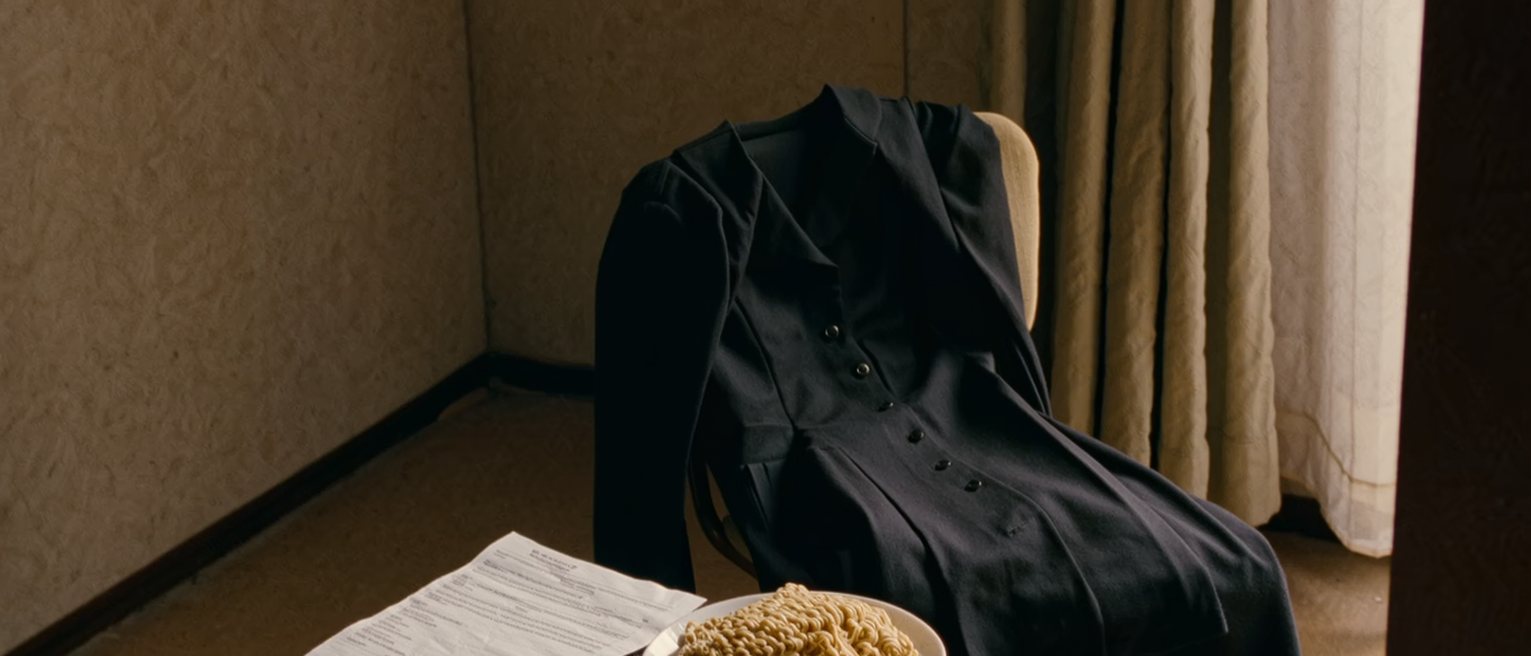
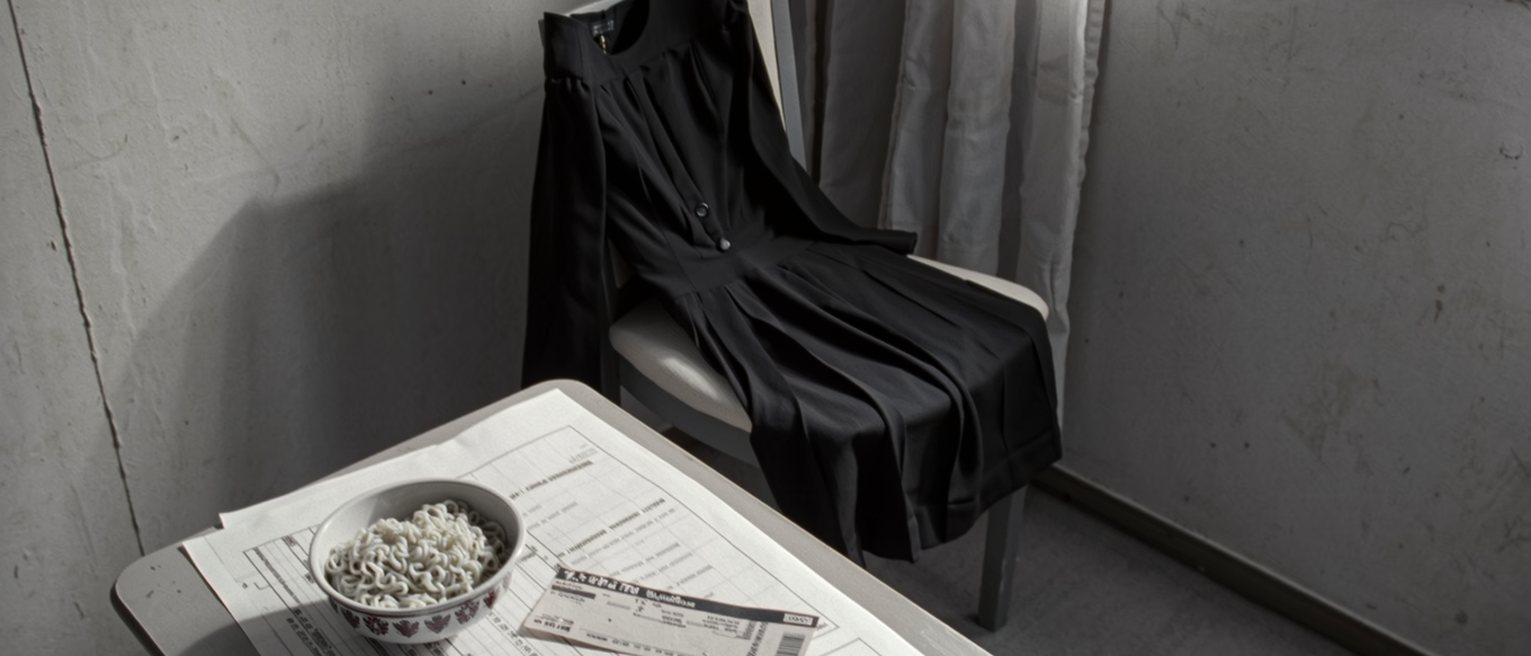
The film is beautiful in a specific and deliberate way. Interiors are held in balanced, frontal compositions. Cars glide. Rooms are quiet in a manner that costs money to achieve. The camera does not lunge, and the performances are pitched low enough that a raised voice would register as an event.
Read as method, that composure is doing real work, and it is the work a shouting film could not do. Class in a society like this one is very rarely legible as conflict. It is legible as room tone, as ceiling height, as how many seconds elapse before somebody is greeted, as whether a person checks a price. A film that wanted to show those things had to be quiet enough for them to be audible, and the decision to shoot the two worlds in the same register — neither one exoticised, neither one shot as squalor — is what allows the audience to notice that the difference between them is not a difference in the quality of life on screen but in the number of doors visible in the frame.
Read as risk, the same composure is the film’s most serious vulnerability, and it has been named in print. Writing at the time of the Rotterdam premiere, the critic Patrick Preziosi called the film toothless and its writing noncommittal, and argued that the acerbity its subject demands is largely confined to its chapter cards rather than built into the scenes. That is a real reading by a serious reader and it should not be waved away. A film about stratification that is itself extremely well-appointed is at permanent risk of producing the sensation of critique while delivering the pleasure of the thing criticised. Handsome rooms remain handsome after you have been told what they cost.
This essay does not think the charge is fully earned, for the reason given two paragraphs up: the observation this film is making is not available at volume. But it declines to say the charge is wrong, because there is no way to settle it from the inside. A reader who comes out of the film mainly remembering the coats has had an experience the film made possible.
What this house sells near this argument
Before the objections, the interest, stated against ourselves rather than disclosed after the argument has done its work.
This house sells private companionship: an evening with a person, arranged in advance, priced, bounded, and stated in terms before it begins. Among the things that description covers is an arrangement in which nobody is being chosen over anybody else. There is no competition in it, by construction. So an essay that praises two women for declining a rivalry, and that treats manufactured competition as a thing one can simply step out of, is an essay that flatters what we sell. A reader is entitled to weigh everything above with that in view.
The constraints follow, stated as things we may not claim. An evening here does not enlarge anybody’s options. The scarce goods in this essay are a university place, a continuous ability to pay for it, a track at work, a family that can absorb a bad year. None of those is for sale here, and a house that implied otherwise would be selling hope on a false description.
Nor does an evening here resolve anything about competition, envy, or the way two people are set against each other. It is bounded, it is paid for, and it ends. It is not a friendship and it is not a model of one.
And none of the people named in this essay has any connection to this house. The novelist, the director, the cast, the producers, the distributors, the festivals and the critics quoted have no knowledge of this publication and endorse nothing. The film is named so that a reader can find it, and for no other reason.
The strongest case against the film and against this essay
Five objections, and they are all good ones.
The first is that the film is gentler with wealth than with the man. Koichiro receives something close to a verdict: he is shown as passive, evasive and finally small. The wealth he comes from receives an aesthetic. The houses are lovely, the restaurants are calm, the clothes are impeccable, and at no point is any of it made ugly. A film genuinely hard on class would have found a way to make the interiors oppressive, and this one mostly finds a way to make them beautiful. That objection largely lands, and the most this essay can say in reply is that the beauty is what makes the invisibility of the advantage legible, which is a defence and also, conveniently, an excuse.
The second is that Miki is given less interiority than Hanako. The film opens inside Hanako’s world and returns there; Miki arrives as the second movement and is more often shown being observed than observing. The consequence is that the woman with less money is also the woman with less access to the audience’s inside, which reproduces on the level of form the very asymmetry the film is describing. The director has said in interview that she understands a woman like Miki intimately and can only partly perceive families like Hanako’s, which cuts in both directions: it may explain why Hanako is rendered with the care an unfamiliar thing demands, and it does not rebut the charge that Miki ends up with the thinner half of the film.
The third is the aestheticisation charge set out in the previous section, and it does not need repeating except to say that it has been made in print by critics who watched the film with attention, and that this essay concedes it cannot be settled from the inside.
The fourth is about the reader rather than the film, and it is the sharpest. An essay that praises a refusal of rivalry may be flattering a reader who has never genuinely been in competition for anything. It is very easy to be gracious about a prize you were never going to be given and did not want. If the refusal in this film is possible partly because neither woman could have had what the other has, then holding it up as an example risks offering cheap absolution to anybody whose own competitions are real, unresolved and ongoing — and worse, handing them one more thing to have failed at. This essay’s answer is a narrowing rather than a rebuttal. It claims only that a manufactured rivalry can be declined, that it is worth learning to tell a manufactured one from a real one, and that the first test is whether the thing being fought over is in either party’s gift. Where it is, none of this applies.
The fifth is that calling any single film the sharpest treatment of a subject is a claim nobody can measure, including the person making it. This Library has not seen every Japanese film of the decade, cannot rank them, and is stating a judgement in the ordinary critical sense. A reader who prefers another film is not being told she is wrong.
What this does not claim
This is not a full reading of the film. It follows one line — the refusal of a manufactured rivalry, and the structural fact underneath it — and leaves a great deal untouched, including the film’s treatment of the older generation, its comedy, its music, and its handling of the friendships each woman already has.
It makes no generalisation about Japanese people, about Japanese women, or about national character of any kind. The migration figures cited are counts of moves recorded in the resident registers. They describe no individual, explain no motive, and predict nothing about any reader.
It does not present any character’s inner life as established. What is described is what the film shows. Where the director’s intentions are mentioned, they are attributed to her published remarks and are treated as an account of her method rather than as evidence about the film’s effect on anybody.
It reports awards narrowly. The three wins named are wins; the sixth place in the Kinema Junpo critics’ poll is a ranking and is described as one; the absence from the principal categories of the 45th Japan Academy Film Prize is stated as an absence checked against a published list, which is not the same as an exhaustive audit of every award body.
It makes no claim about the health, circumstances or life events of any person named, beyond the public professional record: the director’s films, her prizes, and her next feature’s festival selection and announced release date.
It offers no reading of the novel as distinct from the film. The novel is described only by its publication record. Where the film and the book differ, this essay is talking about the film. No dialogue from either is quoted anywhere.
And it holds nothing up as a model of conduct. The two women in this film are not admirable and are not asked to be. What is being praised is an accuracy: the film keeps the competition that was offered and the two people who declined it in the same frame, and it does not pretend that declining it made them better than anybody.