Cinema
In the Mood for Love and the Desire That Lives in Restraint
In Wong Kar Wai's In the Mood for Love, what is withheld becomes intensely present — but restraint is not the same as purity.
Desire that gathers instead of arriving
In Wong Kar Wai’s In the Mood for Love, desire does not arrive as a declaration. It gathers in corridors, repeated meals, borrowed rooms and music that seems to remember before the characters permit themselves to. The film makes proximity feel architectural: two people are continually near, continually interrupted, continually aware of the line they might cross.
Restraint is often mistaken for purity. The film is more complicated. What is withheld becomes intensely present, but withholding also costs something. The characters’ dignity is real; so are the loneliness and lost time. The beauty of the image should not persuade us that deprivation is a superior form of love.
Why, then, does the unconsummated remain so powerful? Because possibility does not suffer the ordinary erosion of reality. It never has to negotiate mornings, irritation, conflicting needs or an ending chosen aloud. It can stay immaculate because life never gets to touch it.
Yet restraint can contain an erotic intelligence worth keeping: the ability to notice before taking, to let anticipation develop, to understand that pace changes perception. Slowness reveals information—comfort, hesitation, curiosity—that speed edits out.
Memory is not neutral evidence
Criterion’s “memory box” description is useful because the film does not present the past as neutral evidence. Repetition, framing and music turn recollection into an authored chamber. We are not simply shown what happened; we are shown how longing edits what happened.
That distinction protects the essay from a seductive mistake. Atmosphere can reveal feeling, but it can also aestheticize conditions that injured the people inside it. To honor the film is to hold both truths: the beauty is real, and beauty is not acquittal.
The city is not merely the pressure around the lovers; it is part of what their memory is made from. Neighbors overhear, rooms are borrowed, languages mark migration, and departures gather political weight. To describe only “timeless longing” risks making Hong Kong disappear inside the very film that remembers it.
Moonlight’s version of slowness cannot be endless suspension. It should make choice clearer. Anticipation is beautiful when it serves attention; it becomes cruelty when it is used to keep someone hungry and uncertain.
The city, the repetition, and the ache
Wong Kar Wai's Hong Kong — rendered in the film's tight corridors, rain-soaked alleys, and cramped rented rooms — is not incidental atmosphere. It is the actual mechanism of the restraint the film examines: a densely populated, socially interconnected community in which nearly everyone would notice, comment on, and judge an affair, whether it stayed emotional or turned physical. The architecture makes visible what a purely psychological reading leaves implicit — restraint here is not simply a personal virtue or a personal failure of nerve, but a structurally rational response to genuine social surveillance.
The film's famous use of repetition — the same walk down the same stairwell, the same noodle stand, the same piece of music — deserves fuller treatment: this formal choice suggests that Su and Chow's restraint isn't a single decision made once but a choice remade continuously, in nearly identical circumstances, day after day, which reframes the film's central achievement. It isn't depicting one moment of admirable self-control; it's depicting the exhausting, unglamorous repetition that any sustained restraint actually requires, stripped of the single-dramatic-moment framing more conventional films would give it.
For women in Japan navigating a culture that similarly weighs social harmony and reputation heavily, the film's central tension — desire that must be managed rather than declared, because declaration would cost more than the desire itself might be worth — will likely register with particular clarity, though the essay should resist collapsing Hong Kong's specific social fabric into a generic “Asian restraint” reading that flattens real cultural distinctions into a single undifferentiated theme.
For an international woman, the film's central ache — desire that exists most fully in the space between two people who never act on it — offers a specific, useful reframe for any relationship that exists under real practical constraint, whether visa status, family obligation, or geographic distance: restraint under real constraint is not automatically failure or waste. Some of the most intensely felt connections are precisely the ones that stayed, by circumstance, unconsummated, and the film insists this intensity is not lesser for having been contained.
A skeptical reading worth including: the film can be read as quietly romanticizing suffering, offering its restrained lovers' unconsummated ache as somehow more sophisticated or more real than a relationship that simply proceeds — a reading some critics find precious, mistaking withheld desire for depth in a way that isn't obviously more mature than simply acting on genuine feeling would have been. The film's beauty should not be mistaken for a verdict that restraint is inherently the wiser choice.
Moonlight's position: the film's real subject is what desire does when it cannot become action — it doesn't disappear, and it doesn't necessarily diminish; it changes form, often becoming more precise, more attentive to small detail, more alive to the specific person rather than to the general idea of romance. That transformation is worth understanding on its own terms, separate from any judgment about whether restraint was, in this particular case, the right choice.
What has restraint taught you about a desire that circumstance never let you act on — and would you actually trade the intensity of that unacted desire for the more ordinary texture of a desire simply lived out?
Dresses, and a secret told to a wall
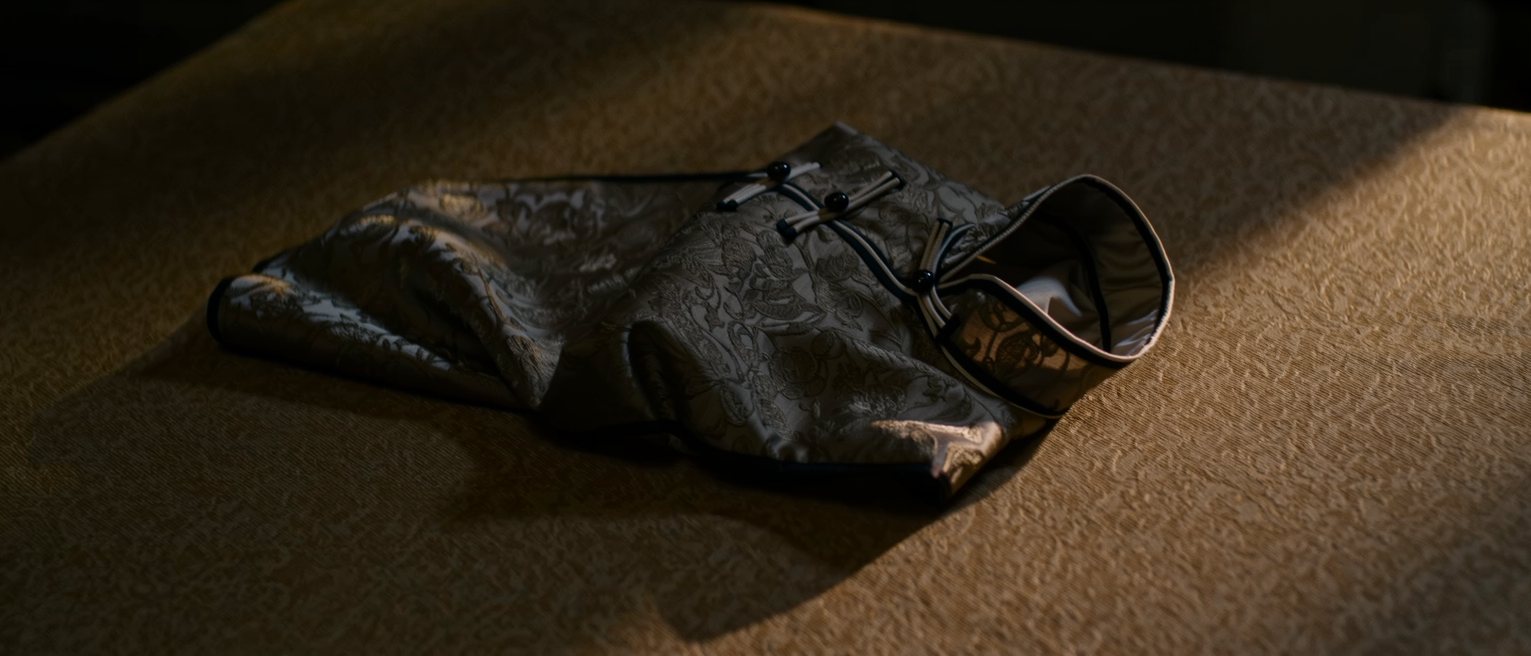
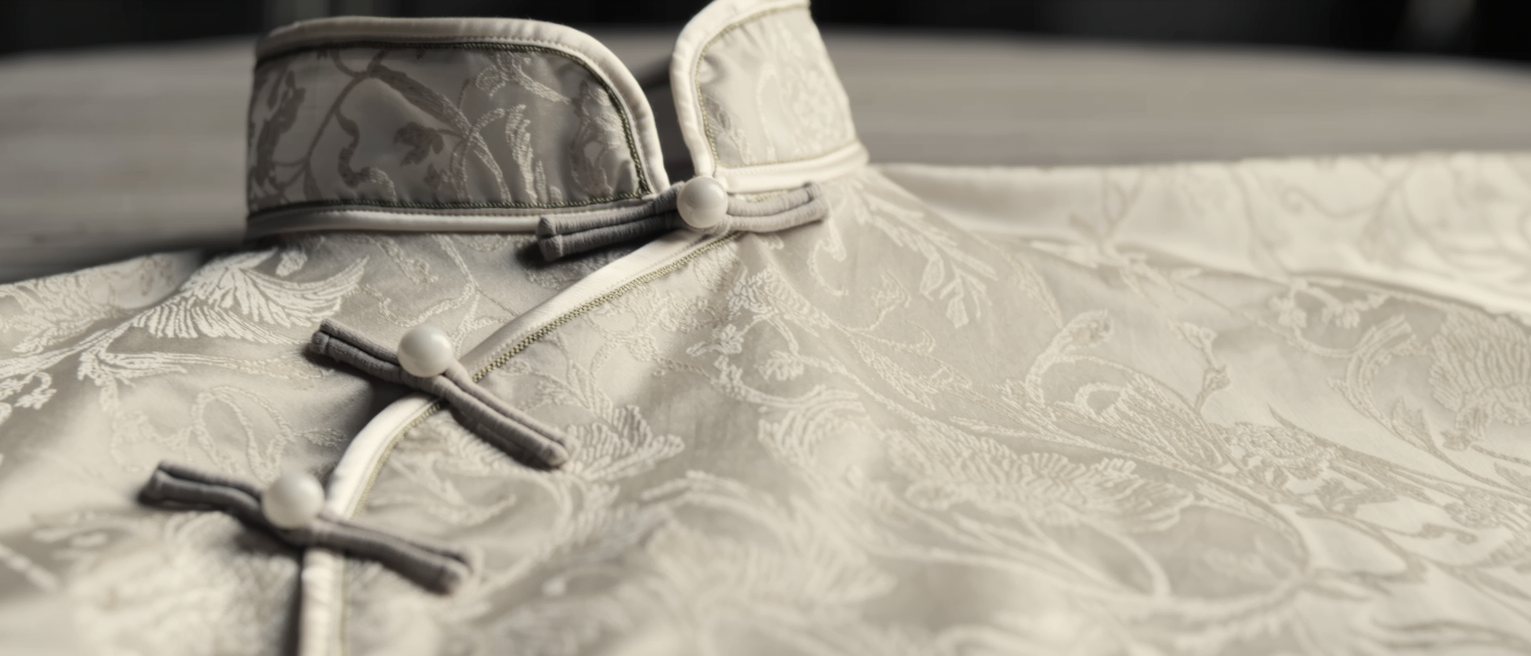
The costume design functions as its own form of restrained communication. Maggie Cheung's character appears in a different, exquisitely fitted qipao in nearly every scene — a visual excess that contrasts sharply with her emotional restraint. The film lets clothing say what dialogue won't, using color and pattern to track her interior state across scenes where her face and words remain carefully composed. Restraint, the choice reinforces, doesn't mean absence of expression, only a redirection of it into channels other than direct statement.
The film's final scene, set at Angkor Wat, adds a last piece to the argument. Chow whispers his secret into a hole in an ancient temple wall and seals it with mud — a gesture the film frames as the only way the era and culture available to him allow a feeling this size to be fully released, not spoken to the person it concerns but confided to something ancient and impersonal enough to hold it safely. Some restrained feelings, the scene suggests, never get resolved through disclosure to their actual object. They simply find another container.
A skeptical reading worth including once more: some contemporary critics have questioned whether the film's aestheticized restraint has aged into something closer to a genre convention than a genuine insight — endlessly imitated in advertising and other films' visual language to the point that its original emotional charge risks being read, by newer audiences, as style rather than substance.
Moonlight's position, restated: strip away the imitation and the film's original observation still holds. Desire contained by real circumstance doesn't disappear; it relocates into gesture, color, timing, and repetition, and learning to read those channels is its own kind of intimacy, available even when direct declaration isn't.
Twenty-five years of reputation, and the Ozu comparison
The film's critical reception deserves treatment beyond a passing citation, since its reputation has only grown in the quarter-century since release: it appeared on the British Film Institute's Sight and Sound critics' poll among the greatest films ever made, and by the 2022 edition of that decennial survey had climbed into the top ten, an unusually rapid ascent for a film without the decades of accumulated canonical weight that typically precedes such rankings. That trajectory says something about how the film's specific treatment of restraint has aged: rather than reading as dated melodrama, as some mid-century romances increasingly do, it has been received as prescient about exactly the themes — surveillance, digital-era self-restraint, the gap between felt intensity and expressed intensity — that later decades would make newly relevant.
The film's visual language has also become one of the most widely imitated in contemporary cinema and fashion photography, to the extent that its specific palette of saturated reds and greens, its narrow depth of field, and its slow-motion interstitial shots of Cheung's character walking to the noodle stand have become genre shorthand, referenced everywhere from music videos to luxury advertising campaigns that borrow the film's surface without necessarily engaging its content — a form of influence that, as with any widely imitated style, risks flattening the original into a purely aesthetic object, detached from the specific social and emotional argument the style was originally built to serve.
Japanese critical and audience reception of the film is worth considering on its own terms, since Wong Kar Wai's aesthetic sensibility — the attention to negative space, the significance placed on what remains unsaid, the treatment of mono no aware, the poignant awareness of transience, as a governing emotional register — has been frequently and not inaccurately compared by Japanese critics to strands within Japan's own cinematic tradition, particularly the work of Yasujiro Ozu, whose films similarly build meaning through restraint, repetition, and the emotional weight carried by domestic ritual rather than dramatic incident.
The comparison to Ozu is worth pressing further than the surface similarity suggests, because the two directors' restraint serves genuinely different purposes: Ozu's characteristically static, low camera and unhurried pacing typically depict a family or social order absorbing change with quiet resignation, restraint as an expression of acceptance; Wong Kar Wai's restlessly mobile camera and fragmented, non-chronological editing depict restraint as active, ongoing labor — two people continuously choosing not to act rather than having already accepted a settled outcome. Reading the films as aesthetically similar without noting this difference in what restraint is doing in each risks collapsing two genuinely distinct philosophical positions into one generic “Asian cinema of restraint” category.
Furin, density, and watching from outside
The specific social mechanism the film depicts — an affair (furin, 不倫) remaining unconsummated primarily because of the density of a socially interconnected community rather than because of either character's individual virtue — maps with unusual precision onto contemporary Japanese social reality, where furin remains one of the most reliably scandal-generating categories of public disclosure, capable of ending careers and public reputations regardless of whether any physical infidelity actually occurred, since the appearance of an inappropriately close relationship is frequently treated with nearly the same social severity as its consummation. Su and Chow's calculation — that being seen together too often, in the wrong configuration, carries real cost independent of what actually happens between them — will likely feel immediately legible to a Japanese audience in a way it may require more explanation to convey to audiences from cultures with more forgiving social surveillance.
A genuine complication follows for any straightforward “Japan understands restraint” reading: Japan's own relationship to furin has been shifting. A steady stream of celebrity infidelity scandals, covered with an intensity bordering on ritual public shaming, coexists with survey data suggesting younger generations hold measurably more permissive private attitudes toward extramarital involvement than the public discourse around scandal would suggest. The gap is a familiar one — between what a culture punishes publicly and what individuals within it may privately tolerate or even practice — and the film's own central couple embodies it almost perfectly, since Su and Chow's restraint is itself a response to that exact gap between private feeling and public consequence.
For international women watching the film while living in Japan, its central social mechanism — desire constrained less by personal conviction than by the near-certainty of being observed, discussed, and judged within a dense, interconnected community — often lands with an immediacy that surprises women who arrive expecting the film's restraint to read as period-piece exoticism rather than as a reasonably accurate description of the social physics still operating, in modified form, in the residential neighborhoods, workplaces, and expatriate communities many of them now inhabit.
This recognition frequently sharpens for women in cross-cultural relationships specifically, where the calculus the film depicts — what a relationship costs socially if seen, versus what it offers privately — can apply with particular force to a relationship between a foreign resident and a Japanese partner still embedded in family or professional networks with strong opinions about appropriate partnership, meaning some of the same quiet, continuous, day-after-day negotiation the film depicts between Su and Chow has a real structural counterpart in contemporary cross-cultural dating in Japan, where visibility itself, not just consummation, can carry social cost for one or both partners.
Some international viewers report finding a specific comfort in the film, precisely because of its foreignness to their own cultural assumptions about romantic disclosure. A film that treats withheld desire as intelligible, even dignified, rather than as simple repression or failure of nerve, offers a useful corrective to home cultures that treat any unspoken romantic feeling as automatically dysfunctional — a vocabulary for restraint as a legitimate, even sophisticated, response to real constraint, rather than only as something to be overcome through more direct communication.
Counterarguments, taken at full strength
A significant counterargument deserves direct engagement here: Wong Kar Wai's own 2046, released four years later and featuring an aged, embittered version of Chow living out the emotional aftermath of the earlier film's restraint, substantially complicates any reading of In the Mood for Love as an unambiguous celebration of dignified withholding. In 2046, Chow has become a womanizer who treats subsequent partners with a coldness that reads, in retrospect, as a direct consequence of the earlier restraint rather than an unrelated character development — suggesting Wong Kar Wai himself may have understood the earlier film's restraint less as a pure achievement than as a wound that produced its own later damage.
A feminist critique of the film also deserves genuine engagement rather than a passing acknowledgment: some critics have argued that Su Li-zhen, despite receiving the film's most sustained visual attention through Cheung's celebrated wardrobe, functions narratively as a relatively passive figure whose interiority the film gestures toward through composition and costume but rarely grants direct access to in the way it grants access to Chow's perspective, a critique worth taking seriously rather than dismissing, since a film's formal beauty in photographing a woman is not the same achievement as giving her genuine narrative agency, and the two are worth evaluating separately rather than assuming one implies the other.
A commercial-nostalgia critique deserves airing plainly, too. The film's aesthetic — saturated color, meticulous 1960s production design, the specific melancholy of Shanghainese emigre Hong Kong — has become such a reliable shorthand for “tasteful longing” in advertising, fashion editorial, and lifestyle content that its use increasingly risks functioning as pure surface signifier: sophistication and restraint evoked as a mood to be purchased or performed, rather than as the specific, costly emotional position the film actually depicts. The film's own popularity has arguably accelerated this drift from substance to style.
It's worth being honest about what a piece of film criticism, including this one, can and cannot establish: interpretive claims about what the film “means” or what its restraint “represents” are readings, however well-supported by textual evidence, not verifiable facts about authorial intent or objective meaning, and Wong Kar Wai himself has been notably reticent in interviews about offering a single authoritative interpretation of the film's ending or its central relationship, a reticence that is itself consistent with a film built around the idea that some things are better left unresolved than forced into a single legible statement.
This interpretive humility matters practically, not just academically, because it bears directly on how any reader should hold this essay's claims: the reading offered here — that the film depicts restraint as costly, structurally rational, and worth taking seriously without treating it as automatically wise — is one considered position among several legitimate ones, not a definitive account that forecloses other equally serious readings, including readings that find the film considerably more critical of its own central couple's choices than the account offered above allows.
Where the title and the premise came from
A more precise question worth sitting with privately, beyond the essay's earlier prompt: when you think of a desire you once restrained rather than acted on, is the restraint you remember one you would describe, honestly, as a form of care — for yourself, for someone else, for a situation too fragile to survive disclosure — or was it closer to fear wearing the costume of prudence, a distinction the film itself, in its more clear-eyed moments, seems aware sits closer together than either restraint's admirers or its critics tend to admit.
It's also worth asking what your own culture's default verdict on withheld desire actually is, since that default shapes how you read a film like this one before you consciously register that you're reading it through any lens at all: a culture that treats restraint as inherently repressive will likely read Su and Chow as tragic victims of their own timidity, while a culture that treats disclosure as inherently reckless will likely read them as admirable, and noticing which reading arrives first, unbidden, tells you something about the assumptions you brought into the theater rather than something purely about the film.
The film's evocative English title, borrowed from Bryan Ferry's 1976 rendition of the Vernon Duke standard rather than coined by Wong Kar Wai himself, sits somewhat awkwardly alongside the far more literal and telling Chinese title, Fa yeung nin wah (花樣年華), which translates roughly to 「the age of blossoms,」 a phrase traditionally used to describe a woman's most beautiful, fleeting years. The Chinese title centers Su Li-zhen's specific temporal predicament — this is happening to her during the brief window when she is, by her culture's own reckoning, at her most beautiful and most constrained — in a way the English title's more generic romantic mood does not fully carry across, and readers encountering the film only through its English title miss a layer of built-in irony the original audience would have caught immediately.
The film draws its structural premise, though not its plot in any direct sense, from Liu Yichang's 1972 novella Duidao (对倒, 「Intersection」 or 「Tête-Bêche」), whose interleaved narration of two strangers' parallel days in Hong Kong supplied Wong Kar Wai with the film's opening epigraph and its guiding formal idea: two lives running alongside each other, close enough to nearly touch, without ever quite merging into one shared narrative. Wong Kar Wai has described the film as, in part, an extended meditation on a mood evoked by Liu's prose rather than an adaptation of its events, which is worth knowing because it reframes the film less as a conventional love story with a source text and more as a formal experiment in atmosphere that happened to organize itself around two specific characters.


Sound, dialect, rehearsal
The film's soundtrack deserves attention beyond its most famous cue, Shigeru Umebayashi's waltz theme, because its use of several Nat King Cole recordings sung in Spanish — a language foreign to nearly everyone in the film's Hong Kong setting — performs its own quiet argument about displacement: the music floating through the Shanghainese emigres' rented rooms belongs to none of the cultures physically present in the scene, existing in a kind of unplaced, in-between register that mirrors the characters' own condition as people who have already been displaced once, from Shanghai, and now inhabit a second displacement in their own withheld desire, at home nowhere in particular, including within their own feelings.
Language itself carries structural weight in the film that a purely visual or emotional reading can miss: the Shanghainese emigre community depicted speaks Shanghainese at home while operating in Cantonese-speaking Hong Kong, a linguistic layering that marks the characters as permanent outsiders within the city they inhabit regardless of how long they have lived there, and this layered non-belonging — Shanghainese among themselves, Cantonese in public, a private language of glances and rehearsed lines between Su and Chow that neither dialect fully captures — reinforces the film's larger argument that restraint here is not simply personal reticence but one more expression of a broader condition of never being fully at home in any single register, linguistic or emotional.
The film's rehearsal scenes — in which Su and Chow practice, playing each other's spouses, how they might confront their unfaithful partners — deserve treatment as among the film's most formally daring choices, since these scenes blur the line between performance and confession so thoroughly that viewers, and arguably the characters themselves, lose track of whether a given line is rehearsal or genuine feeling breaking through the rehearsal's cover. This device lets desire speak precisely because it is nominally not being spoken: what Su and Chow cannot say to each other directly, they can say while notionally playing other people, a structural loophole the film uses repeatedly and which offers its own quiet commentary on how much genuine feeling gets expressed, in ordinary life, only under the cover of some other stated purpose.
It's worth placing the film briefly alongside its closest Western analogue, David Lean's 1945 Brief Encounter, another canonical film about a nearly-consummated affair constrained by social convention and personal conscience, since the comparison illuminates what is culturally specific about Wong Kar Wai's version: Brief Encounter's restraint is framed primarily as a matter of individual English reserve and Christian-inflected guilt, an internal moral struggle largely private to the two characters, whereas In the Mood for Love locates restraint's source much more externally, in the dense, watching, gossiping social fabric of the rooming house and neighborhood, making the Hong Kong film's restraint considerably more sociological and considerably less purely psychological than its closest Western counterpart.
What the performances actually do
The film's reception across different Chinese-speaking markets is worth noting as its own data point: it performed well critically in Hong Kong and internationally but drew a more divided response in mainland Chinese markets partly still adjusting to arthouse pacing at the time of release, and its Shanghainese-emigre setting has since taken on additional resonance in mainland China's own contemporary nostalgia industry around 1930s-60s Shanghai aesthetics, with the film frequently cited, sometimes to its own detriment, as visual shorthand for a specific romanticized vision of old Shanghai that the actual Shanghainese diaspora depicted in the film experienced rather more ambivalently, as exile rather than nostalgia.
The recurring appearance of the number 2046 — the hotel room where Su and Chow write together, later the title and central setting of Wong Kar Wai's loose sequel — deserves brief, specific attention as the film's clearest embedded promise that this story does not end where the credits suggest it does: the room number functions as a kind of authorial marker planted inside the earlier film, indicating that Wong Kar Wai understood, even while making In the Mood for Love, that its ache required further exploration, that restraint this costly does not simply resolve itself when the film ends but continues generating consequence in a character's life well past the frame the first film chooses to show.
None of these additional threads change the essay's central claim so much as thicken it: the film's restraint is inseparable from its specific historical moment, its specific linguistic layering, its specific literary sources, and its specific place within a body of work that continued interrogating the same ache for years afterward. A viewer encountering the film today, stripped of this context, can still feel its central argument land — that desire prevented from becoming action does not vanish but relocates — though knowing the fuller apparatus behind that argument only deepens how precisely constructed, rather than simply felt, the film's famous restraint actually is.
The film's influence extends into the broader lineage of restrained-romance cinema that followed it, with later films frequently cited alongside it — Portrait of a Lady on Fire among the most discussed — sharing its interest in desire rendered through glance, proximity, and deliberate visual composition rather than through spoken declaration, suggesting In the Mood for Love helped establish a durable cinematic vocabulary for depicting interiority under constraint that subsequent directors, working in entirely different cultural and historical settings, have continued to draw on, a testament to how precisely the film's formal grammar isolated something genuinely portable about how restrained desire actually looks on screen.
Finally, it's worth crediting the specific physical craft Cheung and Leung bring to the performance, since restraint of this kind is exceptionally difficult to act convincingly: both performers maintain a controlled, almost formal physical bearing throughout — measured walks, careful posture, minimal unplanned gesture — that makes the rare moments of visible emotional slippage (a held gaze a beat too long, a hand that almost reaches and stops) register with outsized impact precisely because they depart from an otherwise tightly maintained baseline, a performance style that required, by both actors' own accounts, considerably more disciplined technical control than a more conventionally expressive dramatic register would have demanded.
A more complicated version of the claim
Taking the counterarguments seriously does not require abandoning the essay's central claim; it requires holding a more complicated version of it. The film's restraint is neither simply admirable nor simply tragic, neither pure wisdom nor pure repression dressed in beautiful cinematography — it is a specific, costly response to a specific set of real constraints, one that produced genuine intimacy and genuine damage simultaneously, and a serious reading of the film has to hold both without resolving the tension into a cleaner verdict than the material actually supports.
What the film ultimately offers, more than a position on whether restraint was correct, is a rare and patient attention to what restraint actually feels like from the inside — the specific texture of wanting something continuously while continuously choosing not to reach for it, rendered with enough precision that viewers recognize something in it even when their own circumstances bear no surface resemblance to 1960s Hong Kong. That precision, more than any verdict the film does or doesn't offer, is its real and lasting achievement.
Moonlight's considered position, having now sat with the counterarguments: restraint deserves neither the uncritical romanticization the film's aesthetic sometimes invites nor the dismissal a more skeptical reading might apply. It deserves to be understood as one genuine response among several available to real constraint — sometimes the wisest available option, sometimes a wound that produces further wounds, and almost never reducible to a single verdict that applies equally to every person choosing it for their own particular reasons.
The film's cinematography deserves specific attention for its recurring use of doorways, window frames, and narrow corridors as literal framing devices around Su and Chow, a technique cinematographers Christopher Doyle and Mark Lee Ping Bing employ so consistently that it functions as visual argument rather than mere style: the characters are almost never shown in open, unobstructed space together, but rather glimpsed through half-closed doors, around corners, past intervening furniture, a visual grammar that renders architecturally, shot by shot, the same restraint the narrative describes in dialogue and gesture, making the film's formal choices and its thematic content mutually reinforcing rather than merely complementary.
The film sits inside Wong Kar Wai's broader body of work, and specifically inside his recurring collaborations with Maggie Cheung and Tony Leung. Both actors appear across several of his films playing variations on adjacent emotional territory — controlled longing, communication just barely withheld — to the point that audience familiarity with their other collaborations inevitably colors how a viewer receives this particular pairing. Some of the film's emotional resonance for longtime Wong Kar Wai audiences comes not only from what happens within this specific film but from an accumulated sense of these two performers' shared screen chemistry, built up across an entire directorial career — a layer of meaning genuinely available only to viewers who arrive already familiar with the wider filmography.
Clocks, 1997, and the dusty pane
The film's recurring clock imagery and its closing voiceover reference to looking at the past “through a dusty window pane” deserve treatment as more than atmospheric decoration: time in this film is presented not as a neutral, evenly flowing medium but as something the characters actively, if often unsuccessfully, try to control — Chow's repeated insistence on precise timing for their meetings, the exact accounting of hours and days in intertitles, all suggest an attempt to manage an experience that ultimately manages them instead, reinforcing the film's larger argument that restraint requires a form of continuous, effortful bookkeeping that the narrative form itself, fragmented and non-chronological, formally undermines even as the characters attempt it.
The film's initial 2000 release arrived roughly three years after Hong Kong's 1997 handover to Chinese sovereignty, and the timing matters. Critics both in Hong Kong and internationally have frequently read the film's elegiac treatment of a vanished 1962 Hong Kong, populated by displaced Shanghainese emigres themselves uncertain of their belonging, as an oblique meditation on Hong Kong's own contemporary anxiety about cultural identity and continuity under a new political arrangement. Wong Kar Wai has not endorsed this reading as the film's primary intention, but its plausibility, and the fact that it arrived at precisely this historical moment, belongs in any full account of what the film meant to the audiences who first received it.
None of these additional formal and historical threads require abandoning the essay's earlier claims; they simply confirm that a film capable of sustaining this much specific, textured analysis a quarter-century after release is doing something considerably more disciplined than merely photographing beautiful longing. Its restraint is legible in its camera placement, its use of two actors' accumulated screen history, its treatment of time, and its historical moment of arrival, as well as in its plot — which is, finally, the strongest evidence that the film's central argument about restraint was a genuinely considered artistic position rather than an incidental mood.
One additional device deserves isolating on its own terms, since it has been implicit throughout this analysis without being named directly: silence itself functions in the film as a distinct formal element, not merely the absence of dialogue but a deliberately extended duration during which the audience is asked to sit with unresolved tension rather than have it narrated or explained on its behalf. This is a technique that demands real patience from viewers accustomed to more expository pacing, and it repays that patience specifically because it trains the audience, gradually, over the film's runtime, in the same skill the characters themselves are practicing throughout — reading meaning in what is withheld rather than waiting for it to be stated outright, which is finally the same skill this essay has been asking its reader to practice as well.
For a reader who wants to keep exploring what restraint costs and what it protects, Moonlight's wider writing on the difference between privacy and secrecy, on what discretion actually accomplishes inside a relationship under real practical constraint, and on how desire changes shape rather than disappearing when it cannot become action, offers a quieter next place to continue this same question, at whatever pace feels honest rather than performed.