Cinema
Pale Moon, and the First Money She Ever Spent as Herself
A bank employee takes her customers’ money and spends it on a young man. The film is not about greed and it is not about infatuation. It is about a woman finding out that every yen of her life so far has been somebody else’s — her husband’s salary, the bank’s deposits — and that she has never once spent anything as herself. A reading of the 2014 film by a house that sells hours to women with money of their own, and therefore has an interest in the argument it is making.
There is a moment that happens in a very large number of households and is almost never described, because from the outside nothing occurs in it. A woman is about to buy something. She can afford it. The money is in an account she can reach, on a card she is entitled to use. Nobody has forbidden the purchase, and if she made it, in all likelihood nobody would say a word. And still, in the second before she buys, something runs a check. Is this a reasonable thing for me to have spent on. Could I account for it if it came up. Is it, in the particular sense that is hard to name, allowed.
The check is not about arithmetic; she has already done the arithmetic. It is about standing, and standing is a different property from access. Access is the ability to move a sum of money from one place to another. Standing is the right to point a sum at your own preference without owing anybody an explanation. A person can hold the first for twenty years without ever acquiring the second, and the arrangement is so quiet that she may not be able to say what is missing.
Pale Moon, released in Japan in November 2014 as Kami no Tsuki, is the most exact account of that gap this Library has found on a screen. On the surface it is a crime story: a woman working on contract for a bank takes money from the customers whose deposits she collects and spends it on a university student half her age. The reading offered here is different. This film is not about greed and it is not about infatuation. It is about a woman discovering that her entire life has been conducted in other people’s money. Her household runs on her husband’s salary. Her working day consists of carrying other people’s savings to a bank that is not hers either. Money passes through her hands continuously and none of it has ever been hers to direct. The crime is how she finds out what it feels like to spend as herself — which is why the film cannot end with her simply being caught. An arrest answers a question the film never asks.
One thing has to be said plainly at the start rather than smuggled in at the end. What follows is a structural claim about household economics. It is not a defence of embezzlement. The money in this story belongs to people who saved it, many of them elderly, and nothing below makes their loss smaller than it is. A film may be permitted to find a woman’s self-recognition more absorbing than her victims’ balance sheets. An essay should say out loud that it noticed.
What the film is, and what is on the record
The source is a novel. Kakuta Mitsuyo’s Kami no Tsuki was published by Kadokawa Haruki Corporation in 2012 — the National Diet Library records the first edition as March of that year — and won the twenty-fifth Shibata Renzaburo Prize the same year. A Haruki Bunko paperback followed in September 2014, timed to the film. Publisher copy describes the protagonist as Umezawa Rika, forty-one, a contract employee at a bank, who embezzles one hundred million yen. That figure belongs to the novel’s marketing; this essay attaches no sum to the film.
There are two screen versions and the order is worth knowing. NHK broadcast a five-part drama in its Drama 10 slot from 7 January to 4 February 2014, scripted by Shinozaki Eriko and directed by Mayuzumi Rintaro, with Harada Tomoyo in the lead. The film came ten months later, and the two are not interchangeable.
The film was directed by Yoshida Daihachi from a screenplay by Hayabune Kaeko, distributed by Shochiku, and released on 15 November 2014 at 126 minutes. Miyazawa Rie plays Rika; Ikematsu Sosuke plays Hirabayashi Kota, the student; Tanabe Seiichi plays her husband Masafumi; Oshima Yuko plays a younger colleague, Aikawa Keiko; Kobayashi Satomi plays Sumi Yoriko, the long-serving colleague who eventually works out what has been happening. The story is set in 1994, immediately after the collapse of the bubble economy, which is not decoration: it places the action in a year when the institutions around Rika were themselves reconsidering what everybody in them was worth.
The award record deserves stating precisely, because it is routinely blurred. At the twenty-seventh Tokyo International Film Festival in October 2014 the film won Best Actress for Miyazawa and the Audience Award; the Tokyo Grand Prix went to another film, Heaven Knows What. At the thirty-eighth Japan Academy Prize Miyazawa won Best Actress, the top award in that category. The film itself, Yoshida’s direction, Hayabune’s screenplay, the craft departments and supporting-actress citations for Oshima and Kobayashi were all at the excellence tier — the shortlist from which each category’s top award is chosen, a real honour but not a win. At least one widely used Japanese reference work states the film took the top prizes for picture and screenplay. It did not, and the awarding body’s own published list was used here.
The title deserves a paragraph. In English a paper moon is a photographer’s prop, a crescent of painted board people once sat on to have their picture taken, and the phrase carries the sense of something plainly false that can be believed into a kind of truth — the conceit of the old song about a paper moon over a cardboard sea. The international title is not Paper Moon but Pale Moon, and coverage of the festival run reports the change was made to avoid collision with the well-known American film of 1973. The Japanese title is the one that does the work. What is in Rika’s hands the whole time is paper.
The first ten thousand yen
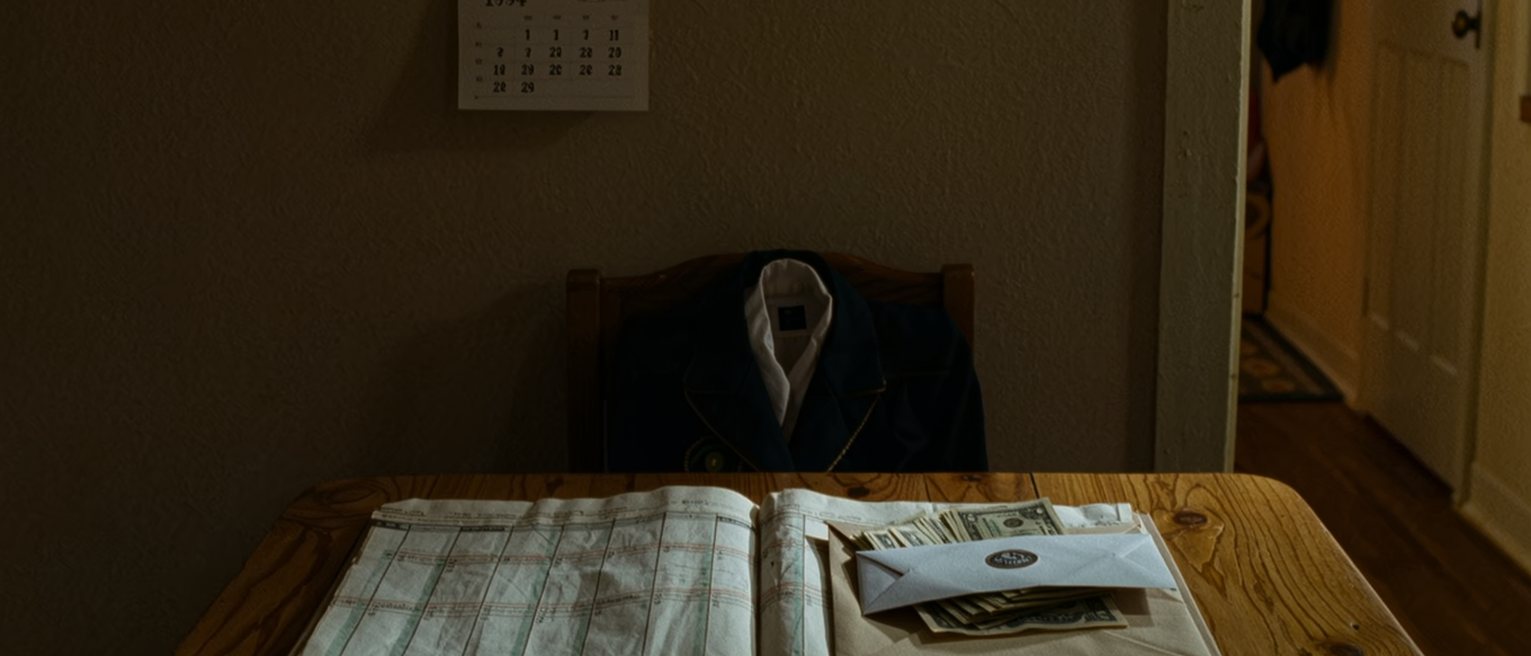
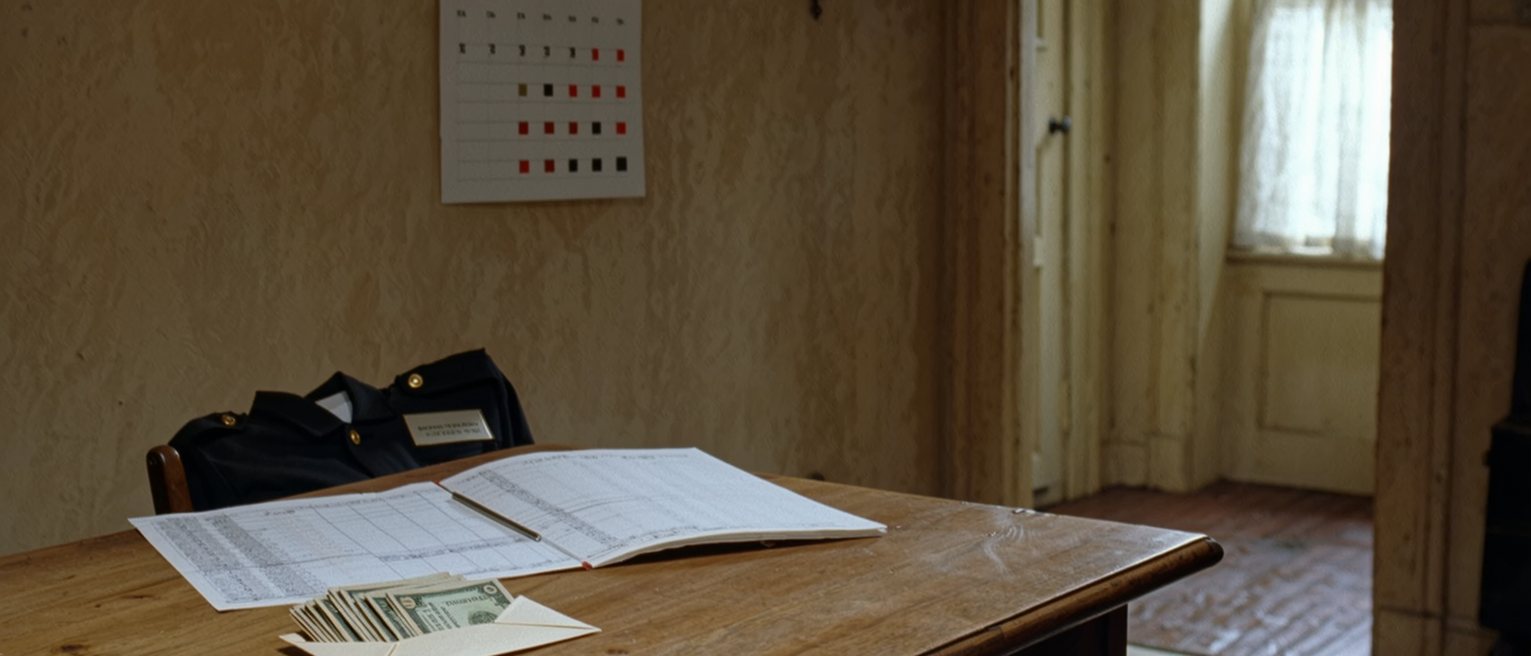
The distributor’s own synopsis is unusually useful about how this starts. Rika is a housewife who works on contract for a bank, going out to customers’ homes to take in their deposits, and she is good at it — trusted, attentive, well regarded. Her marriage is comfortable and her husband is not much interested in her. And one day she takes ten thousand yen of a customer’s money. Published accounts describe the circumstance as a shortfall: she is buying something for herself, expensive, on impulse, does not have enough of her own on her, and the customer’s cash is in her bag. She covers the difference and puts the money back almost immediately.
Everything this essay wants to say is already inside that transaction. Nothing acquisitive happens. She does not want the customer’s money; she wants the thing, and the money is the nearest instrument. What the scene exposes is a gap — between the price of something she wanted and the sum she considered herself entitled to be carrying for her own purposes. She is not poor. She has her own wage. The gap is not between her and the price. It is between her and permission.
The repayment matters more than the theft. She puts it back at once, which tells you she does not think of herself as somebody who takes things. It also tells you something sharper: the only way she could reach the purchase was by routing it through money that did not require her to have standing. Other people’s money is, paradoxically, easier to spend, because spending it involves no claim about who you are. It is a transaction with no self in it, which is what she has been doing professionally for years.
Films about theft usually treat the first act as a threshold: before it the person is honest, after it they are not. This film treats it as a discovery. What she discovers is not that stealing is easy. It is that buying something because she wanted it, without first assembling a justification, is a sensation she has no prior experience of. The rest of the film is the pursuit of that sensation, and the money is the medium rather than the object.
Access is not standing
Here is the distinction stated cleanly, because everything after it depends on it. Access is a mechanical fact: you can reach a sum. There is a card, a passbook, a joint account, a household allowance, a salary of your own. Access is what most married women in a solvent household have, and it is what people usually mean when they say a marriage is equal about money.
Standing is a social fact. It means you may direct a sum at something you want, for no reason other than that you want it, without the expenditure becoming an event. Standing is not about whether anybody would stop you. It is about whether the purchase would need an account of itself — to a partner, to a household ledger, to the version of yourself that keeps the household ledger in your head when nobody else is asking.
These two come apart constantly, and when they do the mechanism is almost never a prohibition. It is a coding. Household money gets quietly coded as originating with whoever earns more of it, and the person who earns less becomes, by increments and without discussion, its administrator rather than its owner. She may handle all of it. She may decide most of it. What she does not have is the ability to spend a sum on herself without the spending meaning something.
Japanese conditions give the coding help, and it is worth setting them down as facts with their limits attached. The Ministry of Health, Labour and Welfare’s Basic Survey on Wage Structure for 2024 puts women’s scheduled monthly pay at 275,300 yen against men’s 363,100 yen, an index of 75.8 where men are 100, reported as the narrowest gap since the series became comparable in 1976. That figure covers full-time general workers and excludes bonuses and overtime, so it omits part-time work, where women are far more concentrated; the difference in total annual income is wider than 75.8 suggests. The Cabinet Office’s gender equality white paper describes women’s regular-employment rate peaking at 59.7 per cent in the twenty-five to twenty-nine age band and declining from there, the pattern it calls the L-curve. Neither statistic describes anybody individually and neither predicts a single household. They describe the ambient arithmetic within which the coding becomes plausible.
That the coding can go all the way to coercion is recognised by the state itself. The Cabinet Office’s materials on spousal violence name withholding living expenses and obstructing a spouse from working outside the home among the behaviours that count as violence within a marriage; its material on why victims cannot leave states plainly that where a person could not live without a spouse’s income, that dependence can itself make leaving impossible. This essay is not describing that situation. Rika’s husband is not violent and does not control her. The point is narrower: the question of who may spend is understood, in Japanese public policy, as a question about power and not only about arithmetic. If the extreme end of the continuum is legible as violence, the ordinary end is not nothing.
The watch, and the correction
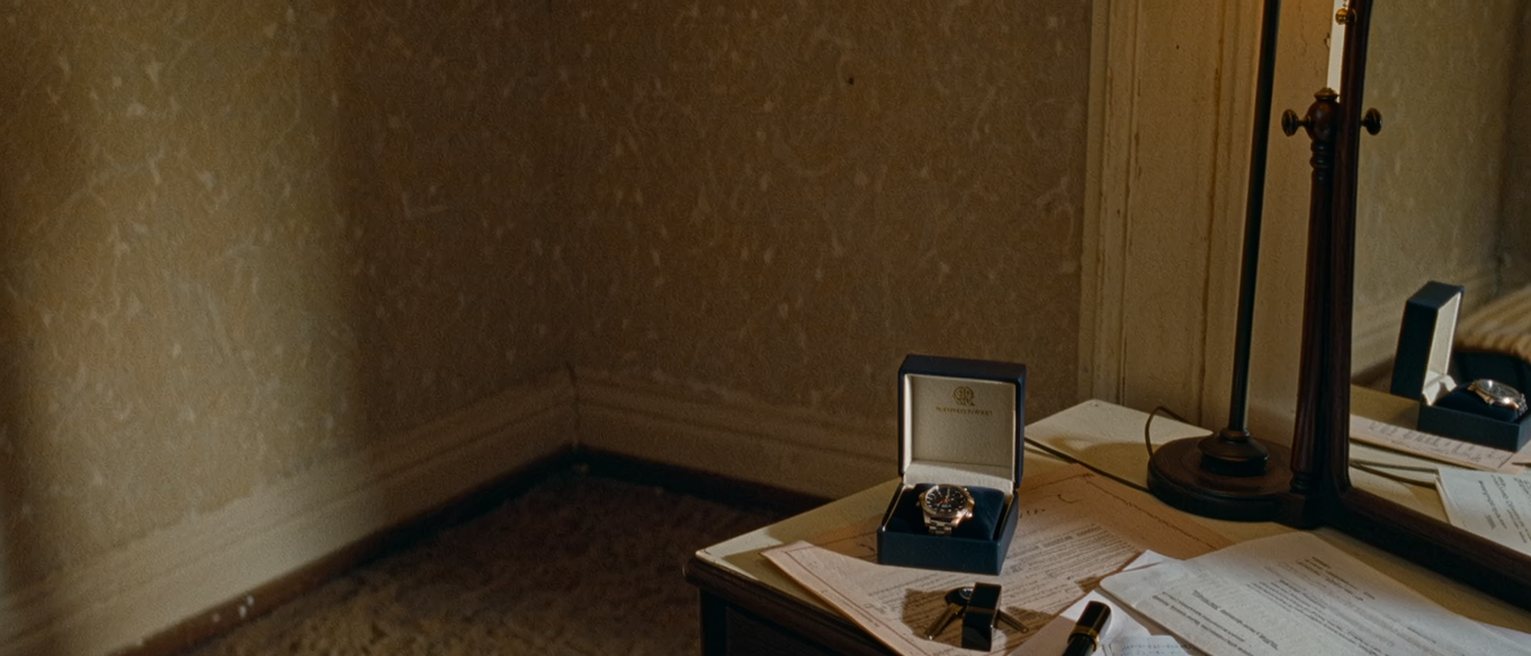
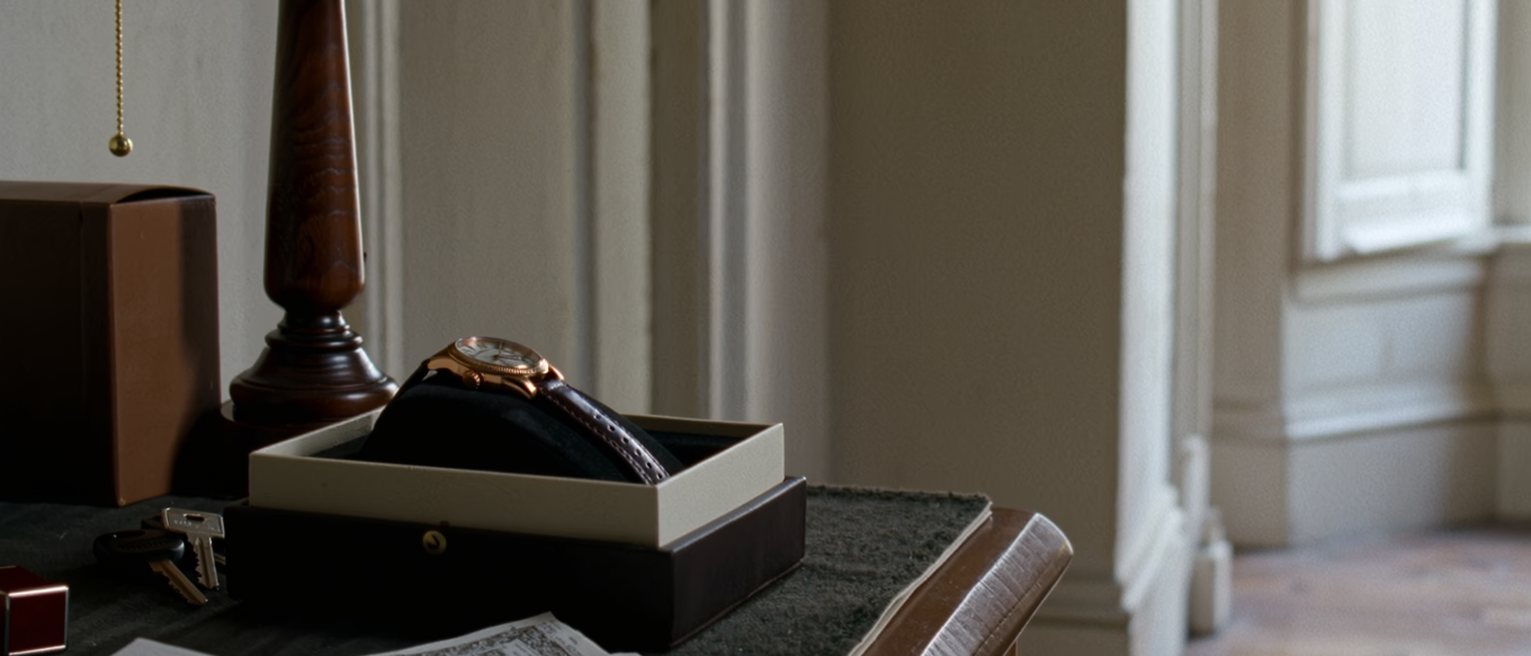
The film has a scene this Library would put at the centre of the argument, and it involves no crime at all. Published accounts describe it this way. To mark her move onto a contract with the bank, Rika buys a pair of watches with money she earned, one for herself and one for her husband. They are not expensive. He receives the gift pleasantly enough, and something in his manner makes clear that the watch is beneath the standard of the household. Later he returns from a business trip abroad with a watch for her, a costly one. She is hurt. She wears it to work.
Read that as an argument about standing and it is almost diagrammatic. Her purchase was made with her own earnings, on an occasion of her own, and it was corrected. Not refused — corrected. He did not say she could not buy a watch. He replaced her judgement about what a watch should cost with his, and he did it generously, in the form of a gift, which is the form of correction that cannot be objected to without the objector looking ungrateful.
If you count only access, nothing has happened. She had money; she spent it; she then received something better. On a household balance sheet she is ahead. What she has lost is the standing of the money she spent, which turned out to be a lower grade of money than the household’s real money, and the standing of her taste, which turned out to require an upgrade. And the second watch is not hers in the way the first was. She wears it because it is on her wrist.
This is how a woman with her own salary can end up with no experience of spending as herself. Her wage exists, but it is small and it has been assigned a role: it tops things up, it handles her own small expenses, it buys the modest version. The household’s real money, the money that sets the standard, arrives from elsewhere, and she administers it without being its author. Over years, the two grades of money teach a person a great deal about her own weight.
What Rika finds when she starts taking from the bank is that stolen money has no grade. It is not the wife’s money or the husband’s money; it has escaped the coding entirely. For the first time she is buying at a level nobody assigned her, and the film is honest enough to show that this is not misery. She becomes, as the actor described the trajectory in interviews at the time of release, more luminous as she goes further in. That is not an endorsement by the film. It is an observation about what permission feels like when it arrives, even illegitimately, after a long absence.
The other women in the building
The film does not leave Rika alone with this. It puts two other women in the same bank and gives each a different relation to the same money, which is the move that lifts the film above a study of one woman’s collapse.
Sumi Yoriko, played by Kobayashi Satomi, has been at the branch a long time. Published accounts differ on how long, so no figure is claimed here; what they agree on is the situation. She is experienced, she is expensive by the standards of an employer that would rather have cheaper and younger staff, and she is being eased toward the exit by people who will not say so in those words. She is also the one who notices the discrepancies, works patiently through them, and brings the thing down. In the confrontation that follows she puts to Rika, in substance, the flat proposition that money is not what makes a person free.
Consider what the film has arranged. The institution that will prosecute Rika for taking money is, in the same building and in the same months, quietly conducting its own assessment of what a woman’s years are worth and finding the answer inconvenient. Sumi is not a moral foil placed there to make Rika look worse. She is the other outcome of the same question. One woman answers the question about her own worth by taking what she was never going to be given. The other answers it by refusing to be moved, and pays for that too. Aikawa Keiko, played by Oshima Yuko, is the third position: younger, inside the rules, her relation to the institution not yet settled.
It matters that all three are women and that the money is never theirs. The film is precise about a working life in which enormous sums pass through a person’s hands daily while the person’s own standing is decided by somebody else on another floor. Whatever else Pale Moon is, it is a film about women whose competence with money is total and whose authority over money is nil.
Why the film cannot end with her being caught
The film ends, by every published account, with escape rather than sentence. Cornered, Rika breaks a window with a chair and goes through it. The last stretch places her abroad, in a market in another Asian country, moving through a crowd. A conventional crime film would find that unsatisfying, so it is worth being clear about why this one needs it.
An arrest-and-sentence ending answers the question of whether what she did was a crime. But that question is not in doubt at any point and no viewer has been asked to hold it open; answering it would be answering nothing. The question the film is actually holding is harder: whether a person who has never in her life spent anything as herself can be said to have been living her life, and what it means that the only route she found to that experience destroys her and takes other people’s savings with it. A sentence does not touch that. A verdict about a body is not a verdict about a self, which is a distinction this Library has been circling for some time and which this film states almost diagrammatically in its last five minutes.
The film also plants a rhyme for the crime in her girlhood. Rika was educated at a Catholic girls’ school, and published accounts describe a schoolgirl episode in which she took money from her father’s wallet to give to a collection for a child overseas, and received a letter of thanks. Near the end the film returns to that history in the market abroad. The rhyme is not there to excuse her. It is there to say that this has always been her only grammar: to be generous, and to be generous with money that was not hers, because generosity with your own money requires standing and she has never had any.
The director has said in published remarks that he was not making a moral textbook and saw no need for the film to adjudicate good and evil, and the ending is consistent with that. A reader should be careful here. Refusing to adjudicate is not the same as approving, and a film that ends with a woman disappearing into a crowd has not said she got away with anything in a sense that would comfort her. It has said that the institution’s verdict would have been the least interesting thing that could happen next.
What this Library has argued before, and what is new here
This is not the first time this Library has written about money inside a marriage, and the earlier work should be credited rather than quietly repeated.
The reading of The Full-Time Wife Escapist argued that the drama’s employment contract did not add terms to a relationship but removed a disguise: an ordinary marriage already has terms, and what it lacks is a document, so the terms get enforced by assumption instead of by agreement. That essay ended on a precondition — a contract is useless to a person who does not believe she has standing to have terms at all. This essay takes the next axis along. That one is about standing to set terms over labour. This one is about standing to direct money already inside the household and already reachable. The two can dissociate completely: a woman can have a documented, negotiated, entirely fair division of household labour and still run the check described at the top of this page every time she buys something for herself. Terms are about what she owes. Standing is about what she may want.
Two other pieces touch this one. The reading of Deborah Levy’s The Cost of Living argued that dismantling a life is logistics — that leaving is not a decision but an infrastructure, and the rebuild is more expensive than the erosion. That is the money required to get out. This is the money already in the room, which is a different problem and often the one that comes first. The reading of A Room of One’s Own argued that the capacity to be close to anybody has material preconditions, a lockable door and an income among them. This essay is downstream of that with one amendment: an income is not sufficient. Rika has an income. What she lacks is the right to point it.
The reading of Anora is the nearest neighbour in the cinema desk, and the difference is instructive. That essay was about what happens when transaction, fantasy and intimacy get mixed and nobody says which is operating. Pale Moon is about a woman for whom no transaction has ever been available in the first place, because she has never held a sum that was hers to trade with.
This is not a defence of what she does
The house doctrine here is that an argument which could be misread as permission should state its limits in the body rather than in a note at the bottom, so this section is placed before the counter-reading rather than after it.
Nothing above is a claim that theft is a route to selfhood. The claim is about a condition — that a person can reach middle age having never spent anything as herself, and that this condition is produced by an arrangement rather than by a defect in her. What Rika does with that condition is a crime, and the film knows it, and this essay knows it.
The people she takes from are depositors. Many of the customers on a route like hers are elderly, and the money is the accumulated savings of ordinary lives. The novel’s publisher puts the sum at one hundred million yen; whatever the film’s figure, the loss lands on people whose working years are behind them. There is no version of the reading above in which that becomes an acceptable price for one woman’s self-recognition, and this Library does not offer one. Nor is there a recommendation buried here. The essay does not say that a woman who recognises the check described at the top should go and do something dramatic. It says the check is real, that it has a structure, and that the structure is worth being able to name. What anybody does after naming it is not something this Library knows or would presume to direct.
What this house sells, and why it is not a neutral party
Now the part that has to be said while the argument is still in the air rather than after it has done its work.
This house sells hours. Its customers are, overwhelmingly, women who have money they are able to direct — women with standing, in the sense this essay has been using the word. An evening here is bought by a woman deciding to spend a sum on something for herself that produces nothing, justifies nothing and shows up on no household ledger as an improvement to anybody but her. An essay arguing that spending as yourself is a form of selfhood is therefore an essay this house profits from, at every step, in the most direct way imaginable.
So this house does not claim that buying anything confers standing. The argument above is that standing is a social position, produced over years by how money is coded inside a household. A purchase does not install it, and a woman who books an evening here and runs the check while she does it has not been cured of anything by the booking.
This house does not claim to be available to the person the essay is most about. A woman who genuinely has no discretionary money of her own cannot buy her way out of that position, here or anywhere. Our customers are largely women who already have what this essay says is unevenly distributed. That is a limitation on our position in this argument, not a credential.
And this house does not claim the film is on its side. Pale Moon is not a film about a woman who learns to spend well. It is a film about a woman who finds the only door available to her and goes through it into ruin. If we found it flattering, we would be reading it badly.
The strongest case against this essay
The objections worth taking seriously are not that the facts are wrong. There are four, and each lands somewhere.
The first is about the victims. This film is considerably more interested in Rika’s transcendence than in the people whose savings funded it. The depositors are largely instruments: an occasion for a transaction, a source of a sum, and in one case a family whose circumstances put the young man in her path. We are shown in detail what taking the money does to her interior life and almost nothing of what losing it does to them. An essay that builds an argument about selfhood on that film has inherited the imbalance, and naming it in a paragraph does not repair it. The objection is correct and there is no answer to it. The most this Library can say is that a film’s attention is not a moral ranking, and that the imbalance is worth naming as a property of the film rather than reproduced as though it were the shape of the world.
The second is about who can afford this reading. Treating a crime as a route to self-discovery is a move most easily made by people who will never be arrested. A reader who can contemplate Rika’s theft as a metaphor for permission is, almost by definition, somebody for whom theft is not a live financial option and prosecution is not a live risk. For the woman actually doing something like this, none of the above is interpretation; it is a charge sheet, a dismissal, a family destroyed and a record that outlasts every feeling involved. The aestheticisation is available to the audience and not to the character. That objection lands too, and the honest response is to concede it rather than dress it up: this is a reading made from a safe seat.
The third is about the young man. Kota is barely written. He has appetites, debts and a certain availability, and very little interiority, and a film that wished to take Rika’s desire seriously might have been expected to give its object a self. A defender would say the thinness is deliberate — that he is a space for her money and her attention to move through, and that this is the point, because what she is discovering is not him but the sensation of directing something at a person she chose. That defence is plausible and it is also convenient. A film cannot fully claim credit for a hollowness that also saves it the work of writing a character, and an essay grateful for the hollowness because it makes the thesis cleaner should say so.
The fourth is about us. This Library sells hours to women with discretionary money and has therefore constructed an argument in which discretionary spending by women is a form of becoming oneself. That is not a coincidence and it is not made innocent by being declared. A reader is entitled to discount this essay for interest, and the correct response is not a rebuttal but a narrowing: the claim is about a gap between access and standing, it is a claim about arrangements rather than about any reader, and a person can accept all of it and conclude that she has plenty of standing, wants nothing, and should close the page.
What this does not claim
This essay is a reading of a film and an argument about household economics. It is not advice, it diagnoses nobody, and it describes no reader’s marriage. Nothing here says that a woman who hesitates before a purchase is being mistreated, or that a household in which one person earns more is unequal by that fact alone.
Every description of the film is a description of the film. Credits, running time, release date, distributor and setting are taken from the distributor’s own materials and from film databases. Scene descriptions — the first ten thousand yen, the watches, the colleague’s situation, the girlhood donation, the window — are drawn from the distributor’s synopsis and from published synopses and reviews rather than from a frame-by-frame viewing, and published accounts disagree on details; where they disagree, as they do over how long the colleague had been at the bank, no figure is claimed here. Dialogue is paraphrased in substance and nothing is quoted.
The award record is taken from the awarding bodies rather than from secondary summaries. Miyazawa Rie won Best Actress at the thirty-eighth Japan Academy Prize. The film, its director, its screenwriter, its craft departments and two supporting-actress citations were at the excellence tier, which is the shortlist and not the top award in each category; at least one widely used Japanese reference work states otherwise and is wrong. At the twenty-seventh Tokyo International Film Festival the film took Best Actress and the Audience Award, and did not take the Tokyo Grand Prix. The figure of one hundred million yen belongs to the novel as described in its publisher’s copy, and this essay attaches no sum to the film.
The Japanese statistics are context and nothing more. The wage index of 75.8 covers full-time general workers and excludes bonuses and overtime, which means it omits part-time work where women are more concentrated and understates the difference in total income. The regular-employment peak of 59.7 per cent describes an age band in a national survey. Neither describes any individual, household or reader, and neither is offered as an explanation of the film.
Where this essay characterises what the film is interested in, what its ending refuses, or what the watch scene means, that is this Library’s reading and is offered as such rather than as the intention of anybody who made the film. The director’s remark about not making a moral textbook is attributed to his published remarks; the actor’s account of the character becoming more luminous is attributed to hers. Neither was speaking about this argument.
This house’s commercial interest in the argument is stated in the body rather than only here, because a declaration that arrives after the persuading is finished is not a declaration. No person, company or institution named in this essay has any connection to this house, knows of it, or endorses it.