Cinema
Restraint That Reads as Acting
Two performers withheld everything, in the same film, under the same director. One of them left Cannes in 2000 with Best Actor. The other left with nothing, while the film’s light and its clothes were honoured in her place. This is not an accusation against a jury. It is an argument about which descriptions arrive first when a woman does difficult work by appearing to do nothing.
In May 2000 a film by Wong Kar-wai played in competition at the Festival de Cannes, and the jury gave it two awards. One went to Tony Leung Chiu-wai, for Best Actor. The other, the Grand Prix de la Commission Supérieure Technique, went to Christopher Doyle, William Chang Suk-ping and Mark Lee Ping-bing — that is, to how the film looked and how it was assembled.
Maggie Cheung Man-yuk received nothing.
This is not a scandal, and nobody at the time or since has treated it as one. It is an entirely ordinary award outcome of the kind that occurs at every festival every year, and it would be foolish to build an accusation on it. What it is, instead, is an unusually clean instance of something this Library has been circling for a long time without ever having a document cold enough to hold it against.
Both performances in that film are performances of restraint. Two people who want each other and do not act; two performers whose whole assignment is to withhold, continuously, for the length of a feature, under one director, in the same corridors, against the same walls. Whatever acting means in a film constructed like that, both of them were doing it, and neither of them could do it by doing anything.
One of them was awarded for a thing done. The other was, in the same ceremony, honoured in the third person — the light that fell on her, the rooms she moved through, the clothes she was inside. And the sentence this essay wants to test is not about that jury, which it cannot see into and will not pretend to. It is about a habit of reading for which the jury happened to leave a receipt. Restraint performed by a man tends to arrive as an act of withholding: a decision, visibly made, visibly held. Restraint performed by a woman tends to arrive as composure — as a quality of her, or of the image she is standing in, rather than as something she is doing.
The record, stated exactly
The 53rd Festival de Cannes was held in May 2000, and its feature-film jury was presided over by Luc Besson. The festival’s own retrospective record lists the competition awards as follows: the Palme d’Or to Dancer in the Dark, directed by Lars von Trier; the Grand Prix to Devils on the Doorstep, directed by Jiang Wen; Best Director to Edward Yang for Yi Yi; Best Screenplay to James Flamberg and John C. Richards for Nurse Betty; the Jury Prize shared between Songs from the Second Floor and Blackboards; Best Actress to Björk, for Dancer in the Dark; Best Actor to Tony Leung Chiu-wai, for In the Mood for Love; and the Grand Prix de la Commission Supérieure Technique to Christopher Doyle, William Chang Suk-ping and Mark Lee Ping-bing, for the same film.
Then the record complicates itself, and the complications are the reason this essay is worth writing rather than the reason it is not. They are set out here, before the argument, so that nobody has to discover later that the picture was tidied.
At the 37th Golden Horse Awards in Taipei, on the evening of 2 December 2000, Maggie Cheung won Best Leading Actress for the film — her fourth win in that category. Tony Leung, reported at the time as the favourite, lost Best Leading Actor to Francis Ng for The Mission. The film also took Best Cinematography, for Christopher Doyle, and Best Make Up and Costume Design, for William Chang.
At the 20th Hong Kong Film Awards, held in Hong Kong in April 2001, Maggie Cheung won Best Actress and Tony Leung won Best Actor, both for this film. William Chang won Best Film Editing, Best Art Direction, and Best Costume and Make Up Design.
So the asymmetry is not general. It is specific, and it occurs at exactly one address. At the two ceremonies held closest to the film’s own language and its own audience, both performers were read as performers, and at one of them the woman was read as a performer while the man was not. At the ceremony furthest from the film — the one that determines how a picture enters world circulation, and whose result is printed on every poster afterwards — only one of them was.
Maggie Cheung did eventually win Best Actress at Cannes. It was in 2004, for Clean. Not for this film, and four years later.
What a jury is, and what this essay cannot say about one
Before the argument, the limit — placed here rather than at the end, because a limit that appears after the argument has done its work is not a limit.
This essay does not claim that the Cannes jury of 2000 was sexist. It does not claim that any juror held any view about women, about Maggie Cheung, or about restraint. It cannot know these things and it is not going to pretend otherwise.
A festival jury is a very small number of people, assembled once, deliberating in private, producing a single ranked output under rules that restrict how prizes may be combined. Its reasoning is not published. Its arguments are not recorded. It may have split three ways. It may have wished to give her something and been prevented by a convention about concentrating awards on one film — a convention that, if it operated at all that year, would have been triggered precisely because the film had already been given two other prizes. It may simply have preferred a performance that is not under discussion here. Juries are particular, and the particulars are sealed.
It is worth adding, because it closes off the lazy version of this argument before anyone can reach for it, that the room was not a room of men. Reference compilations of the 2000 jury list its members, under Besson’s presidency, as Jonathan Demme, Nicole Garcia, Jeremy Irons, Mario Martone, Patrick Modiano, Arundhati Roy, Aitana Sánchez-Gijón, Barbara Sukowa and Kristin Scott Thomas. Five of the ten were women, and two of those were actresses of long standing who had spent careers doing the work under discussion. Any account of this outcome that runs on the intentions of a roomful of men does not survive contact with who was in the room.
So the claim available here is not about intent at all. It is about legibility: about which descriptions arrive first and most easily when a particular kind of work is done by a particular kind of person. Legibility does not require anybody to believe anything. A juror who thought both performances equally fine could still find that only one of them came with a ready-made sentence attached, and could reach for that sentence without ever noticing the reaching. That is the whole of the claim, and it is deliberately smaller than the claim a reader might want it to be.
Two performances under one instruction
What are these two performers actually doing, minute by minute?
They play neighbours in a crowded Hong Kong apartment building in the early nineteen-sixties who work out, slowly and from small evidence, that their spouses are involved with each other. From that point the material of both performances is the same material: a want that is present and may not be shown, in rooms where somebody else is always about to come through the door. Both walk carefully. Both hold posture. Both keep the voice level across sentences that are not level. Both are required to make an audience feel a thing the character is specifically not doing, and neither has access to the ordinary equipment of acting — the raised voice, the gesture, the scene in which somebody finally says it.
This Library has written about that twice already, and neither reading is being re-run here. The essay published under the slug in-the-mood-for-love argued that the restraint in this film is not one admirable decision but a decision remade continuously, in nearly identical circumstances, day after day, and that the beauty of the image should not be mistaken for a verdict that the restraint was wise. The later essay, published as in-the-mood-for-love-ache-of-what-never-happened, argued that the film’s real subject is rehearsal: a form in which a true sentence can be spoken aloud to a real person while its status stays suspended, so that the words are real and only the consequence is withheld.
Both of those essays look inward, at the film. What neither did was look at what happened to the two performances afterwards, out in the world, as objects of assessment by institutions whose whole function is to distribute credit. That is the only new thing this essay has, and it is enough for one.
Acting is the name for restraint whose decision is visible
Here is the mechanism, stated as plainly as it will go.
Restraint is invisible by construction. Its content is an absence: the reach that did not happen, the sentence that stopped in the throat, the face that did not change. An audience cannot perceive an absence directly. It can only infer one, from evidence that there was something to be withheld and that a person is actively holding it.
Which means restraint becomes readable as performance only when the viewer is already treating the performer as the origin of the stillness. If you assume a decision is being taken, every unmoved feature turns into the sign of it: the level voice is control, the steady hand is control, the pause before the answer is an entire interior argument resolved in favour of silence. If you do not assume a decision is being taken, the identical behaviour reads as temperament. She is composed. She is graceful. She is dignified. She has enormous poise. Those are not descriptions of work. They are descriptions of a nature, or of how somebody photographs.
So the same physical output receives two completely different accounts depending on a prior assumption about agency, and the prior assumption is doing all of the work. The performance itself cannot supply it, because the performance is an absence, and absences do not arrive with authorship attached.
This is why restraint is the least protected kind of acting a woman can do. Loud acting is self-authenticating. A breakdown, a rage, a long speech at volume is evidently a thing done, by somebody, on purpose; no viewer needs any prior belief about the performer in order to see the doing, because the doing is the visible content. Quiet acting has no such defence. It depends entirely on being credited, and credit is exactly the thing that gets distributed unevenly.
And the film makes the problem worse for whoever is being under-credited, because it is beautiful. A performance of withholding inside an ugly film has nowhere to go but the performer. A performance of withholding inside a film this composed has somewhere else to be assigned, and the alternative recipient is always to hand: the frame, the colour, the score, the clothes.
The dress is credited and the woman in it is described
The wardrobe is the clearest instance of the substitution, and nothing in what follows is a complaint about the people who made it.
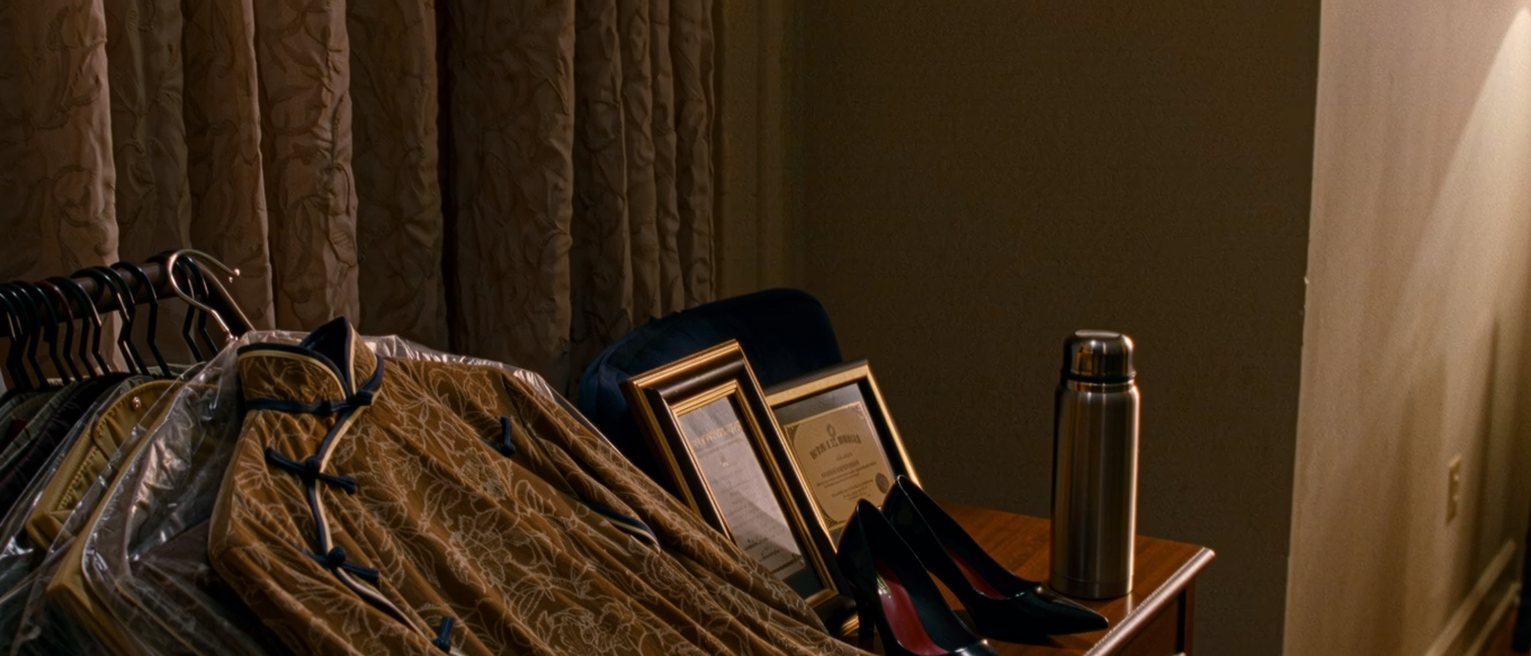
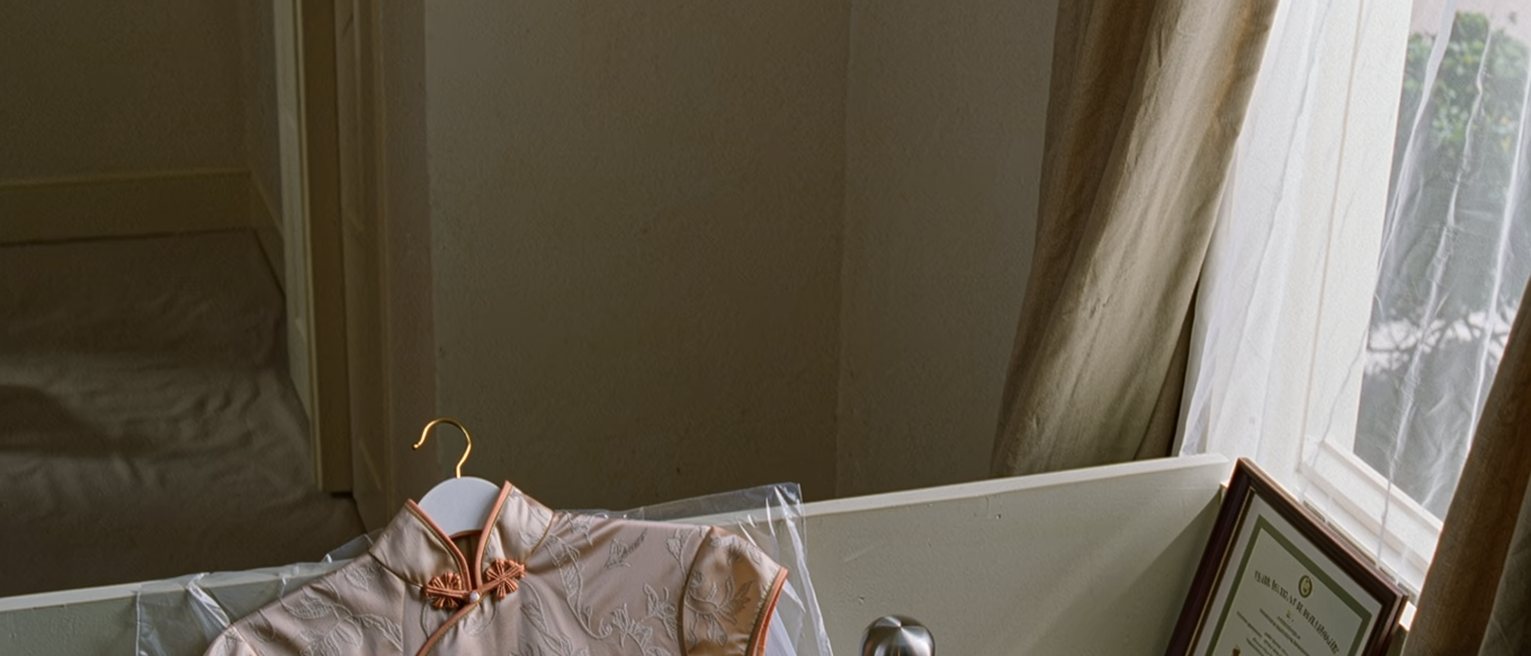
Maggie Cheung’s character appears throughout in a succession of closely fitted cheongsam, high-collared and changed constantly, designed by William Chang Suk-ping, who also did the film’s production design and cut it. The wardrobe is among the most celebrated in modern cinema and deserves to be. It is extraordinary work, and it was awarded as such: Best Make Up and Costume Design at the Golden Horse Awards, Best Costume and Make Up Design at the Hong Kong Film Awards, and at Cannes a share in the technical prize.
Notice what all three of those are. They are awards to the designer. They are correct awards, given to the right person for the right thing, and there is no injustice anywhere in them.
The trouble is downstream, in the vocabulary that a celebrated wardrobe makes available to anybody who needs a sentence about the woman inside it. The sentence is sitting there, pre-formed, and it is a sentence about surface. She is luminous in them. She glides. She seems poured into them. The colours track her interior state. Every one of those is a compliment, and not one of them is a description of a performance. They describe an image and treat the woman as the image’s content.
There is a specific physical irony in this that almost never gets said out loud. A garment cut that closely is a constraint on a body. It sets the length of a stride, the angle at which a shoulder can move, what can be done with the arms, how a person must sit down and stand up, how fast a staircase can be climbed. To act inside such a garment is to act against it, continuously, while making the effort invisible. The costume that is credited as the film’s beauty is simultaneously the problem the performance had to solve, and the solving is exactly the part that disappears the moment the dress is described as doing the expressive work.
That is the ordinary shape of the substitution, and it is not confined to this film or to clothes. Praise attaches to the object. Agency drains away from the person standing nearest to it.
Who is read as the agent of their own stillness
The film is a good instance rather than a special case, and the mechanism it exposes does not stay in cinema.
The general form is this. When a person does nothing visible, an observer has to decide whether the nothing is a decision or a disposition. That decision gets made before any evidence arrives, and it gets made on the basis of what the observer already expects the person to be there for.
A man who says little in a meeting is measured, and the silence is read as selection among the things he could have said. A woman who says little in the same meeting is quiet, and quiet is a property rather than an act. A man who does not react to a provocation has self-control. A woman who does not react is poised, or is good with people, or is good at her job in the sense that a surface is good. A man keeping a difficult feeling off his face is being professional. A woman doing the identical thing is often not perceived to be doing anything at all — which is precisely why the labour of it goes unnamed, and why work that is not perceived as work cannot be credited, cannot be priced, and cannot be refused.
There is a second cost, subtler than the first and harder to get out of. If your stillness is read as your nature, you are not permitted to stop. A decision can be reversed; a temperament cannot. The man whose restraint is read as a choice retains the option of choosing otherwise, and when he takes it the change is legible as a further decision, possibly a dramatic one. The woman whose restraint has been reclassified as composure has no such exit. When she stops being composed she has not made a choice. She has come apart, and the vocabulary waiting for her says so.
That is the argument this essay is actually making. The award record is only the place where it happened to leave a document with names and a date on it.
What this Library has already established, and where it stopped
This is not a new subject here, and the honest thing is to say exactly how much of it was already done by earlier work rather than let the present essay appear to have found it.
The essay published as being-seen-not-available worked through the difference between attention that treats a woman as a specific person and attention that treats her as an interchangeable instance of a category, and it located the whole difference in authorship: an object can be inspected from every angle and still have no say in what the looking means. It also made the correction that matters most here — that women have never been simply passive recipients of a look, only sometimes denied credit for the active management they were already doing. That sentence is the hinge of the present essay. All this one adds is a case where the denial of credit was written down.
The essay on Portrait of a Lady on Fire, published as portrait-gaze-without-possession, pressed further and drew the line in the right place: being looked at is not a passive condition and is not intrinsically diminishing. What diminishes is being looked at inside an arrangement in which you cannot look back, cannot comment, and have no standing to correct the account being formed of you. An award record is an account being formed of you, in public, by people you will never meet, which you have no standing to correct.
The essay published as looking-sexy-and-feeling-sensual established the cost of occupying the observer position at all: attention has a single location, so modelling how one appears and inhabiting what one feels trade one-for-one, and a woman can do the first beautifully for an entire evening and come away with no information about the second. The present argument is the institutional version of that trade. When a performance is described as an image, the performer is moved into the observed position by the description itself, whatever she was actually doing.
And the essay published as what-the-camera-looks-at traced how a single legal constraint — a prohibition on showing one thing — pushed an entire genre’s camera onto the face, and so reorganised what its performers were being asked to do and what viewers learned to read as content. That finding is this one arriving from the opposite direction: what a frame is permitted to show determines what counts, inside it, as a performance at all.
What none of those essays had was an instance where the failure to credit was dated, signed and filed by an institution. That is what an award record is. It is a rare object in this subject: a moment when the distribution of credit stops being a matter of atmosphere and becomes a document.
The counter-reading, at full strength
Now the case against this essay, made as well as it can be made, because an argument built on a single award outcome has more than one way of being wrong.
First, and strongest: the two roles are not symmetrical. Chow is given more to do. He has a workplace, a colleague, a second city, a serial he writes, a sequence of departures and arrivals, and a final movement that belongs to him alone. Su Li-zhen has less scripted material and carries fewer scenes on which the plot turns. A Best Actor award may therefore be tracking screen material rather than gendered reading — more scenes, more registers, more visible variety, simply more for a jury to point at. That is a complete alternative explanation, it requires nobody to have read anything through any lens, and an essay that passed over it would be dishonest.
It has a sting in the tail, which this essay accepts rather than deflects. The earlier Library piece on this film already recorded the feminist critique that Su Li-zhen’s interiority is gestured at through composition and costume but rarely granted the direct access the film grants Chow’s perspective. If that critique is right, then the film itself allocated her less, and the award may be reporting the screenplay accurately rather than misreading the performance. The pattern this essay describes and the pattern that critique describes are not the same pattern, they push in the same direction, and they are extremely difficult to separate from outside.
Second: she won. At Golden Horse she won Best Leading Actress and Tony Leung, the favourite, lost. At the Hong Kong Film Awards she won and so did he. So restraint performed by a woman was read as acting — twice, by two different juries, for this exact performance, in the same award season. What differed was which juries were watching. That may say something about international legibility, about subtitles, about what survives translation and what does not. It may equally say something about home-market recognition of an actress who had already been honoured three times in that category at Golden Horse alone before this film, which is an entirely different mechanism and one that gives this essay no support at all.
Third: awards are a terrible instrument for measuring anything. They are produced by small groups under time pressure, shaped by campaigning, by conventions against concentrating prizes on one title, by who saw what on which day and in what mood, by the chemistry of a particular room. They measure a decision, not a quality. This essay is reading a very noisy signal, and it has one data point, and one data point cannot establish a pattern. If the argument rested on the award, the argument would be worthless.
Fourth, and aimed inward: a publication that has already concluded women are under-credited will find under-crediting everywhere, including in outcomes with ordinary explanations. That risk is live here. The award is doing rhetorical work in this essay that a single jury decision cannot carry on its own, and a reader who suspects the conclusion preceded the evidence is entitled to the suspicion.
Why a noisy instrument is still worth reading
So why run the argument at all, having conceded that much?
Because the prize is not the evidence. The prize is the occasion. The evidence is the vocabulary that gathered around the two performances afterwards, and that anybody can still check, because it is lying about in twenty-five years of published writing about this film.
Read that writing and a pattern is visible that has nothing to do with any jury. When the man is described, the sentences are about what he does: he holds, he withholds, he does not react, he gives away almost nothing. When the woman is described, the sentences are very often about what she is and what is around her — the dresses, the light, the slow shots of her on the stairs, the beauty of her bearing, the way the colours move with her. The first vocabulary contains a verb with her counterpart as its subject. The second frequently does not contain a verb she is performing at all.
That asymmetry needs no jury and cannot be explained by screen time, because it operates at the level of the sentence rather than the level of the ballot. The award is useful here only because it dates the habit and puts an institution’s name on it. A habit of description is hard to argue about; a habit of description with a receipt attached is at least arguable.
And the reason to press it rather than let it go is that the habit does not stay in film criticism. It is the ordinary mechanism by which the labour of holding oneself together gets converted — in an office, in a family, in a marriage, in an evening bought and paid for — into a fact about somebody’s personality. Which is the exact point at which it stops being credited and starts being expected.
What this house sells, and why it is the wrong party to make this argument
This house sells private companionship: bounded, scheduled, paid for. And before anything else in this section, it should be said that the argument above runs against the way this house makes its money.
Part of what is bought in an evening here is the experience of being looked at well. The house produces images. It writes about beauty. Its entire commercial instinct, when a woman is composed and lovely and still, is to praise exactly that — to call her luminous, to photograph the light and the room and the clothes, to treat the surface as the product, because the surface is what photographs. Which is precisely the move the preceding sections have been calling a substitution. A publication attached to a business that profits from composure being read as beauty is not a neutral party to the question of whether composure should be read as work.
There is a second problem, and it is worse than the first. Part of what this house actually sells is a woman’s labour of attention: the managing of a room, the holding of a mood, the not-reacting to something clumsy, the continuous small decision not to say the obvious thing — performed well enough that it is not noticed as performance. That is the invisible restraint this essay has spent its length defending, and this house has a direct commercial interest in it staying invisible. The moment a client perceives it as work, he begins to price it. The moment he perceives it as her nature, he gets it for nothing. We are describing, with some feeling, a mechanism from which we benefit.
Only two positions are honestly available, and neither of them is a claim about outcomes. The first is that we say this out loud, in the body of an essay, where it costs something. The second is that we decline the compliment that does the damage: not to describe a woman as decorative when what she is doing is difficult, and not to accept an account of an evening in which the only agent in the room is the person who paid for it.
We will not get either of those right reliably. They are stated intentions, not achievements, and a reader who concludes that this section is a way of collecting credit for having a conflict of interest is reading it accurately enough for the purpose.
What this does not claim
This essay is cultural analysis. It is not clinical, diagnostic or therapeutic, it describes no treatment, it promises no outcome, and it diagnoses nobody. Nothing in it is a statement about any reader.
It does not claim that the 2000 Cannes jury, or any member of it, was sexist, held any view about women, or acted on any prejudice. Jury deliberations are private and unrecorded, and nothing here is offered as an account of them. The argument concerns a habit of description in the surrounding culture, not the intentions of ten named people, and the composition of that jury is reported from a reference compilation rather than from the festival’s own record, which could not be retrieved.
It does not claim that either performance is better than the other, or that any award should have gone differently. No ranking of the two performers is offered or implied, and both are treated as having done difficult work well.
It makes no claim about the number of garments worn in the film. Figures circulate widely and could not be traced to any reliable reference, so no figure is stated. It also makes no claim about why the film credits two cinematographers; a common account exists and could not be verified, so it is not asserted.
The statement that a closely fitted garment constrains movement is a description of a kind of clothing and of what acting inside it requires. It is not a report of anything any performer has said, and no performer’s experience, opinion or inner life is presented here as established fact.
Nothing here should be read as an endorsement of, or by, any named performer, director, designer, festival, award body or publication. None of them has any connection to this house, and none has been consulted.
The generalisation about who is read as the agent of their own stillness is this Library’s argument, not a measured finding. No statistic, proportion or prevalence is claimed for it anywhere, it describes no individual, and a reader who recognises nothing of it in her own life is not being described.
The plot of the film is given in outline only, no dialogue is quoted, and characters are referred to by situation or by the names the film gives them. The readings of the film in earlier Library essays are cited as this Library’s own prior work, and they remain interpretations rather than facts about the film.
This house’s commercial interest in the subject is stated in the body of the essay rather than only here, because a declaration that arrives after the argument has finished working is not a declaration. Stating it does not neutralise it.