Moonlight Journal
The Space Was Part of the Composition
Margin in a relationship is not the time left over once the obligations are met. It is a designed element, and most modern relationships have quietly eliminated it while believing they were only becoming closer.
Eleven years. Two adults who like each other, who have not had a serious argument in a long time, and whose Sunday is fully allocated by nine in the morning: the shopping, her mother, the thing with the car, an hour that has been designated for talking about the move, and in the evening a series they are watching together, which they are enjoying, and which occupies the part of the day that used to be nothing in particular.
Nothing is wrong. That is the difficulty. If something were wrong there would be a subject, and a subject can be discussed. What there is instead is a quality of airlessness that neither of them can name without sounding ungrateful, and which surfaces as a small, unattributable irritability at about four in the afternoon.
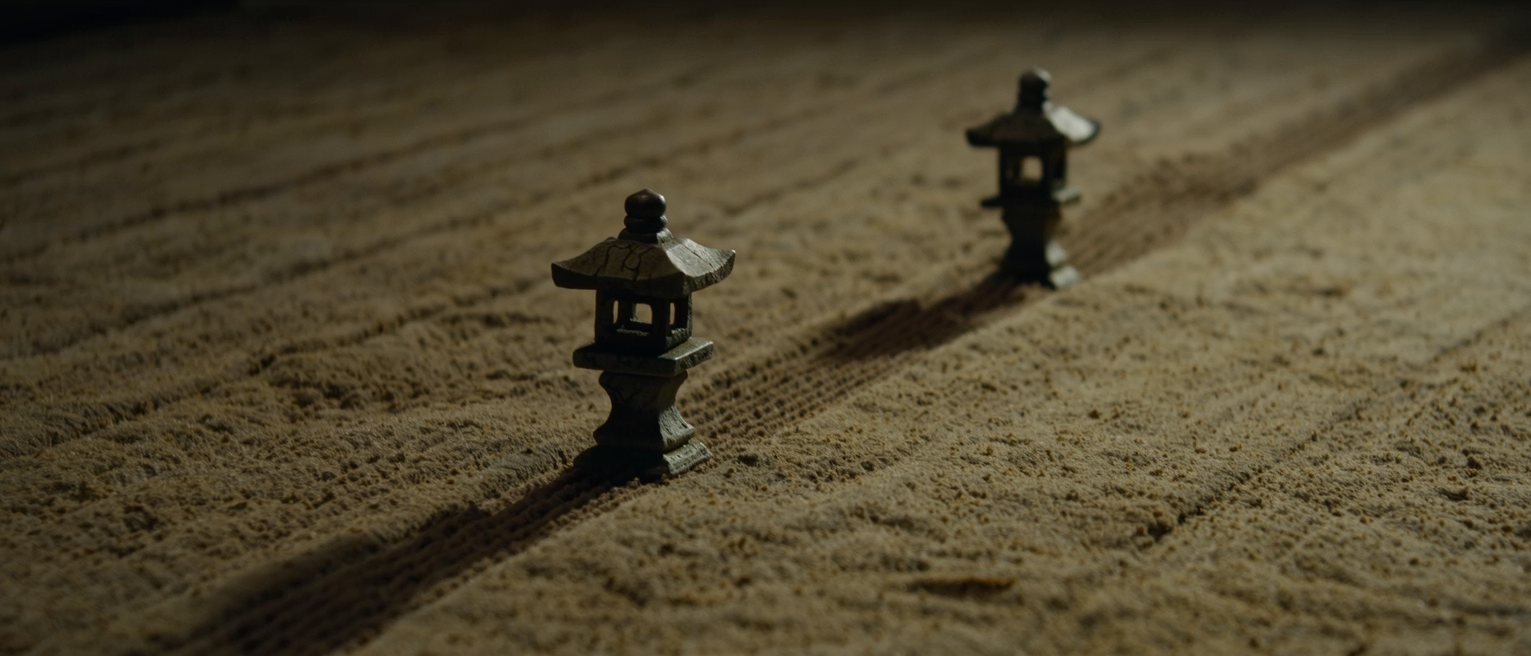
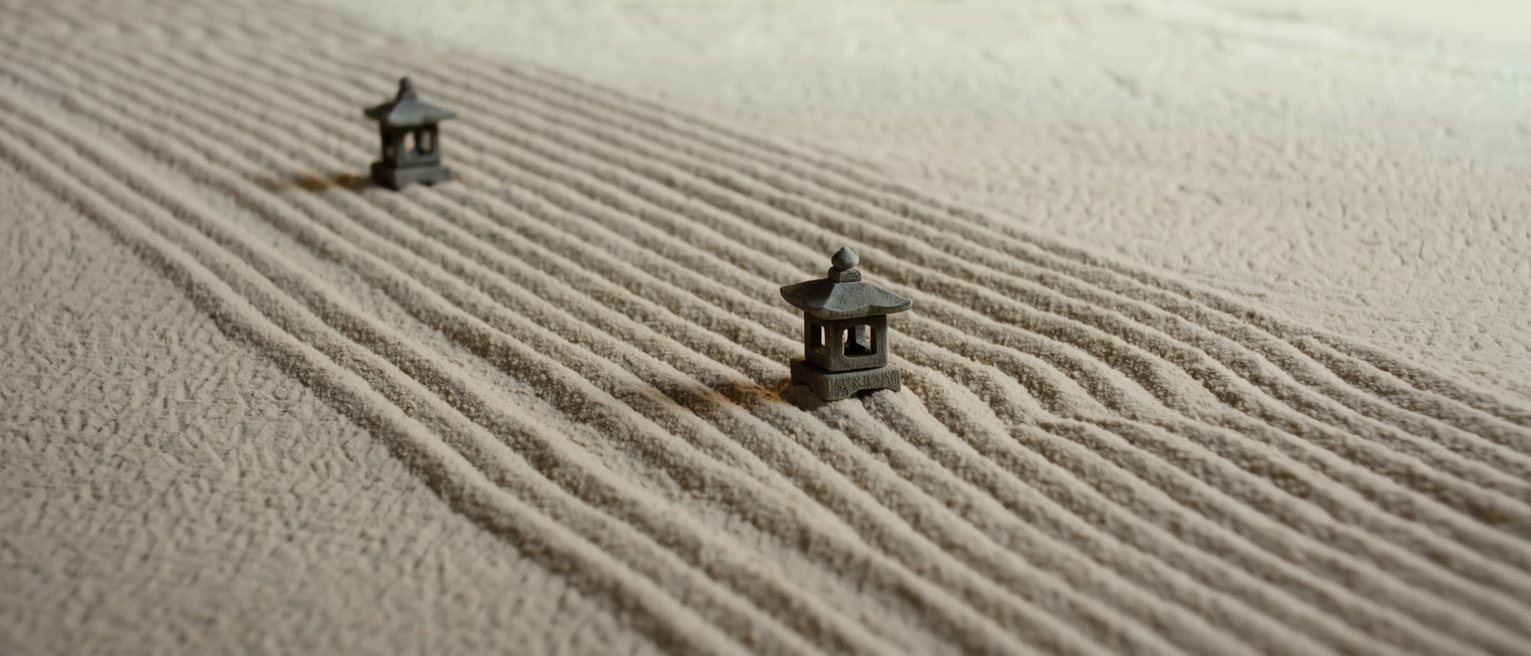
They do not have a communication problem. They communicate constantly. What they have run out of is margin: the unallocated part of a shared life, which is not the leftovers and is not free time and is not a gap in the schedule. In ink painting and in calligraphy the unmarked area of the paper is composed. It is chosen, bounded and load-bearing, and removing it does not give you more picture. It gives you a worse one.
What 余白 actually means
Japanese distinguishes two things that English tends to fold together. 空白 is a blank: an absence, a gap where something should be, a vacancy. 余白 is a margin: the unmarked area of a composed surface, which the composition requires and which the maker positioned as deliberately as any brushstroke. A page can have both. They are not the same and they do not feel the same.
This is not decorative vocabulary. A calligrapher does not fill the paper and then stop when it is full; the placement of the character is a decision about where the emptiness will be, and a work in which the emptiness has been squeezed out reads as crowded regardless of how good the individual strokes are. The unmarked area is not what is left. It is what makes the marked area legible.
Tanizaki Junichiro made the aesthetic case for this most famously in 陰翳礼讃, published in 1933, arguing that a great deal of what is beautiful in Japanese material culture depends on partial illumination: lacquer designed for candlelight rather than electric light, the recessed alcove, gold that is meant to gleam intermittently out of darkness rather than to be seen entire. His central claim is that certain qualities exist only under incomplete information and are destroyed by resolution rather than revealed by it. Turn the lights up and you have not finally seen the bowl. You have ended a different bowl.
That essay has to be introduced with its problems attached. It is a personal essay rather than scholarship, nostalgic to the point of romanticising material conditions that were also simply inconvenient, and it is written in a period register that treats “the Japanese” and “the West” as coherent essences in a way nobody would write now, at a moment when that framing had political uses. It is worth reading and it is not an authority on anything except its author’s eye. What survives all of that is the formal insight, which is transferable: some qualities are not preserved by full disclosure, because full disclosure removes the condition they were living in.
A film built entirely out of what is withheld
Lost in Translation, written and directed by Sofia Coppola and released in 2003, puts Bob, an ageing American actor in Tokyo to film a whisky commercial, and Charlotte, a young woman accompanying her photographer husband, in the same hotel, and gives them a few days of each other’s company. The relationship is defined almost entirely by what does not happen and what is not said, and the film’s most discussed moment is a final line the audience cannot hear. The withholding is not coyness. It is the method: the film declines to resolve, and the refusal is what the thing is made of.
The objections are serious and belong in the body of this essay rather than at the end of it, particularly in a publication read in Japan. The film’s Tokyo is a backdrop for two Americans’ alienation, and its Japanese characters function largely as comic texture, incomprehensible surfaces against which the leads feel adrift. That criticism has been made consistently since release and it is correct. A Japanese reader is entitled to find the film’s treatment of her country tiresome and to be right about it, and nothing in the formal point below requires accepting the rest.
What it supports, and it is worth separating cleanly, is not an observation about Japan. It is a demonstration that a relationship can be substantially constituted by its margin, and that the intensity of the connection is not reduced by the withholding but produced by it. The two of them are not failing to say the thing. The unsaid thing is where the relationship is.
Classification: fiction, American, written and directed by an American about Americans abroad, with a documented and legitimate criticism of its treatment of its Japanese setting. It establishes nothing about intimacy generally. Director and year are from memory and should be verified before this piece is marked fact-checked. The spoiler boundary is the premise and the existence of the inaudible line, not its speculated content.


How the margin was removed without anybody deciding to
Nothing here is a claim that things were better before, and the mechanism is not mysterious. Four ordinary developments, each of them individually good, removed the margin between them.
Continuous contact. The default assumption is now reachability, and the interval between seeing someone has effectively closed. That interval used to do real work: it was where a person reassembled themselves, had experiences the other one was not present for, and generated the thing there was to say next. When the interval disappears there is no accumulation, which is one reason two people in constant contact can find they have nothing to talk about, having already reported everything within four minutes of it happening.
The shared calendar. Once time is visible it becomes allocable, and once it is allocable, unallocated time starts to look like waste. A blank Saturday in a shared calendar is not read as margin. It is read as an opportunity that has not been used yet, and it attracts a plan.
The norm that everything should be discussed. Communication is good and this publication has argued for it repeatedly, including against the Japanese habit of leaving too much to inference. But there is a further norm, arrived at by way of a popularised therapeutic vocabulary, which holds that a feeling is not fully legitimate until it has been narrated to a partner. That is a different proposition and it has a cost: it converts private interior life into shared administrative material, and it leaves a person with nothing that is only theirs, which is not intimacy but a kind of merger.
And the disappearance of separate rooms, separate friendships, separate errands. Much of the margin in older arrangements was not chosen at all; it was a by-product of inconvenience. When the inconvenience went, the margin went with it, and nobody noticed because nobody had ever named it as a thing they had.
The distinction this whole essay depends on
Here is where an argument like this usually goes wrong, and it is worth being blunt about it. A marriage in which nothing is said is not an ink painting. Japan produces a great many relationships that are full of silence, and the overwhelming majority of that silence is 空白 rather than 余白: not composition but accumulation, not restraint but avoidance, not margin but a subject that has been left alone for so long that approaching it now would require an occasion neither party will create.
This publication has argued at length against relationships run on inference, and none of that is being retracted here. So the distinction has to do real work rather than being a nice piece of vocabulary, and three tests separate the two.
The first is shape. In 余白, the silence has an outline: both people could tell you roughly what is not being discussed and why, and the reason is something like 「that is his to have」 rather than 「we cannot go there」. In 空白, nobody can describe the shape, including the people inside it. A margin you cannot describe is not a margin. It is a hole with a nicer name.
The second is choice. Margin is positioned. Blank is what remained after avoidance. The practical version of this question is simply whether either of you would say, out loud and without an argument starting, that this is an area you have deliberately left alone. If saying that sentence is itself impossible, the answer is already in.
The third is reversibility. Composition is enterable at will: a person can walk into the unmarked area, ask the question, raise the subject, and the relationship absorbs it as an ordinary event. A blank is defended. If entering would cost a scene, a week of coldness or a negotiation, then it is not space. It is a wall that has been described as space by two people who would each rather not test it.
Any silence that fails all three tests is not what this essay is recommending, and reading it as permission would be reading it exactly backwards.
What margin looks like on an ordinary week
Unassigned time that is not a date. The defining feature of a date is that something is expected to happen and can therefore go well or badly. Margin is the opposite: a stretch in which nothing is expected, no one has prepared, and it is entirely acceptable for it to amount to nothing. Most couples have not had one of these on purpose in years, because unassigned time feels like a wasted opportunity when the calendar is visible.
Solitude that is not a grievance. One person going somewhere alone without it being an event, a statement, or a thing requiring an explanation afterwards. The tell is whether the returning person is asked to account for it. A partner who is asked to give a report of their solitude did not have any.
Experience that is not narrated. Something a person did, enjoyed, and simply did not mention, not as concealment but because not everything has to become shared material. This is the one most likely to sound like a warning sign, and the difference from concealment is straightforward: concealment is about the other person, and would be damaging if discovered. This is about having a life whose every hour is not a deliverable.
A question deliberately not asked. Knowing a thing is available to be known and choosing not to open it, as a form of regard rather than of distance. This is the most difficult of the four in a culture of transparency, where restraint is easily read as indifference, and it only works when both people understand it as a gift rather than as a retreat.
The honest problem is that all four are indistinguishable from neglect when observed from outside, and sometimes from inside. That is precisely why margin cannot be unilateral. Composition requires two people who know the space is composed, which means the only way to have it is to have said so once, plainly, in words, which is a slightly absurd requirement for a thing made of silence and is nevertheless how it works.
The commercial version, and why it is not the point
There is a version of this argument that ends with a recommendation to buy something, and it would be easy to write. An evening with a stated end is margin by construction: it is bounded, so what happens inside it makes no claim on the rest of the week; it is not narrated to anyone; nothing is expected to accumulate. Everything in this essay could be pointed at that conclusion in about three sentences.
It should not be, and a business that sells time to women has an obvious and disqualifying interest in persuading them that their marriages are airless. So the point is stated the other way round. A reader who finishes this and books nothing, and instead takes three hours on a Saturday that are not allocated to anybody, tells no one what she did with them, and finds them pleasantly uneventful, has understood the argument completely and has done the thing it recommends.
The only claim worth making from this side is a narrower and less flattering one: bounded time is easier to obtain commercially than domestically, which is a fact about how households allocate hours rather than a virtue of any service. It is worth noticing that a person often has to leave a relationship’s physical space to find margin inside her own week, and worth asking why that is, and the answer is usually that the calendar at home has no category for time that is not for anything.
The limits
Tanizaki is a personal essay by an author with a particular eye, aestheticised, nostalgic, and written in a period framing that essentialises national character. It is used for a formal insight and is not evidence of anything about Japanese psychology or about relationships.
Nothing here romanticises silence, and the 余白 and 空白 section exists specifically so that it cannot be read that way. A relationship in which important things go unsaid because saying them is unsafe is not being praised, and this Journal’s arguments against inference stand unaltered.
The distinction between margin and blank is offered as a usable one, not a validated one. The three tests are practical heuristics derived from the concept, not instruments, and reasonable people will place particular silences differently.
And a great many people genuinely prefer continuous contact, full disclosure and a fully allocated week, and are not suffering from anything. The argument is about a default that arrived without being chosen, not about a preference that was.
Back to the Sunday. What would help is not a conversation about the relationship, which would be one more allocated hour, and not a holiday, which would be allocated more thoroughly than an ordinary week.
What would help is that at some point in the afternoon there is a stretch with nothing in it, that neither of them fills, and that neither of them treats as a problem to be solved by suggesting something. It will be uncomfortable the first few times, because unallocated time in a shared space feels like a question, and both of them will reach for the phone.
The unmarked part of the paper is not the part where nothing happened. It is the part the maker left, on purpose, so that everything else could be seen. Two people who have spent eleven years filling the page have not been careless. They have been diligent, in the way people are diligent about things they were never told were optional.