Books
Earthlings, the Factory, and the Refusal That Is Not a Lifestyle
A girl of eleven looks at her town and calls it a factory for making people. Murata Sayaka’s 2018 novel treats that as a description rather than an image, and then follows it past the point where a reader can stay comfortable. A reading of why the last act is neither a failure of nerve nor a stunt, and why a reader who cannot follow it there has not misunderstood the book.
There is a word in this novel that a reader can walk straight past. A girl of eleven looks at the town she lives in and calls it a factory. Not a town with factories in it. A factory: one machine, with one product, and the product is people. Human beings are manufactured in it, raised to specification, shipped out at the appropriate age, sorted into pairs, and set to work producing the next batch. She includes herself in the description. She is a component, and she knows what components are for.
It is easy to file that as a child’s exaggeration, or as the kind of image a novel supplies to let you know that its narrator is unhappy. The book does not let it stay filed. The Factory is not decoration, and it is not a metaphor the reader is invited to admire for a moment and then set down. It is offered as an account of how things actually are, and everything that follows in the novel behaves as though the account were correct.
That is the argument here. Murata Sayaka’s Earthlings is a book about what follows from taking its own central description literally. The violence that readers have found hardest to forgive is not a lapse of judgement late in a good book. It is the bill for the premise, presented in full, and the novel’s refusal to discount it is the most serious thing about it.
Two things should be said before the argument starts rather than in a note at the end. First: this novel depicts the sexual abuse of a child, and this essay will name that as abuse, describe it as the book’s content, and decline to use it as an illustration of anything. Second: the argument cannot be made without discussing the general shape of the ending. Nothing is quoted from the novel and no scene is narrated in detail, but a reader who wants the last act to arrive unannounced should stop here and come back afterwards.
The record, and what Murata has actually won
Murata Sayaka was born in Chiba prefecture in 1979. Earthlings first appeared in the literary magazine Shincho, in the May 2018 issue, and was published in volume by Shinchosha on 31 August 2018 in a 248-page hardback. A Shinchosha bunko edition followed on 27 March 2021. The English translation, by Ginny Tapley Takemori, was published as Earthlings by Granta in the United Kingdom and by Grove Press in the United States, the Grove edition dated 6 October 2020. Takemori had already translated Convenience Store Woman into English in 2018, so the two books reach Anglophone readers in the same voice, which matters more than it sounds.
The prize record is worth stating precisely, because it is often reported loosely. Murata’s debut work took an excellence award in the 46th Gunzo Prize for New Writers in 2003. She won the 31st Noma Prize for New Writers in 2009. She won the 26th Mishima Yukio Prize in 2013, having been a candidate for that prize three times previously, in 2009, 2010 and 2012, and not won it. She won the 155th Akutagawa Prize in 2016 for Convenience Store Woman. In 2025 she won the 78th Noma Literary Prize.
Earthlings itself won nothing. Prize databases record it as a candidate for the 35th Oda Sakunosuke Prize in 2018, which is a candidacy and not an award, and this Library has found no record of a Japanese literary prize going to the book. Abroad it did well on lists rather than juries: TIME placed it among its 100 Must-Read Books of 2020, and Shinchosha’s own press office recorded its selection by the BBC among the best books of that year so far. Lists are not prizes, and a publisher’s press release is a promotional document; both are reported here as what they are.
That gap is itself informative. The novel that made Murata internationally legible was the one before this. The novel that states her position most completely is this one, and the institutions that had been rewarding her did not reward it.
A metaphor you can put down, a description you cannot
The difference between a metaphor and a description is what each one asks of you.
A metaphor asks you to notice a resemblance. Society is like a machine: yes, in certain respects, and the pleasure of the observation is that it is partly true and partly not, and you can hold the partly not in reserve. Having noticed, you are free to put the image away and carry on inside the thing you have just compared to a machine. Almost all social criticism in fiction works this way, and it is why so much of it is comfortable. The reader gets the satisfaction of a sharp description plus the reassurance that a description is only a description.
A description works differently. If the town really is a plant for manufacturing human beings, then a set of consequences follows and they are not optional. Your body is equipment. Your attachments are scheduled inputs. The affection of your family is quality control. Marriage is an assembly step, not a private matter that happens to be common. And the question of what you should do about it is no longer a matter of taste, because you do not have an aesthetic disagreement with a factory. You are either working in it or you are not.
Earthlings takes the second road. Natsuki does not deploy the Factory as a witticism and then get on with an ordinary life. She uses it as a working model of her situation and acts on it, and the novel neither corrects her nor rescues the reader by supplying a saner narrator who knows better. There is no character standing slightly outside the book to say that things are more complicated than that. The account holds, and the plot is the account being carried out.
This is the point at which most readings of the novel soften. It is very tempting to say that the Factory is a powerful image for social pressure, that Murata is exaggerating for effect, and that the real subject is loneliness or conformity or the position of women in a demanding society. All of that is true and none of it is enough, because every one of those formulations reinstalls the escape hatch the book took out.
This Library has read Murata twice already, and this is a different book
Two essays in this Library have already been written about Convenience Store Woman. One reads the novel as a study in performing normality, working through the store’s manual, the coworkers whose speech and clothes Keiko copies, and the man who arrives to tell her what a life like hers is worth. The other reads it as a book less about Keiko than about the people around her, and about the way concern for someone can take the shape of a demand that she be fixed. They are good arguments and this essay does not restate them.
It is worth being exact about the difference, because the two books are routinely discussed as a pair and the pairing usually flattens them.
Keiko Furukura wants to be a usable component. That is the striking and easily missed fact about her. The store gives her a manual, a uniform, a script, a schedule for her body, and a place in a system that tells her exactly what she is for, and she finds this not oppressive but a relief. Her problem is not that she has been assigned a function. Her problem is that it is the wrong function: the world will accept her as a worker only if she is also a wife, a mother, or at minimum a person on the way to becoming one. She is punished for being the wrong kind of usable. Her novel is therefore, in the end, a book about fit, and it can close on a note that is almost triumphant, because there exists a place where she fits.
Natsuki does not want to be a component. She has not misread her assignment; she has declined the entire arrangement under which assignments are made. Nothing in the Factory can be adjusted to accommodate her, because what she objects to is not her position in it but its existence. And a novel whose protagonist refuses in that way cannot end the way the other one does. There is no shelf she can be put on. The earlier book asks whether a person can find a liveable spot inside the arrangement. This one asks what is actually involved in stepping outside it, and then declines to pretend that the answer is manageable.
That is the whole distance between the two books, and it explains why readers who loved the first often feel betrayed by the second. They have not encountered a writer who lost control. They have encountered the same writer following the same observation to a different depth.

What is done to a child in this book, said plainly
Natsuki is eleven in the early sections. A teacher at her cram school sexually abuses her. That is what it is, and the sentence does not need adjusting: an adult with authority over a child used that authority to harm her. Published reviews of the novel in both languages describe this material, and Murata has said in a Japanese interview that it was a painful subject to write and that she had approached it only lightly in earlier work before facing it directly here.
Three refusals apply for the rest of this essay.
It will not be aestheticised. There is a habit in literary writing of treating depicted harm as a texture — the darkness at the heart of the book, the unflinching gaze, the courage of the prose. That vocabulary converts an injury into an effect, and once an injury has become an effect it can be praised. This Library will not praise it.
It will not be used as evidence. The temptation, given the argument above, is obvious: here is the Factory failing at its own task, an institution built to process children unable to register a child being harmed inside it. The observation is available and it is even accurate as a description of what the book shows. It is still not a licence to make the abuse of a child into an exhibit in an argument about society, and this essay declines the trade.
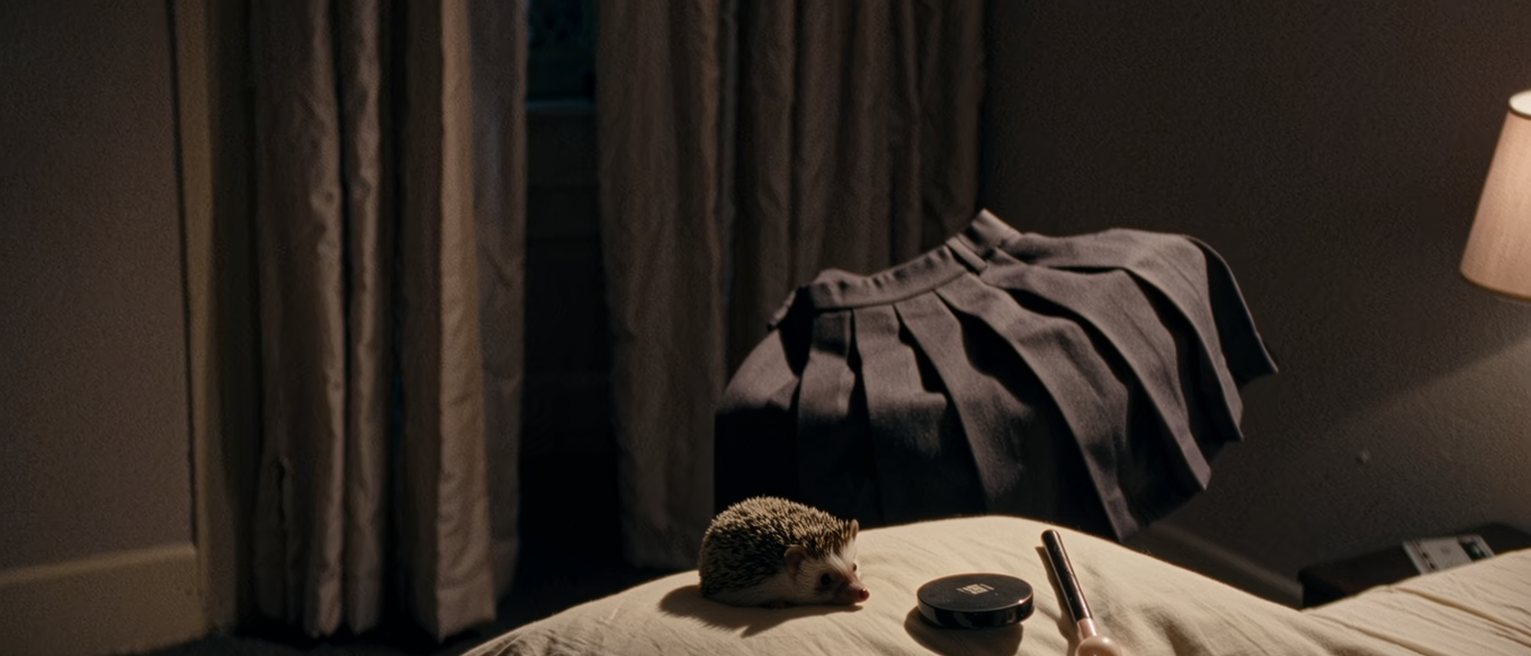
And it will not diagnose anyone. Natsuki afterwards holds more tightly to the story that she is not from this planet, that a plush hedgehog is an emissary from elsewhere, that she has work to do that the people around her cannot see. Readers and critics have reached for clinical language about this, and some have reached for it about her cousin too. This essay will not. What the novel shows is a child who was hurt and who kept a story; naming that story with a diagnosis adds nothing a reader needs and takes something from a character the book deliberately keeps unclassified.
The one thing worth saying is the simplest. The adults in the book do not see it. Not one of them looks at her and asks the question that would have opened the matter. Whatever else the Factory is, it is a system with no inspection step at the point where it matters most, and the novel establishes that early and without commentary.
A marriage as a compliance document
The adult section of the novel contains the coldest joke Murata has written, and it is a joke about paperwork.
Natsuki marries. Her husband shares her view of the arrangement almost exactly; the marriage is contracted between two people who want the same thing, which is to be left alone. There is no romance in it and no pretence of any. It is an agreement to present the correct exterior so that two sets of relatives will stop asking, stop worrying, stop reaching. They will look married. They will therefore be left in peace.
Read one way this is very funny, and reviewers have found it so. Read another way it is the single most damning thing in the book. What the two of them have discovered is that the Factory does not actually require the product. It requires the documentation. Nobody is checking whether a marriage contains affection, desire, or anything at all; the family gathering wants a form correctly filled in, and once the form is in order the pressure lifts. A system that cared about people would notice the difference between a marriage and an alibi. This one does not, because it was never looking at people.
It is also the last place in the novel where a reader can be comfortable. The arrangement is recognisable. A good many adults have made some version of it, in smaller denominations: the plausible answer kept ready for the holiday table, the partner produced at a wedding, the vagueness maintained for a parent’s benefit. Up to this point the book is a satire that a reader can enjoy from a safe distance, because the compromise on offer is one most people could imagine making.
And that is precisely why the novel does not stop there. An alibi is not an exit. The two of them are still in the Factory, running a small deception inside it, and the deception costs them the thing they were trying to protect. The next movement of the book asks what it would take to actually leave.
Why the last act cannot be a tidy alternative
Here is the test the novel sets itself, and it is a rigorous one.
If the Factory description is accurate — if this society exists in order to produce workers and children, and treats persons as components in that production — then leaving it cannot look attractive. It cannot look like moving to the countryside, growing vegetables, keeping bees, finding a gentler community with better values. Every one of those is a transfer within the same system: a different department, a lower floor, a quieter shift. If the exit were pleasant, the premise would be false, because a machine that permits a comfortable exit was never the kind of machine Natsuki said it was.
So the novel does the only honest thing available and follows its three characters out. They go to the mountain house in the country, the place where the summers of the first section happened, and they attempt to live outside the categories entirely. Not outside one norm, or a few: outside the whole apparatus by which a person is issued with a role. What may be eaten. What a body is for. Who counts as kin. Which forms of touch exist. Each of these turns out to be a component of the same system, and each is discarded in turn.
What results is a final act that includes killing and includes the eating of human flesh, and it is written in the same untroubled, matter-of-fact register as the rest of the book. Reviewers have consistently noticed the flatness of the prose at exactly the point where a novel would normally raise its voice, and that flatness is not an oversight. A horrified narrator would have restored the moral frame the book has spent three hundred pages removing.
It is worth saying clearly what this essay claims about that ending, because the claim is contested.
It is not a failure of nerve. A failure of nerve would be the opposite move — a last-minute retreat into a liveable compromise, a reconciliation, a suggestion that the Factory can be negotiated with after all. That book would have been far more popular and would have falsified its own premise in the last twenty pages.
And it is not a stunt. A stunt is an effect detached from an argument, escalation performed because escalation is memorable. What happens at the end of Earthlings is entailed by what the novel established at the beginning. If human beings are components, then the categories that govern them are manufacturing conventions, and a person who genuinely rejects the manufacture has no principled reason to keep any of the conventions, including the ones the reader most wants kept. The last act is the premise being paid for in full, in public, with nothing held back to make it bearable.
Whether that is a good thing to have written is a separate question, and the answer is not obviously yes. But the objection to it has to be the right objection. A reader may argue that the premise was wrong, or that a novelist owes her reader something the novel refuses. A reader cannot argue that the book lost its nerve, because losing its nerve is the one thing it conspicuously did not do.
The reader who stops, and is not wrong to
Having said that, the essay owes something to the reader who cannot go there. That reader is not a minor case to be handled with a sentence.
There is a style of literary argument that treats a reader’s revulsion as a failure of sophistication — as squeamishness, as literal-mindedness, as an inability to distinguish depiction from endorsement. It is a cheap move and it is usually made by people who are not upset, about people who are. Declining to follow a book is not the same as failing to understand it. It is entirely possible to grasp the argument set out above, to accept that the ending is entailed rather than gratuitous, and still to close the book, because being convinced that something is coherent is not the same as consenting to spend an evening inside it.
There is also a version of the objection that is not about squeamishness at all. A reader may hold that a novel which removes every constraint in order to test a thesis has stopped doing the thing novels are good at, which is attending to people who exceed the thesis about them. On that view the last act is not shocking but thin: it proves a proposition and loses the characters. That is a literary judgement, it is available on the evidence, and nothing in this essay refutes it.
So two positions are honest here. One reader finishes the book and finds the ending necessary. Another puts it down and finds that necessity is not a sufficient reason. This Library holds the first position and does not think the second one is a lesser way of reading. What would be dishonest is the middle position that recommends the book while quietly implying that the difficult part can be skimmed, or that it is less than the novel means. It is not less. It is the novel.

The reception was genuinely split, and not evenly
This is one of the rare cases where the phrase divided reception is accurate rather than a reviewer’s reflex, and the division is legible in the record.
On one side, the book was widely and seriously admired. The Financial Times called it an unforgettable hybrid of absurd fantasy and stark realism. The novelist Lydia Millet, writing in the New York Times Book Review, treated the tonal flatness as a deliberate and effective technique. The Guardian’s reviewer described the book as the evil twin of Convenience Store Woman, a formulation that concedes the difficulty while granting the continuity. The Irish Times praised the ending’s visceral force while noting that the book lacks the restraint of the earlier one. TIME included it in a hundred-book list for the year.
On the other side, the objections were substantive and they clustered. The trade review in Kirkus, which had reviewed Convenience Store Woman warmly, judged this one to proceed without subtlety or depth, found its shocking scenes more pornographic than enlightening, and summed up with a verdict worth repeating because it is the sharpest formulation of the case: simultaneously too much and not enough. The Chicago Review of Books argued that Murata revels in the otherness itself rather than in its implications, and that the constant escalation undermines the social critique it is supposed to serve. A review in the Observer found the other characters less convincing than the protagonist and the finale lurid and not quite pulled off.
The split is not symmetrical, and it should not be presented as though it were. On the review aggregator Book Marks, which collects Anglophone outlets, the raves and positives together outnumbered the mixed notices by a wide margin, and no outright pan was recorded at the time this Library consulted it. The honest summary is that the book was mostly admired and that its detractors made a specific, repeatable argument which its admirers largely did not answer.
In Japan the picture is quieter and harder to read from outside. The book sold and was discussed, and it was a candidate for one prize and won none. Murata told an interviewer that Japanese readers surprised her by sympathising with the characters, and said she had worried that readers abroad who had loved Convenience Store Woman would reject this one. That is the author’s impression of her own reception, not a measurement, and it is reported here as such.
What this house sells, and why this argument suits it
The interest is declared before the essay is allowed to sound persuasive, because a declaration made afterwards is not a declaration.
This house sells private companionship. It sells hours of attention arranged outside marriage, outside the family, and outside the sequence of obligations that the novel calls the Factory. Which means a book arguing that the conventional family is a production line, and that the roles it hands out are manufacturing conventions rather than natural facts, is a book this house profits from being believed. A reader who finishes this essay slightly more suspicious of the standard arrangement is, in the crudest commercial sense, a better prospect for us. That is true, it would have been true whether or not it was written down, and a reader who worked it out at the bottom of the page would be right to discount everything above.
So the declaration arrives with constraints rather than reassurances. This house does not claim that any reader needs what it sells. It claims no outcome. Nothing here says that an evening in anyone’s company relieves, repairs, corrects or answers anything, and the reason we will not say it is that it cannot be supported and that unfalsifiable promises are exactly how people in this line of work take advantage of the people they serve.
A second constraint, and it is the important one. Nothing sold here is outside the arrangement the novel describes. It is a paid, scheduled, bounded transaction, conducted by people who also have families, rent and obligations, inside the same economy as everything else. If Natsuki’s account of the Factory is right, then this house is a department of it, and possibly a more honest one than some, but a department. Any essay from here that implied otherwise would be selling the reader precisely the comfortable exit the novel refuses to supply.
And a third. Nothing above suggests that a reader should conclude anything about her own marriage, her own family, or her own arrangements. The novel is about a fictional woman, written by an author with her own intentions, and a reading of it is not an instruction. It is a proposal about a book.
The strongest case against this reading
Four objections, and the essay is worse than it looks if they are not stated at full strength.
The first is that reading the novel as social critique domesticates it. This is the serious one. Earthlings appears to have been built to resist exactly the operation this essay performs. Its flat register, its refusal to explain, its unwillingness to supply a sane narrator or a moral frame all work to prevent the reader from converting the book into a position. And then along comes an essay that converts it into a position anyway: here is the thesis, here is why the ending is entailed, here is what it argues about society. Once a reader has that paragraph, the book has been made safe. The horror becomes evidence, the ending becomes a conclusion, and the thing that was designed to be unassimilable has been assimilated, politely, by a publication with a commercial interest in assimilating it. This objection largely lands. The only honest answer is to lower the claim: what is offered here is a reading a reader may decline, and a reader who holds that the book is better encountered without one is not making a mistake.
The second is that the Factory is an eleven-year-old’s coinage, and that the book may not endorse it. The word arrives in the mind of a child who is frightened, isolated and, shortly afterwards, badly harmed, and it is exactly the kind of totalising image that a bright, unhappy adolescent produces. The novel never corroborates it from any independent vantage. No adult character confirms it; no narrator steps outside Natsuki to say that her diagram of the world is correct. It is entirely possible to read the book as depicting a compelling and untrue account of reality, held by a person with reasons to need one, and to read the ending as showing what happens when such an account is acted on rather than what happens when a true account is followed through. This essay’s reply is a partial one. The novel does supply corroboration of a kind, in that the surrounding adults behave very much as the model predicts. But corroboration by narrative arrangement is weak evidence, since the author arranged both, and a reader who holds that the Factory is Natsuki’s and not the book’s has substantial support.
The third is that the ending has been read as adolescent provocation by serious people, and that this reading is not a failure of comprehension. Kirkus judged it to be without subtlety or depth and closer to pornography than illumination. The Chicago Review of Books held that the escalation undermines the critique. The Observer found the finale not quite pulled off. These are not reactions of shock; they are craft judgements, and they say that escalation is the easiest tool available to a novelist and that reaching for it repeatedly is a sign of a book that has run out of the harder ones. The essay above answered that the escalation is entailed by the premise. It should be noted that entailment is not merit. A premise can entail a conclusion that it was a mistake to write.
The fourth has already been conceded in its own section and is simply correct: a house that sells intimacy has an interest in a book that indicts the conventional family, and everything above should be read in that light. There is no answer that makes the interest go away. The only compensation available is to keep it visible and to refuse the claims that would make it profitable.
And one structural problem underneath all four. An argument that the ending is the price of the premise cannot easily be contradicted. If a reader finds the last act excessive, the essay can say the excess is the point. If a reader finds it inevitable, the essay is confirmed. Readings built like that feel deep and establish nothing. The verifiable parts of this essay are in the publication record, the prize record and the reception record. The interpretive part is a proposal about why a novel ends as it does, offered because it seems to explain the ending better than the alternatives, and it does not become true by being hard to disprove.
What this does not claim
This essay is a reading of a novel. It is not guidance of any kind, it describes no condition, it promises no outcome, and it diagnoses nobody — not the reader, and not any character in the book.
Earthlings depicts the sexual abuse of a child. That is stated in the body of this essay because a warning placed at the end is not a warning. The novel’s depiction is fiction and describes no real person. Nothing here treats that material as an image, an atmosphere or an example, and nothing here makes an argument that rests on it.
Every statement about the novel’s contents in this essay comes from publisher synopses, from published reviews in English and Japanese, and from Japanese review and interview pages, all of them consulted directly and recorded in this Library’s evidence ledger. This Library has not inspected the volumes. No passage of the novel is quoted in either language, and where romanisations of character names differ between sources, this essay has not chosen between them.
The publication and prize records are reported from publisher catalogue pages and prize databases. Wins are distinguished from candidacies throughout: Earthlings is recorded as a candidate for one Japanese prize and is not recorded as having won any, and an absence in a database is not proof that nothing exists. Appearances on magazine and broadcaster lists are appearances on lists, not prizes, and one of them is reported from a publisher’s own press release, which is a promotional document.
The account of the book’s reception is drawn from named reviews and from a review aggregator that collects Anglophone outlets. An aggregator is a self-selecting sample consulted on one date. It supports a statement about how a set of publications wrote about the book, and nothing about how the book was read by anyone else.
Remarks attributed to the author come from published interviews, summarised by this Library from the Japanese. An author’s account of her own intentions is evidence about the author and does not settle what a book means.
Neither Murata Sayaka, her translator, nor any of her publishers has any connection to this house, knows of it, or endorses it. The two earlier essays on Convenience Store Woman referred to above are this Library’s own work, and they are cited as prior argument rather than as authority.