Cinema
We Made a Beautiful Bouquet and the Sadness of Loving the Same Things at Different Speeds
Two people miss the last train and discover an improbable overlap of taste. They are, precisely, what every matching interface is built to produce — and the film spends two hours demonstrating that the match was the beginning of nothing. Shared taste is a filter. A filter tells you who to start with and nothing whatsoever about what happens when one of you changes.
Two university students miss the last train and end up in the same place for several hours. In the course of it they discover that they like an improbable number of the same specific things — not broad categories but particular books, particular music, a particular exhibition, the kind of overlap that feels statistically impossible and is therefore experienced as fate.
It is worth saying clearly what that couple is. They are the output. Every matching interface ever built, every compatibility questionnaire, every algorithm weighting interests against interests, is trying to manufacture exactly this: two people whose stated enthusiasms coincide to an improbable degree.
The month’s theme is dating fatigue, and the sentence underneath it is: there are endless options, and I do not want intimacy to feel like shopping.
So this film is the most useful possible test case, because it hands us the perfect result and then spends two hours showing that the result was the beginning of nothing at all.
A perfect match is a filter, not a relationship
The overlap does something real, and the film is generous about it. It gives them an enormous amount to do. Shared enthusiasm is genuinely pleasurable, it fills time beautifully, it produces the sensation of being known, and it supplies an endless stream of things to show each other. For a long stretch that is indistinguishable from intimacy.
What it does not supply is any method. A list of things two people both like is a description of a moment. It contains no information about what either of them will do when the list stops matching — and the list always stops matching, because people are not fixed and a shared enthusiasm is a coincidence of position rather than a property of either person.
This is the structural flaw in the shopping model, and it is not that shopping is unromantic. It is that shopping selects on overlap, and overlap is a snapshot. The variable that actually determines whether a relationship survives is a different one entirely: what the two of them do when the overlap moves. No interface asks about that, because it is not a property of either person taken alone. It only exists between them, and only after some time has passed.
Which means a perfect match is a perfectly good place to start and tells you nothing. The filter passed. Nothing has been predicted.
What actually breaks them, and it is not the company
The available reading of this film is generational and economic: two young people with real interior lives are ground down by Japanese corporate employment, he is absorbed into a job that takes everything, and the culture kills the love. That reading is not wrong about the facts and it is wrong about the mechanism.
Watch what actually happens. He begins to change — his attention goes elsewhere, the things he used to care about stop reaching him, and he becomes someone who does not have the energy for what they had. That is ordinary. People change continuously and employment is only one of the things that does it.
The failure is not the change. The failure is that neither of them can say it.
He cannot say: I am becoming a person who does not like what I liked, and I do not know what that means for us. She cannot say: I am watching you leave the thing we were, and I need to know whether you have noticed. Those are the two sentences the situation requires, and neither of them is ever spoken.
And the reason is specific rather than a character flaw. Their entire relationship was conducted in the language of shared reference. That language is superb for establishing delight and recognition and has no vocabulary whatsoever for divergence. You cannot say I am changing in a dialect made entirely of things we both love. When the references stop being shared, two people fluent only in that dialect are mute.
So the tragedy is a vocabulary failure, not an economic one. The company supplied the pressure. The silence was already installed.
The title is the argument: a bouquet is cut flowers
The title is doing far more work than it is usually credited with, and taking it literally repays the effort.
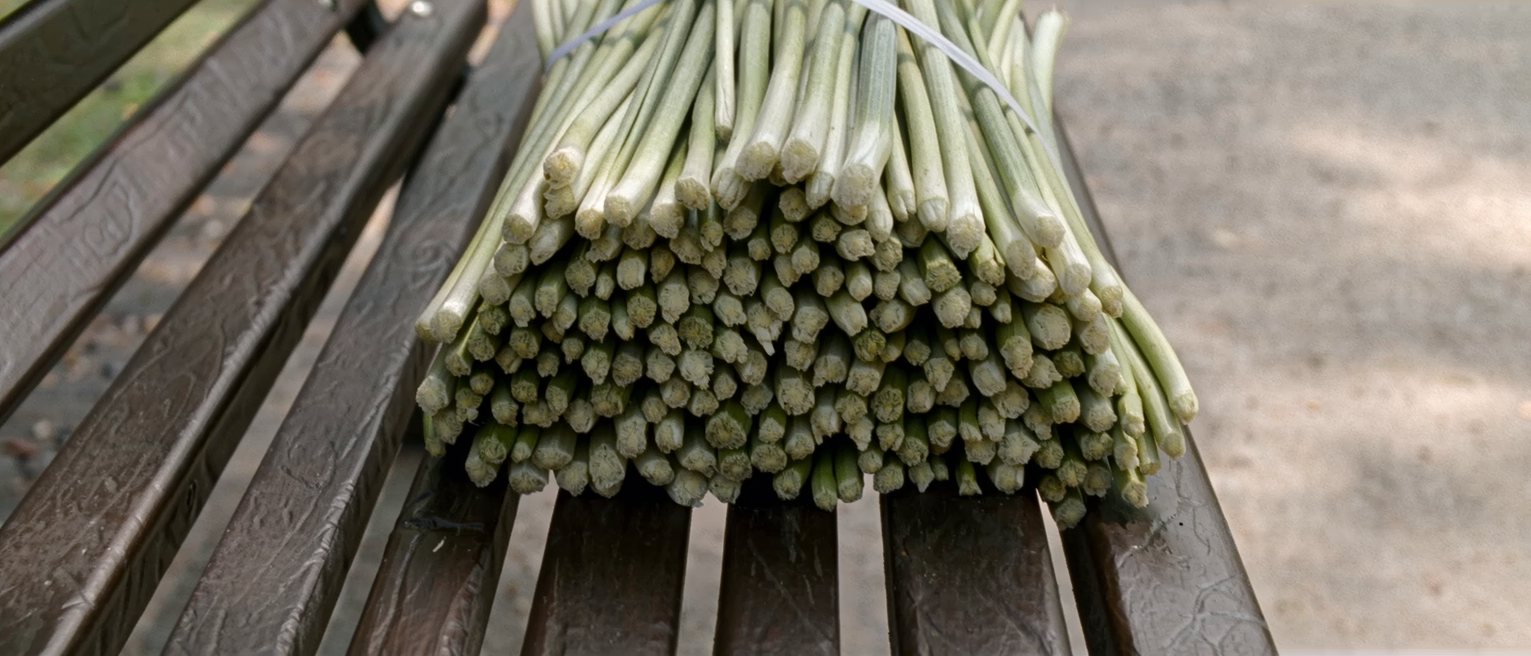
A bouquet is cut flowers. It is beautiful precisely because it has been severed from the thing that was keeping it alive. It is arranged — composed deliberately, for effect, out of elements selected for how they look together. It is at its absolute peak the moment you receive it. And its decline is not a misfortune that befalls it later; the decline is a consequence of how it was made.
That is a description of their relationship with no metaphorical slack in it. It was assembled out of things already finished — books already written, records already recorded, tastes already formed before either of them arrived. It was arranged for how those things looked together. It was at its peak almost immediately. And it had no root system, because nothing in it was growing.
The film is therefore not making the soft claim that love is sad because it ends. It is making a harder one about construction. A relationship built like a bouquet has a shape that runs out, and no amount of care keeps cut flowers alive, because the problem is not the care.
Which also tells you what the counter-image is, and it is not a longer-lasting bouquet. It is a plant: uglier at the start, worse as a gift, and attached to something that produces new material.

The one who does not change, and what that costs
This essay has so far treated the two of them symmetrically, and the film does not. Only one of them changes. The other keeps everything.
She goes on caring about what she cared about. She finds work that matters to her. Her interior life does not contract, and across the whole span of the film she is recognisably the same person she was at the station.
The position of the person who does not change has even less vocabulary available to it than the other one, and it is worth naming carefully. She is not being left for somebody else. She is not being mistreated, and there is no incident she could point at. She is watching a person she loves slowly become someone who cannot reach her, while everybody around them would describe what is happening as him growing up.
And the asymmetry there is gendered, which the film is quietly sharp about. A man who stops reading, stops playing, stops going to exhibitions and pours himself into a company is described as having become 社会人 — a person of society, which is a status word rather than a job description, and which is awarded rather than merely observed. A woman in her late twenties who still cares intensely about books and music is liable to be described as somebody who has not grown up.
Same behaviour, opposite verdicts. The pressure on him to change arrives as a reward and the pressure on her to change arrives as a reproach, and neither pressure has the slightest relationship to what either of them actually wants.
Which means her holding on is not passivity, and reading it that way gets the film backwards. Of the two positions hers is the more effortful, because it is maintained against a social judgement rather than toward one. The film gives her no speech about it for the same reason it gives neither of them the sentence about change: there is nowhere for her to make it.
The wave, which is what it always was
The film’s ending has become the thing people remember: long after it is over, they catch sight of each other across a street and wave.
It is generally read as bittersweet grace — two people who loved each other well enough to be glad, without bitterness, at a distance. And it is genuinely moving, and the film has earned it.
There is a second reading that the film also supports and that is worth putting next to the first. A wave is exactly what their relationship always was. Recognition at a distance. Mutual delight. No obligation in either direction. Nothing asked for and nothing required. They were extraordinarily good at that, for years, and they never learned to do anything else.
Put that way the ending is not a consolation laid over the story. It is the story’s most accurate single image, and it is tender and damning at the same time, which is the film’s real achievement.
And it is a useful thing for a reader to hold, because the wave is available constantly and costs nothing. The thing that is scarce is the sentence you have to stand still to say.
Why the shopping feeling is accurate, and what is actually wrong with it
The month’s sentence is not a complaint about inelegance. The shopping feeling is an accurate perception of the structure, and it is worth naming what the structure actually does to the person inside it.
It makes you the evaluator. A shelf of options puts you permanently in the position of assessing, comparing, and deferring — and the posture of assessment is incompatible with the posture of being met. You cannot be in a room with somebody while also holding them against an alternative, and the holding is not a moral failing, it is just what an interface full of alternatives trains.
But the deeper defect is that it trains you to answer the wrong question. The shopping question is: is this person right for me. That question is nearly unanswerable in advance, almost entirely answerable in retrospect, and the vast apparatus built to answer it in advance is the reason everybody is tired.
There is a different question, and it is answerable immediately. Can I say a true thing to this person, and does anything happen when I do.
That one takes an evening. It requires no profile, no overlap of taste, and no estimate of the future. And it is the question whose answer actually predicts something, because it tests the only capacity that matters when the overlap moves.
What to do with the month’s sentence
There are endless options. I do not want intimacy to feel like shopping.
The film supplies an unusually practical answer, and it is not to abandon the options or to choose more carefully.
Stop treating compatibility as a prediction. It is a starting position and it has no forecasting power. Two people with a vast overlap and no way to discuss change are worse placed than two people with modest overlap who can both say an awkward sentence out loud.
Find out early whether the other person can receive a true thing. Not a preference, which is what taste-matching tests. Something with a cost to saying it — a discomfort, a want, a thing you are unsure about. What comes back tells you more in ten minutes than a shared reading list tells you in a year.
And build in the sentence the film never gets. I am changing, and I do not know yet what it means for us. A relationship that has never heard that sentence has not been tested; it has only not yet been asked.
None of that is romantic and all of it is cheap. The expensive part is that almost nowhere in ordinary life is arranged to let a person practise any of it.
What this essay is not saying
Shared taste is not worthless and this is not an argument for deliberately choosing somebody you have nothing in common with.
Overlap is how people find each other at all. It is pleasant, it is a real form of pleasure, and the delight these two take in each other is not an illusion the film later exposes — the film is careful about that, and a reading that treats their happiness as fake has misread it badly.
Nor is the film recommending that anybody stay. It does not present their separation as a failure to be avoided, and the essay is not going to either. Some relationships are a specific shape that runs out, and running out is not the same as going wrong.
The claim is narrower. A filter is a filter. It selects who you begin with, and it predicts nothing about the part that decides the outcome, and an enormous amount of contemporary effort is spent improving the filter rather than acquiring the thing the filter cannot see.
Limits
The film is from 2021, directed by Doi Nobuhiro from a screenplay by Sakamoto Yūji. Credits and current availability should be verified at the publication gate, per the atlas entry’s note on external works.
The plot is described in outline and no dialogue is quoted. The specific books, music and exhibitions the couple bond over are deliberately not enumerated here: the argument does not require them, and listing titles from memory is exactly the kind of detail this Library does not assert.
The closing image is characterised rather than reproduced, and a reader who knows the film may weigh its tone differently. The second reading of it offered here — that the wave describes the relationship rather than redeeming it — is this essay’s argument and not a consensus.
The claim that the couple’s silence is a vocabulary failure rather than an economic one is an interpretation. Economic pressure is plainly present in the film and a reader may reasonably hold that it is the primary cause rather than the occasion.
The reading of the title as a structural claim about cut flowers is this essay’s, and the film does not state it.
And the description of what matching interfaces optimise for is a characterisation of how such systems are built rather than a measured account of any particular product’s ranking, and no figure about dating outcomes is offered anywhere in this essay.
The last train
What stays from this film is not the breakup and not the wave. It is the beginning: two people who have missed the last train and therefore have several hours they did not plan and cannot leave.
That is the condition under which they say everything. No schedule, no next thing, no way to escape politely, and a defined end that neither of them chose. The entire relationship is produced by an accident of transport, and nothing in the years that follow ever reproduces those conditions again.
This Library keeps arriving at the same finding from different directions, and here it is once more. Honesty is not mainly a function of how much two people have in common. It is a function of the architecture they are sitting in — and adult life is almost entirely built out of encounters with an exit, a schedule, and something else to get to.
Which is why the sentence the film needs is never said. Not because either of them is a coward, but because after the station there is never again an evening with no way out of it and nothing else to do.
That is the gap an evening at Moonlight is arranged to sit in. Not a match and not a search: a set number of hours with a stated beginning and a stated end, terms set in advance and set by you, where saying a true thing is the activity rather than the risk, where nothing is being compared against an alternative, and where nothing at all is inferred from your silence.