Cinema
Good Luck to You, Leo Grande and the Permission to Want
A woman who has spent a life authorising other people arrives in a hotel room with a list, because a list is what you bring when you have never been allowed to want without a justification. What the bounded room makes sayable, what the mirror is actually arguing, and why a house that sells bounded evenings has to declare its interest before it reads this film at all.
Good Luck to You, Leo Grande was released in 2022. It was directed by Sophie Hyde, written by Katy Brand, and acted by two people: Emma Thompson and Daryl McCormack. It ran ninety-seven minutes, had its world premiere at the Sundance Film Festival in 2022, and reached cinemas in the United Kingdom and screens in the United States on the same day in June of that year. Its premise, as its own synopsis states it, is that a retired teacher and widow named Nancy Stokes, who wants adventure and human connection and good sex, and who never had the third of those inside her marriage, hires an escort called Leo Grande and meets him in an anonymous out-of-town hotel room.
This Library has spent a year writing about wanting, about agreements, about bounded companionship, about what a woman is permitted to ask for out loud. It has never once written about this film. That is not a small oversight. Of every film that exists, this is the one standing closest to the subject of this publication, and the silence around it has begun to look like avoidance.
So here is the gap being filled, and it will not be filled with a recap. The ordinary description of the film, an older woman discovers sex late, is not false and is the least interesting true thing anybody has said about it. It flattens a careful piece of writing into an anecdote, and it puts the emphasis in the wrong place entirely.
The subject of this film is not sex. It is permission. Nancy arrives in that room with a written list of acts she would like to get through, and the list is the whole argument in miniature. A list is what a person brings when she has never been allowed to want something without producing a reason for it. Everything the film does afterwards follows from what that list is for and from what happens when she finally puts it down.
One further thing, stated at the start rather than discovered at the end. This house sells bounded paid companionship. A film in which a bounded paid encounter changes a woman’s life is, for a business like this one, an advertisement this house did not have to pay for or produce. That interest is real, it is direct, and a reader is entitled to weigh everything below against it. There is a section further down that does nothing but that.
A room whose edges are agreed in advance
The film is structured as four meetings, all of them in the same hotel room, with essentially two people in it. Critics have noted that this gives it the feel of a play barely opened out, and some of them meant that as a complaint. It is worth arguing that the shape is not a limitation the film is working around. It is the thesis.
Consider what the room actually provides. The duration is fixed and both parties know it. The terms, including the money, were settled before either of them walked in. Nobody from her life is present, nobody from her life will be told, and the encounter carries no consequence into the ordinary week on either side. Neither of them is using a real name.
This Library has argued before that candour is not produced by courage but by the predictability of the response. You can say a true thing to somebody when you can forecast, well enough, what they will do with it. Almost everything that makes a person hedge in ordinary life is a failure of that forecast: the answer will have to be lived with tomorrow, the listener has standing to reconsider the whole arrangement, the sentence will still be in the room at breakfast.
A room with agreed edges removes all of it at once. Not by being warm, and not by being intimate in any sense a couple would recognise, but by being small enough that the worst plausible outcome is survivable. That is why the most artificial room in the film is the one in which the truest sentences get said. The falseness is doing the work.
And the falseness is not a criticism of the room. A stage is false in exactly this way and nobody holds it against a play. The room is a device for lowering the cost of speaking, and a device for lowering the cost of speaking is precisely what a person who has never spoken about this needs, and almost never has.
The list as armour
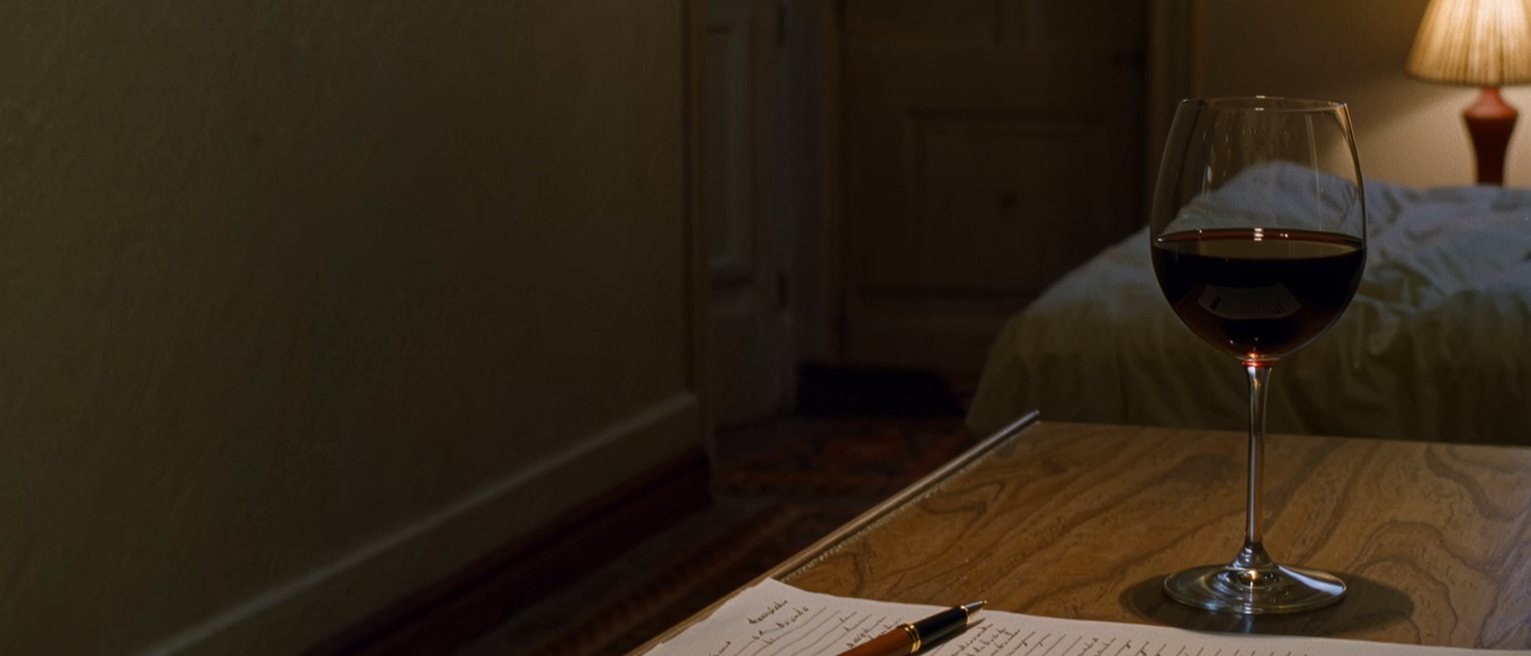
Nancy brings a written list of things she would like to do, drawn up in the register of achievable goals: specific acts, things her husband would not do, items to be worked through in order. It reads as comic and it is played, in part, for comedy. It is also the most revealing object in the film.
Think about what a list does to a want. It converts it into a task. A task has a specification, a completion criterion and a natural end; a task can be scheduled, reported and evaluated. A want has none of those properties. It simply sits there being a want, and it belongs to the person who has it, and that is the problem.
A woman who has spent a working life administering other people’s propriety, deciding what is appropriate for other people’s children and running a household to a standard other people set, has enormous practice at authorising things. She has no practice at all at authorising anything for herself. The list solves that. It looks like an agenda, and an agenda implies a body somewhere that approved it.
The list is also armour in a plainer way. With a list, failure is procedural rather than personal. If an item does not come off, the item was wrong, the method was wrong, the sequence was wrong. Without a list there is nothing between her and the possibility that she asked for something and it did not work and the thing that did not work was her.
None of this is a judgement on the character and none of it is a diagnosis. It is a description of a device, and the device is extremely common. Most people who have never been allowed to want out loud arrive at the first opportunity with some version of it: a script, a plan, a joke prepared in advance, a set of conditions that make the asking somebody else’s idea.

What happens when the list is put down
The turn in the film is not an act. It is the moment the list stops being useful, and it is the closest thing the film has to a climax.
A list fails for a structural reason. To write one you have to know the answer before you have asked the question. What goes on it is not what you want; it is what you have heard of, what you have read about, what you believe a person in your position is entitled to request. It is an inventory of the permitted. And the permitted is exactly the category that a woman in this position has no reliable information about, because she has never been in a room where the category was open.
What replaces the list is not spontaneity, which is a word people use carelessly. Spontaneity is what someone can afford when permission has been available so long that she has forgotten she ever needed it. What replaces the list is attention: noticing what is actually happening in the room and responding to that rather than to the plan. It is a much harder skill and it cannot be acquired by being told to relax.
The film is honest enough to make the abandonment go wrong first, and this is the part most admiring accounts of it skip. Once the armour is off she overreaches. She presses him for personal information he has declined to give, and she goes looking for it when he refuses. Reviewers writing from inside sex work have specifically named this sequence: the client pressures the worker to breach his own boundary and then pursues his private identity anyway.
It matters that the film does not make her admirable simply for wanting. A person newly released from a rule does not automatically behave well, and the first thing many people do with a permission is to test how far it extends. The film puts that in, unflatteringly, and it is the single strongest evidence that it is not merely a wish-fulfilment piece.
Both of them are performing, and only one is being paid
Leo Grande is a working name. So is Nancy Stokes. Neither person in that room is using the name on their documents, and the film makes this explicit rather than leaving it as subtext. Two people have each constructed a person for the occasion, and the encounter takes place between the constructions.
That symmetry is real and it is worth resting on, because the reflex is to treat the paid party as the only one performing. He is not. She has invented a biography, a manner and a level of composure. The difference is not that one of them is authentic and the other is not.
The difference is the obligation. He is paid, so his performance has to hold. It has to stay warm when she is difficult, stay steady when she changes her mind, stay available for the duration that was purchased. Hers does not. She can drop the character at any moment she likes, and the cost of dropping it is carried by him.
That asymmetry is the source of the most uncomfortable minutes in the film, and it is not resolved by his being good at his job. Money did not make the encounter false. It made the obligations unequal. What she bought was time, attention, reliability and a frame that had been agreed in advance. What she did not buy, and what the film shows her trying to take, was access to the life of the person providing it.
The general point, stated without generalising about anybody: an unexamined purchase does this to almost everyone. When the terms of a transaction are left vague, the paying party tends to expand them quietly in her own mind, and the person being paid absorbs the expansion because absorbing it is part of what is being bought. That is a fact about vagueness, not about her, and not about him.
The argument the mirror is making
The film ends with Nancy alone, undressed, looking at herself in a full-length mirror. It is the most discussed image in the film and the most frequently misread.
The easy reading is self-acceptance, in the sense the phrase now carries: she has decided that she looks all right after all. That reading is too small and slightly false to the scene as it is filmed. It is filmed without flattery and without cruelty, which is an unusual combination, and it does not play like a verdict being delivered.
The argument the image is making is about jurisdiction rather than verdict. For a lifetime the body was assessed, by a husband, by a culture, and above all by the internal assessor assembled out of both, who sits behind the eyes and reports on what is seen. What changes at the end is not the finding. It is who is looking. She is not being judged more kindly; she has stopped being the object of a judgement and become the person doing the seeing. Emma Thompson has said in published interviews that she played the moment as the first time the character genuinely sees her own body, with a gaze that is neither approving nor condemning.
And the scene is deliberately unaccompanied. There is no partner in the room to confirm anything, which is the whole point and is why the film cannot be reduced to a story about a man who fixed a woman. If the permission had been granted by him, it would have left with him. What the paid encounter supplied was an occasion. The looking is hers, it happens after he is gone, and it requires nobody’s agreement.
This is also why the film is not, finally, about sex, and why treating it as a story of late-arriving pleasure gets the emphasis wrong. Pleasure was available to her all along in the trivial sense. What was not available was the standing to look at her own body without first imagining somebody else’s opinion of it, and that is a question about authority, not about desire.
This house’s interest, declared before the reading
Now the part that ought to be in the body of an essay rather than at the bottom of a page.
This house sells private companionship: bounded, paid, arranged in advance, between a woman and a companion, with the terms settled before anything begins. A film in which a bounded paid encounter transforms a woman’s relationship with her own wanting is, for a business of that description, the most useful cultural object imaginable. Nobody here had to make it, nobody here paid for it, and it flatters this trade more thoroughly than any copy this house could write about itself.
That is a direct commercial interest in a particular reading of a work of art, and it should be weighed against every appreciative sentence above.
So here is what will not be claimed. The film is fiction. A screenwriter decided what Leo would say and when, decided that he would be patient at every moment patience was required, and decided that the encounter would end where it ends. Four meetings across a stretch of time, with an exceptionally perceptive person, in a story engineered to arrive somewhere, is not a description of what an evening does. Nothing that happens on that screen is evidence about what happens in any actual arrangement, including this one.
What can honestly be borrowed is narrower and it is structural. A bounded encounter lowers the cost of saying a true sentence, because the response is forecastable and the consequences do not travel. That much is a claim about the shape of an arrangement rather than about anybody being transformed by one, and it would be just as true if no money were involved and just as true of a conversation with a stranger on a train. The film illustrates it unusually well. It does not prove it, and it does not underwrite anybody’s business.
The strongest case against this reading
The serious objection to everything above is not that the film has been misread. It is that the film itself is a comfortable fantasy about sex work, and that a reading which treats it as an argument about permission quietly launders that fantasy.
It goes like this. Leo is preternaturally patient, articulate, self-possessed and untroubled. He has no financial desperation, no danger, no bad night that cannot be resolved inside a conversation, and an apparently complete freedom to set and hold his own terms. Writing in Jacobin in 2022, Eileen Jones named the problem directly: a magic sex worker, angelic and selfless, whose function in the script is to teach a middle-aged woman to love her body, rather than a person with an occupation and interests of his own. A sex worker reviewing the film in openDemocracy put it more bluntly still, observing that workers with Leo’s patience and perceptiveness are not the norm and that the film remains Nancy’s story throughout.
The configuration is unrepresentative in another way that the same criticism identifies. The overwhelming reality of the trade is men purchasing from women. The film selects the least typical arrangement available, an older woman buying from a younger man, which is also the arrangement an uneasy audience finds easiest to accept. Choosing the most palatable case and presenting it as an argument for the humanity of the whole is a rhetorical move, whatever the intentions behind it.
All of that lands. It is not partly right; it is right. A film that makes a trade look safe by casting it perfectly is doing public relations whether or not anybody involved wanted to. And a viewer who leaves the cinema believing that the conditions of sex work broadly resemble that hotel room has been misinformed by a work of art, and nothing in this essay repairs that.
The honest answer is a narrowing rather than a rebuttal. This film is not evidence about the conditions under which sexual services are sold and should never be cited as though it were, by this house least of all, since this house would benefit from exactly that misuse. What it is good evidence about is something much narrower: what a bounded, pre-agreed encounter does to a particular person’s ability to say what she wants out loud. That claim survives the objection. The larger one does not, and was not being made.
It should also be said that the film half-knows this about itself. Leo states limits and holds them. He refuses. There are moments where he stops functioning as a device and objects to being treated as one, and the script lets him win those. That is not enough to answer the criticism, but a film that were purely a fantasy would not have bothered to put them in.
What permission actually looks like
If the film’s subject is permission, it is worth saying what the word means here, because it is usually used as though it named a feeling.
It does not. Permission is a structure, and the film is unusually clear about its components. There is an end time that both parties know. There are terms that were settled before anyone was in the room. And there is a second person whose response can be forecast, because the arrangement constrains what he can do with what he hears.
Notice what is absent from that list. Nobody grants permission to anybody. Leo does not give Nancy anything she did not have; the conditions of the room simply make asking cheap, and asking becomes possible at the point where its price falls below what she can pay. That is why the ending works without him and why it would have been a worse film if he had been there for it.
The things that make asking expensive elsewhere are easy to enumerate and they explain most of the silence in most ordinary lives. The answer has to be lived with tomorrow morning. The person hearing it has standing to revise the whole arrangement on the strength of it. Whatever is said will be remembered by somebody who was there before and will be there after. Under those conditions a person builds a list, or a joke, or a set of preconditions that make the asking look like somebody else’s idea, and then wonders why none of it produces what she wanted.
This is also why the film’s insight travels without requiring any generalisation about groups of people. It is not a claim about older women, or about widows, or about teachers, or about anybody who sells anything. It is a claim about the cost structure of asking. The same mechanism applies to a person of any age, in any arrangement, who has worked out that a particular sentence is too expensive to say in the only room where it would matter.
The residue for a reader is a question rather than an instruction, and it is not a comfortable one. What would you want, if you did not first have to construct a justification for wanting it? Most people discover, on being asked that, that they do not know, and the not knowing is the injury the film is actually about.
What this does not claim
This is film criticism. It is not clinical guidance, not therapy and not advice, it describes no treatment and promises no outcome, and it diagnoses nobody. Nancy and Leo are invented people performed by actors and written by a screenwriter; nothing here is a statement about their psychology, because they do not have any.
Nothing here generalises about older women, about widows, about retired teachers, or about people who sell sexual services. Two fictional characters are described. No claim is made that either is typical of anybody, and the section above says in terms that the film should not be read as evidence about the conditions of sex work.
The factual statements, which are confined to what published sources support, are these: the year, the director, the writer, the two principal performers, the running time, the world premiere at Sundance in 2022, the release in June of that year, the official description of the premise, the four-meeting structure in a single hotel room, the use of working names by both characters, the presence of Nancy’s written list, and the closing scene at the mirror. Each is recorded in this essay’s evidence ledger with its source. The readings built on top of them, including everything said about lists, about jurisdiction, and about the cost of asking, are this Library’s interpretation and are not claimed as anybody else’s.
No dialogue from the film is quoted anywhere in this essay. The remark attributed to Emma Thompson about the mirror scene comes from published interviews given while promoting the film, and is reported as such.
Nobody involved in making this film knows of this house, has any connection to it, or endorses it in any way. The film is discussed here the way any published work may be discussed, and the fact that this house profits from a sympathetic reading of it has been stated in the body of the essay rather than buried underneath.