Cinema
Secret Sunshine, and the Forgiveness That Was Already Given
A woman travels to a prison to forgive the man who killed her son, and is told, calmly, that he has already been forgiven without her. Lee Chang-dong’s 2007 film stays on that moment far longer than comfort allows. What it exposes is not a fact about faith. It is a fact about a certain architecture of consolation: the kind that settles your account by routing it through a third party, and hands it back to you closed.
There is a scene about two thirds of the way through Lee Chang-dong’s Secret Sunshine that is, considered purely as a piece of construction, one of the most precise things ever filmed about consolation.
A woman named Lee Shin-ae has moved to a small city with her young son, and her son has been kidnapped and killed. In the months afterwards she is taken into a church, and inside that church she is given, for the first time since it happened, something to do. She may forgive the man who did it. She announces the decision at her own birthday gathering, and is driven out to the prison. She sits down opposite him in the visiting room. And before the words she has come to deliver can be delivered, he tells her, calmly, with every appearance of peace, that he has found God in there, and that God has already forgiven him.
Her forgiveness is not needed. It has already been given away, without her, by a party she did not authorise.
What happens to Shin-ae afterwards takes up the rest of the film and is not the subject here. The subject is those few minutes, and the structure they make visible — a structure not confined to prisons, or to churches, or to anything as extreme as the worst thing that can happen to a person.
The claim is narrow and is better stated before the argument than after it. Some consolations work by requiring you to hand your grievance to a third party who is in a position to settle it, and where that third party can settle it without you, the consolation can leave you nothing to do with the thing that was done to you. Being made redundant to your own injury is a distinct injury, separate from the first and sometimes worse, because the first at least left you standing somewhere with a position in the matter. That is an observation about the architecture of certain consolations, not an argument about religion, and the shape is demonstrated below in wholly secular settings so the distinction stays visible rather than asserted.
The film, and what is on the record
Secret Sunshine is a South Korean film of 2007, written and directed by Lee Chang-dong, his fifth feature. The festival record gives its running time as 142 minutes. It opened in Korea on 23 May 2007 and reached Japanese cinemas on 7 June 2008 as Shiikuretto Sanshain, with a further Japanese release in August 2023.
It was selected In Competition at the 60th Cannes Film Festival, where Jeon Do-yeon, who plays Shin-ae, received the prize for Best Actress; the festival’s own record dates the award to 27 May 2007 and names Alain Delon as the presenter. Japanese film databases note that she was the first Korean performer to take it. Song Kang-ho plays Kim Jong-chan, who owns a car repair shop in the town, and that supporting performance was recognised as a lead one by two Korean awards bodies the same year — a small fact worth holding onto.
Lee Chang-dong, born in Daegu in 1954, came to film late and from literature. He published fiction through the 1980s before writing for the screen, and directed Green Fish in 1997, Peppermint Candy in 1999 and Oasis in 2002. Between Oasis and this film he served as South Korea’s Minister of Culture and Tourism, from 2003 to 2004. Poetry followed in 2010 and Burning in 2018.
The screenplay is adapted from a short story by Yi Chong-jun, who lived from 1939 to 2008 and whose fiction was also the source of Im Kwon-taek’s Seopyeonje. The story is Beolle iyagi, published in the quarterly Oeguk munhak in the summer of 1985. A bibliographic caution belongs here, because English-language reference sources very widely name the source as a different Yi story altogether; the Korean record is unambiguous and is what this essay follows.
The Korean title is Miryang, the name of the city in South Gyeongsang Province where the film is set and was shot. Written in hanja as 密陽, it joins a character carrying the senses of dense, close and secret to a character for sun. Secret sunshine is a literal rendering of those two characters. That is a fact about how a place name is written, and nothing beyond it is claimed here — not that the film contains a scene explaining it, and not that the town is a metaphor.
One further item is on the record and it matters to everything that follows. Yi Chong-jun, in a preface written for a 2007 edition of the story, said that a kidnapping and killing of a child in Seoul had preceded his writing it, and that what had shaken him more than the crime itself was the condemned man’s final statement before execution: that he had received God’s mercy, and hoped that mercy would extend to the family of the person he had killed. The Korean press, reporting this at the time of the film’s release, identified the likely case as one from 1980. So the scene in the visiting room is not a screenwriter’s invention devised for symmetry. It is a writer’s response to something a real man actually said, and the film is the second thing built on top of it.
What she was actually offered
To see the structure clearly it helps to be exact about what Shin-ae is given, because the film is exact about it and most descriptions of the film are not.
She is not, in the first instance, offered an explanation. She asks for one — why a child — and no satisfying answer arrives, and the film does not pretend that one does. She is not offered the return of anything, or a procedure for feeling better on a schedule. What she is offered, and what visibly works on her, is a task. There is something she can do. The thing that has happened, which until then has been simply a fact lying across her life with no handle on it anywhere, acquires an action that she is the one to perform. She can forgive.
That is a real gift and it should be named as one before anything critical is said. Shin-ae’s condition before the church reaches her is total inactivity with respect to the central fact of her life. Nothing she does will bear on it. The offer of a task is the offer of a position in a matter she has been standing outside of, and the relief on her face when she takes it is not a delusion the film invites anyone to look down on.
But the task comes with a condition attached, and the condition is the whole mechanism. The forgiveness she is invited to extend is not hers to define. It is administered within a system in which forgiveness is a transaction with a third party, and in which that third party can transact directly. She is being given a task whose object is already inside somebody else’s jurisdiction. She just does not know it yet, and the film lets her not know it for a long and generous stretch of running time.
The scene in the visiting room
The scene is shot without emphasis. There is no score cueing what to feel, no cutting pattern that tells the audience a blow is coming. She goes in composed, almost stately, prepared to perform something she has rehearsed.
The man opposite her does not behave as a person hoping for absolution behaves. He is calm and he looks well. He tells her that he came to God in prison, that he has been forgiven and has found peace, and that he prays for her. There is no visible calculation in it and the film declines to supply any. The performance gives no signal that he is lying, and the film never resolves whether he is. That refusal is the hardest thing about the scene, because an audience wants very badly to be told that his serenity is fraudulent, and being told would settle everything.
The words Shin-ae came to say are never said. There is no point at which she can say them, because the transaction she came to complete has been completed by other parties.
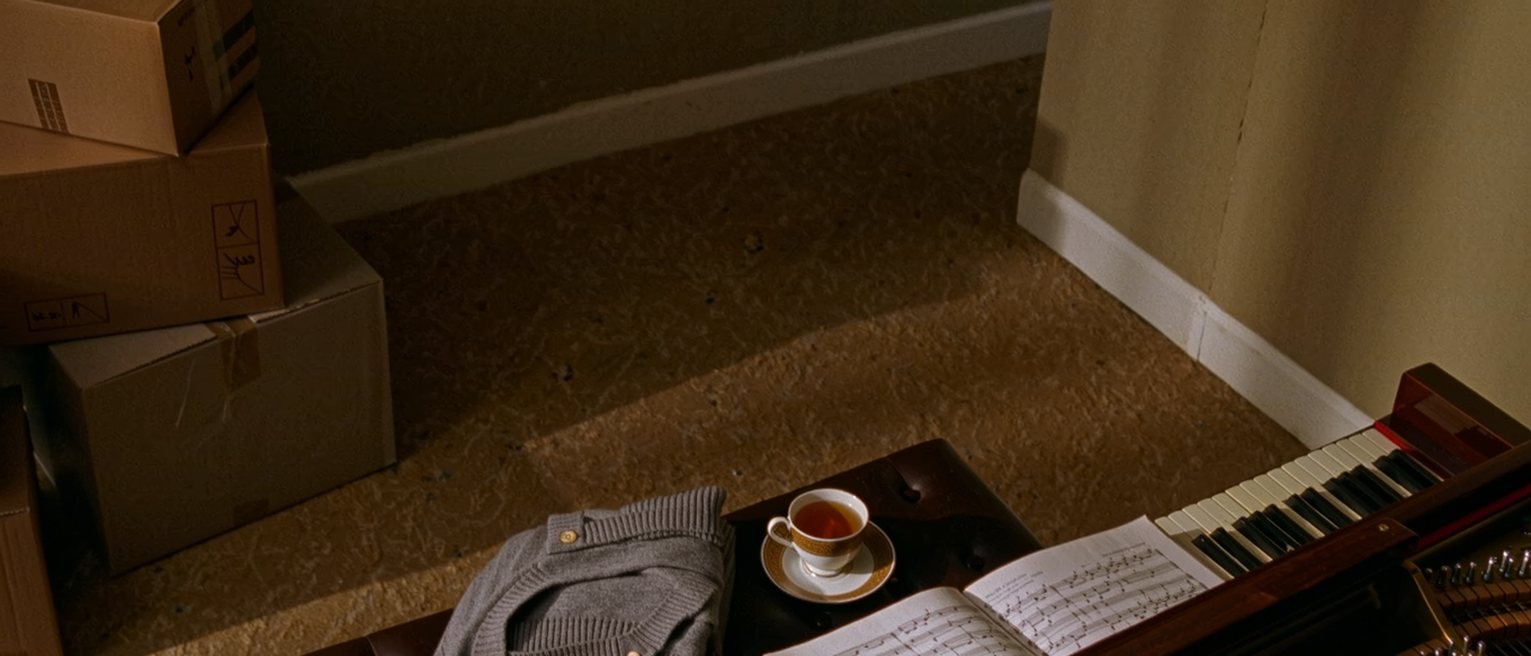
And here is what a careless description misses. She is not, at that moment, refused. Nobody refuses her. She is not told that her forgiveness is unwelcome, or insufficient, or late. She is told, with warmth, that the matter is closed and that everyone is at peace. What she has been handed is not a rejection. It is a receipt.
The difference matters. A refusal leaves the thing in your hands: you can be angry at it, appeal it, hold it against somebody, come back. A receipt for a settlement you were not party to leaves nothing in your hands at all. There is no one to be angry at, since no one has wronged you in the transaction, and nothing to appeal, since the matter is not open. Shin-ae leaves the prison carrying the injury she came in with, plus a second one that has no name and no address.

Made redundant to your own injury
That second injury is the one this essay is named for, and it is worth separating from three things it is usually confused with.
It is not the loss of an opportunity for revenge: Shin-ae is not deprived of the pleasure of watching him suffer, and that reading, which some viewers take, cannot account for why the scene devastates people who have no appetite for anyone’s suffering. It is not the discovery that he is unrepentant, because as far as the film shows he is not unrepentant, and the devastation would be smaller if he were. And it is not the ordinary failure of a consolation to console. Consolations fail all the time — words do not land, rituals feel hollow, the food goes uneaten — and that is disappointment, which leaves the underlying situation exactly where it was.
What happens in the visiting room is different in kind. The consolation did not fail. It worked, and in working it disposed of the object. Shin-ae was given a role in the matter of her son’s death, accepted it, and then discovered that the role had been written out while she was learning her lines. She is not merely uncomforted. She has been made surplus to the only transaction the matter contained.
This Library has written before about who ends up carrying the remaining obligation after harm. In an earlier piece on apology and what becomes different after it, the finding was that once an apology has been delivered and witnessed, the last open variable is the injured party’s interior state, so the question quietly transfers from his conduct to her character, and forgiving becomes something she is expected to produce. That is the burden landing on her. Secret Sunshine shows the same structure inverted: the burden does not land on her at all, because the settlement is completed elsewhere and she is not needed for it. Being required to forgive and being made unnecessary to forgiveness look like opposites. They are one mechanism seen from two sides, and the mechanism is that the disposal of a wrong has been located somewhere other than with the person who was wronged.
This is not an argument about religion
The film is set inside a church and the scene turns on a theological claim, so it would be easy, and lazy, to read the whole thing as a case against religious consolation. This essay declines that reading, and the reason is not diplomacy. It is that the structure is not religious. It is administrative, and it is everywhere.
Consider an employee who reports a colleague’s conduct. The report goes into a process; the process concludes; she is informed that the matter has been handled, that appropriate steps were taken, and that she should now consider it resolved. She is not told what was decided, because the decision is confidential, and she is not asked whether she is satisfied, because her satisfaction is not an input. A wrong done to her has been adjudicated, settled and closed by parties who did not require her participation past the initial report. She is thanked, and the thanks are sincere, and she goes back to her desk holding nothing.
Or consider the friend who says, of somebody who treated you badly, that he is clearly suffering, that he has had a hard year, that he is doing his best. Every clause may be true. The function of the sentence is to move the matter out of the space between you and him and into a general account of human difficulty where it is already understood, already forgiven in advance by a kind of ambient decency. The sentence is not unkind. It closes the file.
Or consider a therapeutic vocabulary in which resentment is reframed as a burden the resentful person is carrying, and letting go is presented as a service she performs for herself. Whatever its merits, notice what has happened to the wrong: it has been reclassified as a property of her interior life. It is no longer a thing that occurred between two people. It is a weight in her own hands that she is being helped to put down, and once she puts it down there is no residue anywhere, because the other party was never in the frame.
In each case somebody is offered relief, the relief is genuine, the people offering it mean well, and the mechanism moves the disposal of the wrong to a jurisdiction the injured party does not sit in. The film stages the purest available version because a religious settlement is the only one that can be completed with total finality and no appeal. But it is a demonstration of the shape, not an indictment of the setting. A reader who takes this essay to be about Christianity in Korea, or about faith of any kind, has taken the example for the argument.
What a consolation leaves you holding
If the structure is real it suggests a test — not a test to apply to yourself or to anyone else in trouble, which is not what this Library does, but a test for reading a consolation as an object. After this consolation has done its work, does the injured party still hold a position in the matter?
Some consolations obviously do leave one. Company leaves one: being accompanied closes nothing, since you are still the person it happened to, still the one who decides what it meant and when, and the other person is beside you rather than between you and the wrong. Acknowledgement leaves one, because to say that a thing was wrong and was done to you is to confirm your standing rather than discharge it. Practical help leaves one, since carrying a box for somebody makes no claim on the box’s contents.
Some consolations do not. Any consolation whose relief comes from the matter being closed will close it, and closure is by definition the removal of a position. That is not a hidden defect; it is the actual product, and a person who wants the thing to be over is not being tricked when they are given an ending.
The problem is that the two are extremely hard to tell apart in advance and feel identical at the moment of acceptance. Shin-ae could not have told them apart. The offer she took was warm, competent, made by people who stayed with her, and it contained a task. Everything about it was correct except the location of the jurisdiction, and that was not visible until she went to the prison to use what she had been given.
That is the honest position, and this essay is not going to improve on it with a procedure. There is no advice here about what anyone should accept, decline or feel. The observation is only that consolations have a shape, that the shape can be described, and that one particular shape carries a cost which is invisible when the offer is made and severe when it is redeemed.
The man holding the mirror
There is a second person in this film, and any argument this rigid has trouble with him, which is a reason to give him his own section rather than a clause.
Kim Jong-chan runs a car repair shop. He fixes Shin-ae’s car when she breaks down outside the town at the start, and then he simply does not leave. He is not impressive. He talks too much, arranges himself around her plans, turns up where she is, and joins the church she joins, apparently and unembarrassedly because she is there. A sympathetic viewer finds him touching and a less sympathetic one finds him a nuisance; the film lets both readings run and never converts him into a hero.
What he never does, across the entire film, is settle anything. He does not explain what happened. He does not tell her it was God’s will, or that it will pass, or that she should forgive, or that she should not. He does not carry her grievance off to be processed. He has no jurisdiction and seeks none. He is simply there, in a slightly foolish way, for a long time, at a distance she sets.
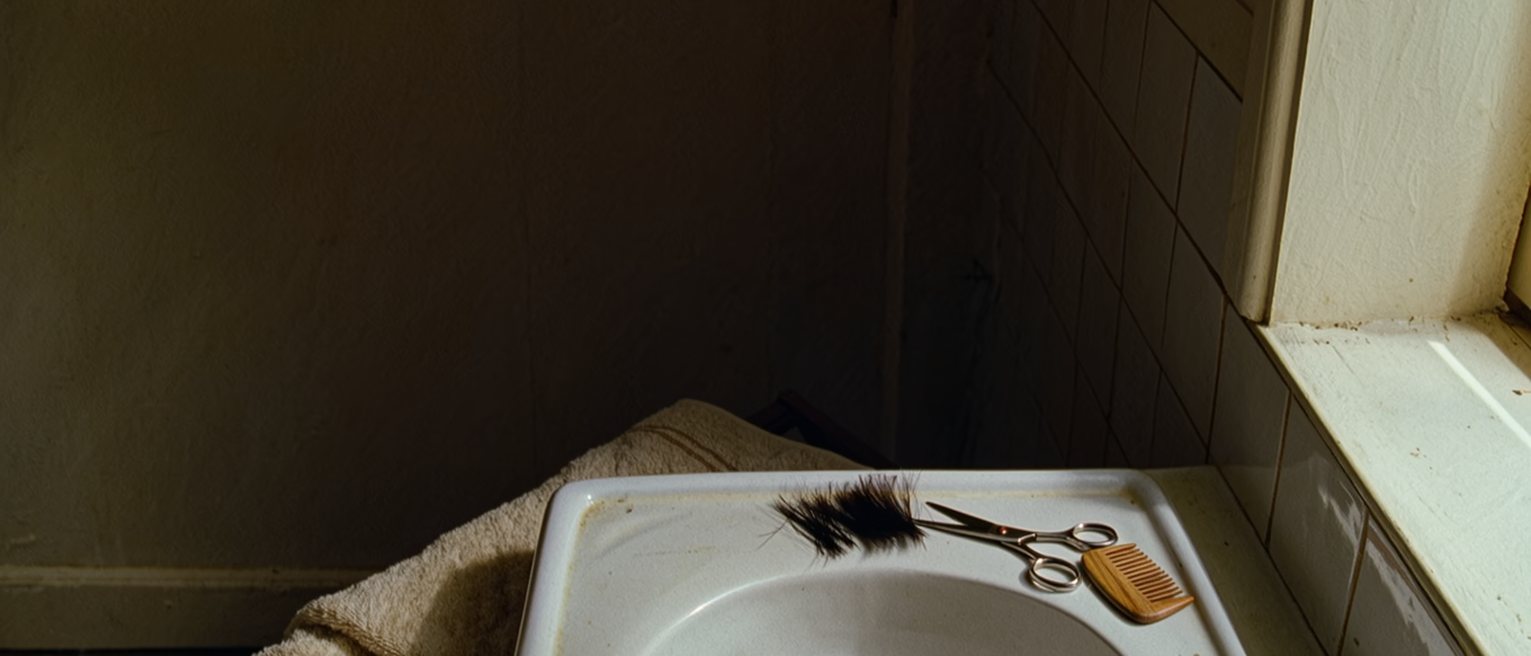
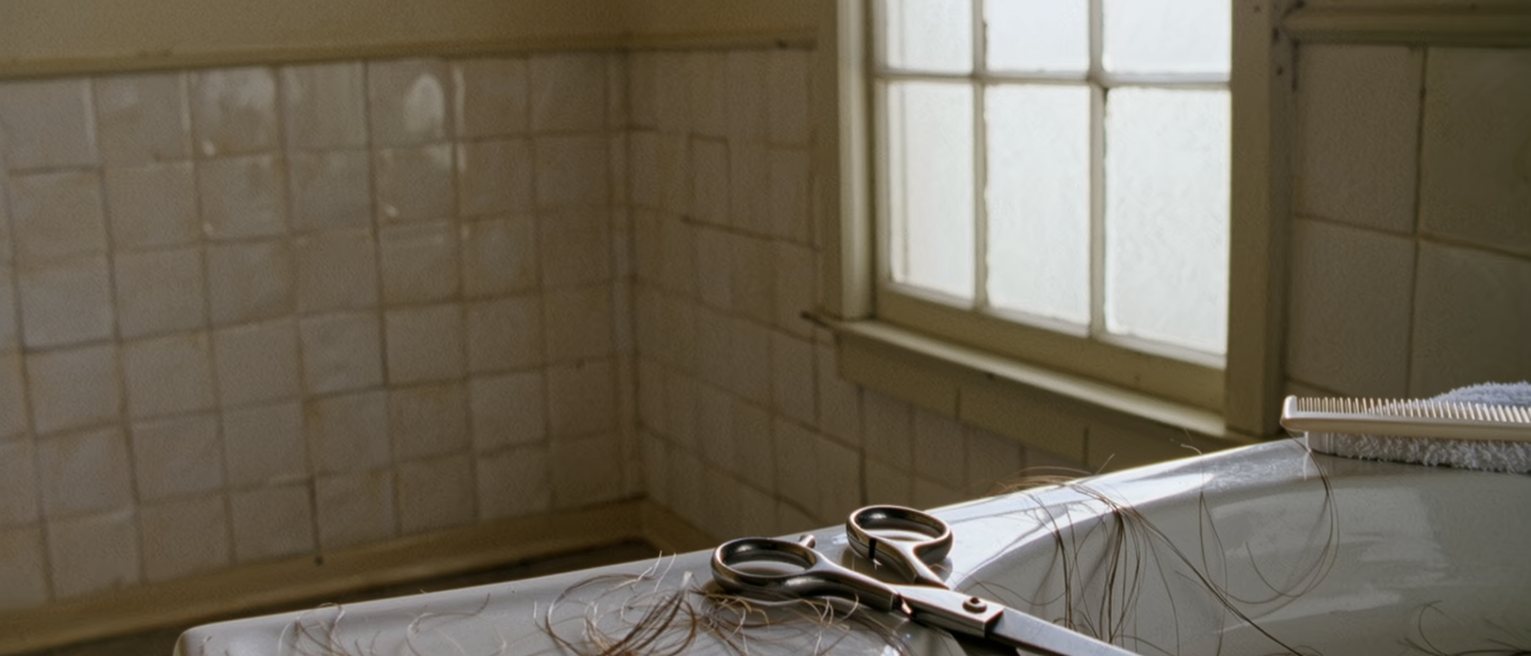
The film ends in the yard of her house. She has begun cutting her own hair, badly, having walked out of a salon mid-cut. He arrives and, without being asked, holds up a mirror so she can see what she is doing. Then the camera drifts off her and settles on an ordinary patch of ground — leaves, mud, bits of plastic, cut hair — lit by a small piece of sun.
This is easy to over-read and has been over-read in exactly that direction for twenty years. Here is the least sentimental thing that can be said about it. The mirror does not cut her hair. He is not doing the thing; she is doing the thing, badly, and he is making it marginally more possible for her to do it. He has not taken the matter anywhere. That is the whole of the contrast, and the film is not claiming that it is enough, because nothing in the last shot suggests that anything has been made better.
What this house sells, and what it is not able to settle
This house sells private companionship: an arranged, bounded, paid evening in the company of another adult. It should be obvious that an essay praising the man who holds the mirror and dismantling the institution that closes the file runs in this house’s commercial favour, and it is better to say so here than to leave a reader to notice it at the bottom. So the declaration comes with constraints rather than reassurances.
This house does not offer consolation and does not describe what it sells as consolation. Nothing on offer here addresses a loss, and nobody should arrive at an evening expecting it to. An evening is an evening: conversation, attention, company, a few hours that end.
This house is also the wrong party for the distinction just drawn, and in the most awkward direction. The companionship it sells is scheduled and paid for, which means the presence on offer is arranged rather than freely given, and a paid presence is not the same object as a man who keeps turning up for two years with no prospect of anything. Jong-chan is not a model of the service. If anything he is a rebuke to it, since the one thing he supplies is the thing that cannot be bought: unpurchased persistence over time.
And this house claims no competence anywhere near grief. It is not a form of care, it treats nothing, it fixes nothing, and if a reader is carrying something serious then an evening with a stranger is not addressed to it in any way. That is not modesty. It is the accurate description of what an arrangement of this kind can and cannot be.
The strongest case against this essay
Four objections deserve to be put at full strength rather than softened, and two of them are not fully answerable.
The first is that the film is harsher on the church than on anybody else, and that this essay has inherited the bias while dressing it as structural analysis. This is a fair hit. Secret Sunshine gives its church members bad faith and worse timing, gives the pharmacist’s husband a grotesque scene, and gives the outdoor prayer meeting a texture close to mockery. Lee Chang-dong is not neutral about it, and the film is, among other things, a portrait of a specific religious culture at a specific moment made by someone with a view. An essay that borrows that film’s pivot and then announces that the argument is not about religion may simply be laundering the film’s hostility into a general principle where it cannot be checked. The honest reply is not that the objection is wrong but that it is testable: the secular cases above either exhibit the structure or they do not, and a reader who finds that they do not should conclude that this essay has taken a local animus for a general shape.
The second is that reading Shin-ae’s arc as an illustration of a mechanism underplays, to the point of indecency, the fact that this is a mother whose child was killed. It is a serious charge. There is a genuine risk that a structural vocabulary — jurisdiction, position, disposal, settlement — functions as a way of not looking at the thing, and that an essay which handles a murdered child as the occasion for a diagram has done something worse than sentimentality. All that can be said in reply is what this essay has tried to do: to state the death once, plainly, and not use it for momentum; to make no claim about what Shin-ae feels beyond what the film shows; to offer nobody any instruction about loss; and to say here, explicitly, that the mechanism described is not the important thing about what happens to her. The important thing about what happens to her is that her son is dead. The mechanism is the only part this essay is competent to discuss, and its competence is not the measure of what matters.
The third is that Jong-chan is the one tender thing in the film and that this essay’s frame has no proper place for him. Largely true. The frame is built to describe what consolations do to a person’s position in a matter, and Jong-chan’s significance is not structural at all; it is temperamental, and it lives in performance rather than in architecture. Song Kang-ho supplies a foolishness and a physical patience that no account of mechanisms can reach, and the section above, by describing him as the man who does not settle anything, arguably reduces a whole human being to a negative space in an argument. He is more than that in the film, and a reader who comes away thinking his function is to illustrate a contrast has been given the wrong impression by this essay rather than by the picture.
The fourth is aimed at the essay’s own key phrase. Being made redundant to your own injury sounds truer than it can be shown to be. It has the ring of a discovery, and phrases with that ring are usually doing rhetorical rather than descriptive work. What would it take to show that it names something real rather than a feeling of aptness? Very little of the usual kind is available: no measurement, no study, no prevalence, nothing counted. What there is, is one film that stages the case with unusual clarity, a story behind that film which began with something a man actually said, and a handful of secular analogies a reader can test against their own experience or reject. That is the whole of the evidence for the phrase, and it is thin. The formulation is offered as a description that may be useful, and a reader who finds it merely elegant has found a real defect.
What this does not claim
This essay is a reading of one film. It is not guidance of any kind, clinical or otherwise. It contains no advice about grief, no account of how anyone should mourn, and no suggestion about what any reader should accept or refuse from the people around them. It diagnoses nobody.
It makes no claim about religion, about Christianity, about churches in Korea or anywhere else, or about any believer. The film’s church is the film’s church. The argument advanced here concerns the architecture of consolations that route a settlement through a third party, and that architecture is demonstrated in secular settings precisely so that it is not mistaken for a claim about faith.
Nothing here describes the inner life of Lee Shin-ae, of the man in the prison, or of Kim Jong-chan beyond what the film puts on screen. Where the film declines to say whether the man’s peace is genuine, this essay declines too, and a reader should not take its use of the scene as a verdict on him.
The publication and festival facts above are taken from the festival’s own record, from film databases and from encyclopedia entries, read rather than independently audited. The running time is given as 142 minutes in the festival record and as 141 in some Korean records, and the discrepancy is not resolved here. Published synopses differ on the occupation of the man convicted of the killing, so no occupation is stated above.
The remark attributed to Yi Chong-jun about the origin of his story is reported here as a newspaper’s rendering of a preface, in translation, and not from the preface itself. The identification of a specific 1980 case is that newspaper’s inference rather than the author’s statement, and this essay takes no view on the case, names no one connected with it, and does not use it as material.
This house has a commercial interest in the essay’s sympathies and has said so in the body rather than only here. Neither Lee Chang-dong, nor any performer, writer, estate, distributor or festival named above has any connection to this house, knows of it, or endorses it. No passage of the film’s dialogue or of the source story is quoted anywhere.