Cinema
The Souvenir, and the Question That Should Never Be Asked of Her
Joanna Hogg’s film is usually discussed as a portrait of a clever young woman who could not see what was in front of her. It is something harder and more useful: a record of how a life gets assembled out of small accommodations, each one defensible on its own, with no moment at which refusing would have been obviously correct. The film declines to give her a scene of revelation, and that refusal is the whole argument.
A film student in London in the early 1980s is introduced to an older man. He tells her he works at the Foreign Office. He is courteous, well read, faintly formal, and considerably more certain about the world than she is. Before long he is living in her flat, which her parents pay for. He borrows money. He disappears for stretches and returns without accounting for them. He is patronising about her work and then, without warning, exactly right about it.
This is The Souvenir, written and directed by Joanna Hogg. Audiences leave it arguing about one question, and they have been arguing about it since it first played. The question is: how did she not know? It is asked of the character and, because the film draws on Hogg’s own early twenties, it gets asked of the director too, which is a further discourtesy.
The argument of this essay is that the question is wrong — not unkind, though it is that, but wrong in its structure, and wrongly constructed at the level of what knowing is. And the reason to spend three thousand words on a British film from 2019 is that it is, as far as this Library can establish, the most precise account anybody has filmed of how a person can be entirely clear-sighted and still end up somewhere she did not choose.
The film does this by refusing something almost every other film about this territory supplies. It gives Julie no scene of revelation. There is no moment where the truth arrives, no envelope, no phone call, no friend who says the sentence that reorganises everything. What it shows instead is an accumulation: a long, quiet series of small accommodations, each of which is defensible on its own terms, which together add up to a life.
The record, stated plainly
The Souvenir was written and directed by Joanna Hogg and premiered at the Sundance Film Festival on 27 January 2019. At the festival’s awards ceremony on 3 February, the World Cinema Grand Jury Prize: Dramatic was presented to Hogg for the film by Jane Campion. A24 released it in the United States on 17 May 2019; Curzon released it in the United Kingdom and Ireland on 30 August 2019. It runs 119 minutes.
Honor Swinton Byrne plays Julie. Tom Burke plays Anthony. Tilda Swinton plays Rosalind, Julie’s mother, and is Honor Swinton Byrne’s mother in life as well, which is a fact worth holding lightly rather than treating as a key.
On awards it is worth being exact, because the received summary of this film’s reception is more triumphant than the record. The Sundance prize is real and it is the film’s significant win. At the British Independent Film Awards later in 2019 the film was nominated across a long list of categories — best film, director, screenplay, actor, supporting actress, most promising newcomer, and several crafts — and it won nothing at all. Two years later, three of the people who lost in 2019 won for the sequel.
The film is drawn from Hogg’s own life. She was a student at the National Film and Television School, and she has spoken publicly and without evasion about a relationship in her early twenties with an older man who was dependent on heroin and who died. She has also said publicly that she does not always know what in the film is memory and what has become something else, and that her wish to take hold of the moment in front of her tends to override any duty to reconstruct a shaky recollection accurately.
Both halves of that need keeping. This essay therefore describes Anthony as the film renders him, and attributes anything about the man to Hogg’s own published remarks. He is not a case and he is not evidence. He is a character built by a director out of material she has said she can no longer fully sort.
There is no scene in which she finds out
Watch the film for its structure and the omission becomes conspicuous. The information a conventional drama would deliver in one devastating scene is instead distributed across the whole running time in pieces too small to act on.
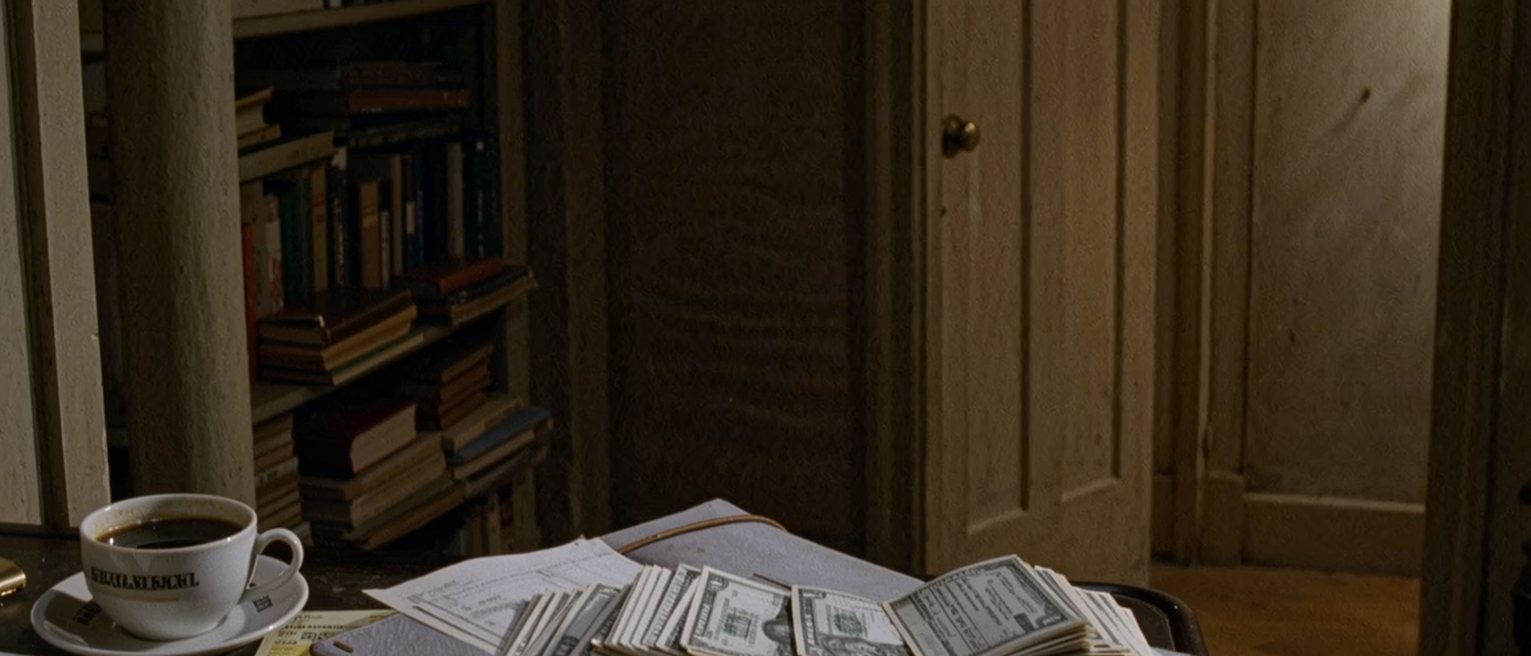
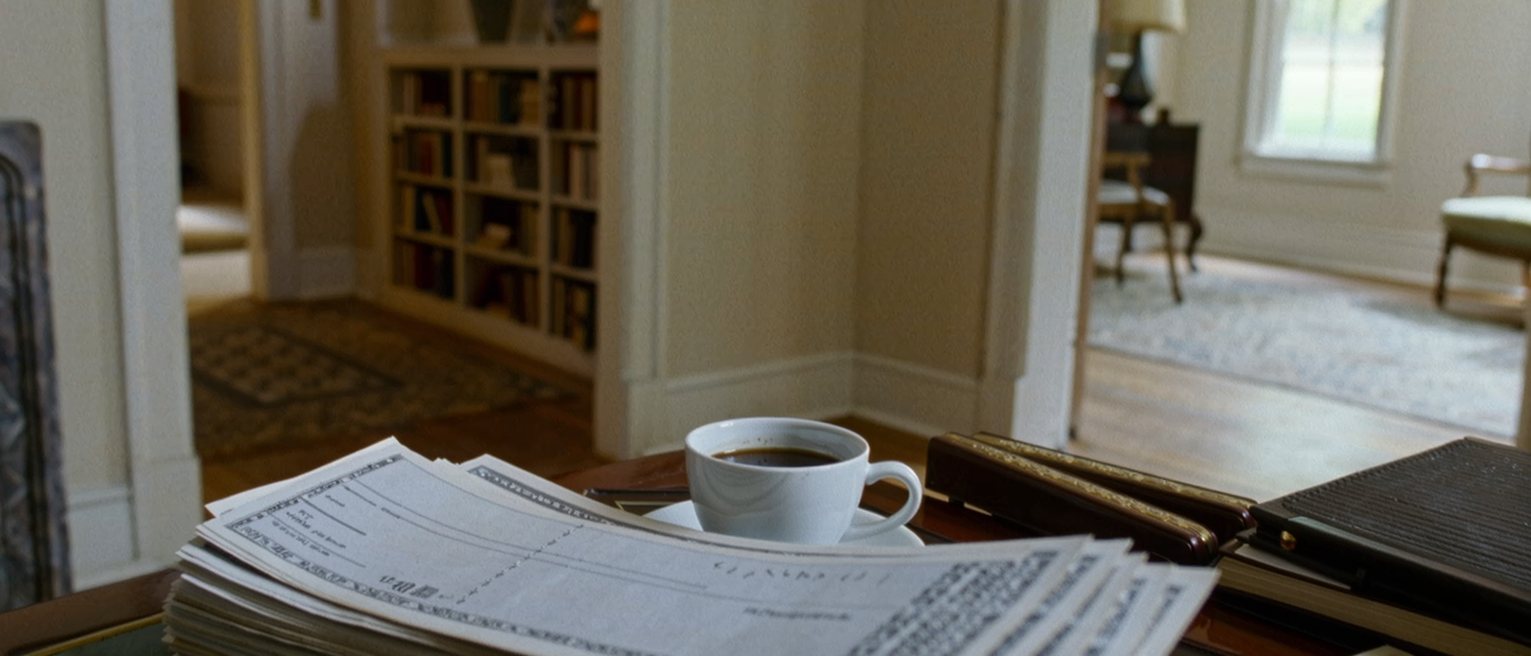
Money is borrowed, repeatedly, in amounts that are awkward rather than alarming. There are absences with thin explanations. There is a stated employer that nobody quite corroborates. There is a marked and unexplained physical decline. And there is a dinner party at which another guest, a filmmaker, says the thing out loud — but says it sideways, condescendingly, as a piece of social cruelty rather than a warning, which is precisely the register in which such information usually arrives and precisely the register in which it is easiest to discount.
Hogg keeps large events off the edge of the frame as a matter of method. The 1983 Harrods bombing is rendered as sound from outside the image, which is how it would have reached two people in a flat. The same technique governs the private material. Things happen adjacent to Julie, at the border of what she can see, and the film consistently declines to cut to them.
This is not coyness. It is an argument about the shape of knowledge. In life, a fact of this kind does not arrive whole. It arrives in fragments, out of order, from unreliable sources, mixed in with a great deal of other information, and each fragment is individually explicable. The explicability is the trap. A person who could account for every piece as it came has not been fooled; she has been supplied with a sequence of adequate explanations.
And so the film never gives her the thing that would let an audience relax: the moment of knowing, which would convert everything afterwards into a choice. Withholding it is the single most rigorous decision in the film, and it is the one that makes people uncomfortable enough to ask the question.
Each accommodation is defensible on its own
Here is the mechanism, stated as plainly as it can be, because everything usable in the film follows from it.
Consider what Julie is actually asked for, one request at a time. Lend me this, and I will return it. Do not make an issue of where I was. Accept this explanation, which is plausible. Come to this restaurant rather than that one. Do not ask in front of other people. Let this pass, since you have already let the larger version pass. Each of these, taken singly, is a request that a reasonable and generous person grants. Refusing any one of them would look, at the moment of refusal, like an overreaction.
That is the whole of it. There is no point at which the correct answer is obviously no. The situation never presents itself as a decision. It presents itself as a series of small courtesies, and the person extending them is behaving, at each step, exactly as a decent person behaves.
What makes it a trap rather than merely a sequence is that each accommodation raises the cost of the next refusal. Having lent money once, refusing the second time requires an accusation. Having accepted an explanation, questioning the next one implies the first was a lie. Having said nothing at the dinner, saying something at the next dinner means admitting she said nothing at the last. The ratchet is not built out of fear. It is built out of consistency, and out of the ordinary human reluctance to retroactively convict somebody you have already forgiven.
By the time the arrangement is visible as a whole, it is not a decision she declined to make. It is a place she is already living. And the crucial feature, which the film gets exactly right and almost every other treatment of this material gets wrong, is that she can describe her situation accurately at any point along the way. Clarity about each part is entirely compatible with not seeing the shape. That is why the film is precise rather than merely sad: it locates the problem at the level of structure rather than at the level of a person’s character.
Why the question is the wrong question
Now the question can be handled properly. How did she not know?
The question contains a premise, and the premise is false. It assumes that knowing is an event: that there is a point before which a person does not have the information and after which she does, and that the interesting question is why the point came so late. The film is an argument that knowing of this kind is not an event but a gradient, and that on a gradient there is no instant at which a reasonable person is obliged to act.
The question also runs backwards. It is asked by somebody holding the completed picture, which converts every ambiguous fragment into an obvious sign. Nothing in the film is ambiguous on a second viewing. Everything in it is ambiguous on the first, which is the condition she was actually in. Asking why she did not read the fragments as a pattern is asking why she did not have information that only exists once the sequence has ended.
And the question has a function, which is worth naming without accusing anybody of bad faith. It reassures the asker. If she failed to see something visible, then the asker, who would have seen it, is safe. The alternative — that a clever, well-supported, reasonably self-aware person can be inside an arrangement like this and be accurate about every individual part of it — offers no protection at all, which is why it is resisted.
This Library has published before on a related point: that nobody finds out what they want by thinking about it, because introspection is the wrong instrument for the job and a description of an experience is not the experience. The same instrument fails in the other direction too. A person cannot determine, by reflection, what somebody else is. Reflection operates on what has been supplied, and what has been supplied is a set of explanations that were built to be adequate.
So the honest replacement for the question is not a kinder version of it. It is a different question entirely: at what point would refusing have been obviously correct? Ask it of the film, scene by scene, and the answer is that there is no such point. That is not an excuse offered on Julie’s behalf. It is a description of the terrain.
Not stupidity, and not low self-worth
Two explanations are always reached for, and the film defeats both, which is the main reason it is worth the time of a reader who has no interest in British art cinema.
The first is that she must not be very bright, or at least not bright about this. The film makes this untenable by the simple device of showing her working. She is a student with a project. She argues about it, defends it, revises it, and is precise about what she is trying to do. Her intelligence is not asserted in dialogue; it is visible in her conduct, continuously, including during the period in which the arrangement is at its worst. Nothing about her judgement is switched off.
The second is that she must not value herself. This is the more flattering explanation and the more damaging one, because it converts a structural situation into a defect in the person, and it licenses the entire apparatus of advice that follows from that conversion. The film gives it nothing to work with. Julie is not abject. She is not begging. She has a family, a flat, an education, work she cares about and friends who are around. She is, by every external measure, a person with a great deal to fall back on.
This Library has already written about a related but distinct case: a novel in which a young woman reduces herself for a remote man, where the argument was that the shrinking is not the price she pays but the thing she is obtaining — relief from the labour of being a self. That reading holds for that book. It does not transfer here, and the difference is the point.
Julie is not being relieved of herself. She keeps her occupation throughout. The relationship does not become her project; the film is quite clear that her film remains her project, which is precisely why Part II exists. What she loses is not her self but her bearings — the outside view, the capacity to see the sequence as a sequence. Those are different losses, and the second one does not require any prior deficit to explain it.
Which leaves the uncomfortable residue. If it is not stupidity and not low self-worth, then the explanation has to be situational, and a situational explanation does not come with a reassurance attached. It says that the mechanism is available to competent people and that competence is not protective against it. That is the film’s actual finding and it is the reason the film is disliked by some people who admire everything about it except what it says.
The method is the argument
A film cannot show gradual not-knowing by ordinary means, because ordinary means require an actor who knows the ending to perform not knowing it. What results is dramatic irony: the audience watching a character walk into something, which is a completely different experience and produces exactly the question this essay is trying to retire.
Hogg’s way around this is the reason the film works, and it is documented in her own remarks and in her cast’s. She worked without a conventional screenplay. Honor Swinton Byrne has described the process as having no script, with each scene given an endpoint and the route to it left to her, and has said that Hogg would explain almost nothing before a first take and adjust afterwards. Hogg has said in interview that Swinton Byrne saw nothing of the writing, and that she instead gave her access to her own diaries from the period and to her early work — insight into who she was at that age, rather than into what happens next.
Two further decisions follow the same logic. The film was shot broadly in story order, so the performer discovered the narrative as the character did. And Hogg has said that she did not tell Swinton Byrne about the relationship the film draws on, which means the actor was working without the interpretive frame that every viewer brings.
The physical production is built on the same principle in reverse. Hogg reconstructed her own flat of the period as a set on a stage rather than filming in a real one, working from memory, and has described building sets from memory as her practice. Tom Burke was given a recording of the voice of the man Hogg knew, a detail she has stated publicly.
Hogg herself resists the word improvised, and the resistance is informative. There is a design; what has been removed is the dialogue. The distinction matters because it identifies what the method is for. An actor given the situation and not the lines cannot anticipate. She can only respond to what is actually in front of her with what she actually has — which is the precise condition the film is about, reproduced in the making of it rather than depicted.
That is why the film reads as an account rather than an interpretation. Julie does not see the pattern because Honor Swinton Byrne, scene by scene, had not been given it either.
The painting the film is named after
The title is borrowed from a small painting, and the borrowing is not decorative.
The Souvenir is an oil on panel by Jean-Honoré Fragonard, dated to roughly 1776 to 1778, measuring about 25 by 19 centimetres, held by the Wallace Collection in London as P382. It shows a young woman in a pale dress carving a letter into the bark of a tree, watched by a small dog. The collection’s own record notes that a sale catalogue of 1792 identified the young woman as Julie, the heroine of Rousseau, and reads the spaniel as a figure of fidelity.
The film’s Julie shares the name. In the film the two characters stand in front of the painting together, and the exchange they have is the entire thesis in miniature: she says the young woman looks sad, and he says he thinks she looks determined. Neither is misreading. The surface supports both.
Hogg has said publicly that she was shown that painting by the man she knew at the time, and that it mattered more to him than to her. That is her account of it and it is stated here as her account.
What the scene does inside the film is establish, early and without commentary, that two people can look at the same object with equal attention and derive incompatible readings, and that nothing further in the object will settle which is right. Everything that follows is an extension of that: a woman looking closely at a surface that continues to support more than one account of itself. The painting is not a clue. It is a demonstration of why clues do not work.
What Part II does differently
The Souvenir Part II premiered in the Directors Fortnight at Cannes on 8 July 2021. A24 released it in the United States on 29 October 2021 and Picturehouse in the United Kingdom and Ireland on 4 February 2022. It runs 107 minutes, and at the 2021 British Independent Film Awards it won three craft prizes — costume design, editing and production design — having been nominated in six further categories and having won nothing at all as the first film two years earlier.
Part II picks up after the relationship has ended and follows Julie attempting to make her graduation film about it. It is therefore about the work of construction rather than about the experience, and the move that matters is this. Part II does not supply the revelation that Part I withheld. Julie does not arrive at an understanding that reorganises the past. What she does instead is build it: she reconstructs the flat on a stage, directs other people through versions of what happened, gets it wrong, argues with her crew, and works. Understanding, in this account, is not something that strikes a person. It is something a person manufactures afterwards, laboriously, with equipment.
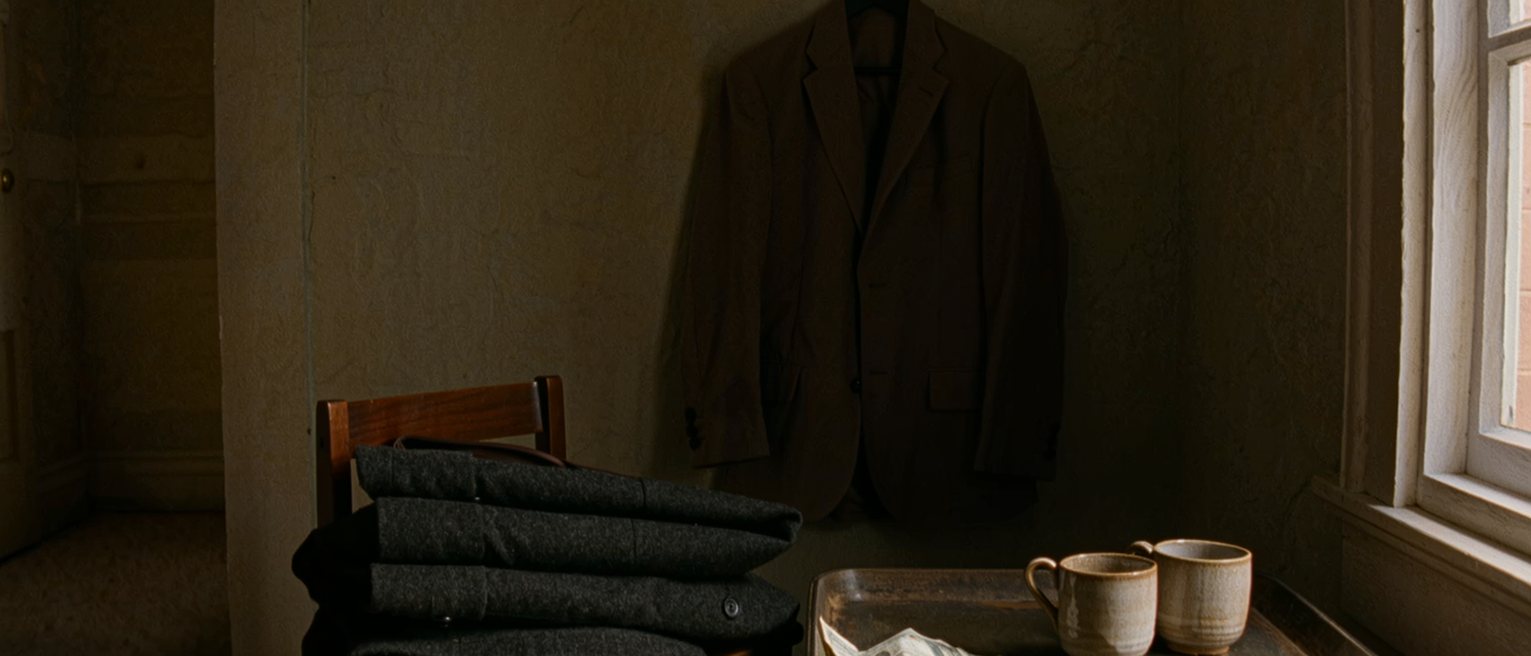
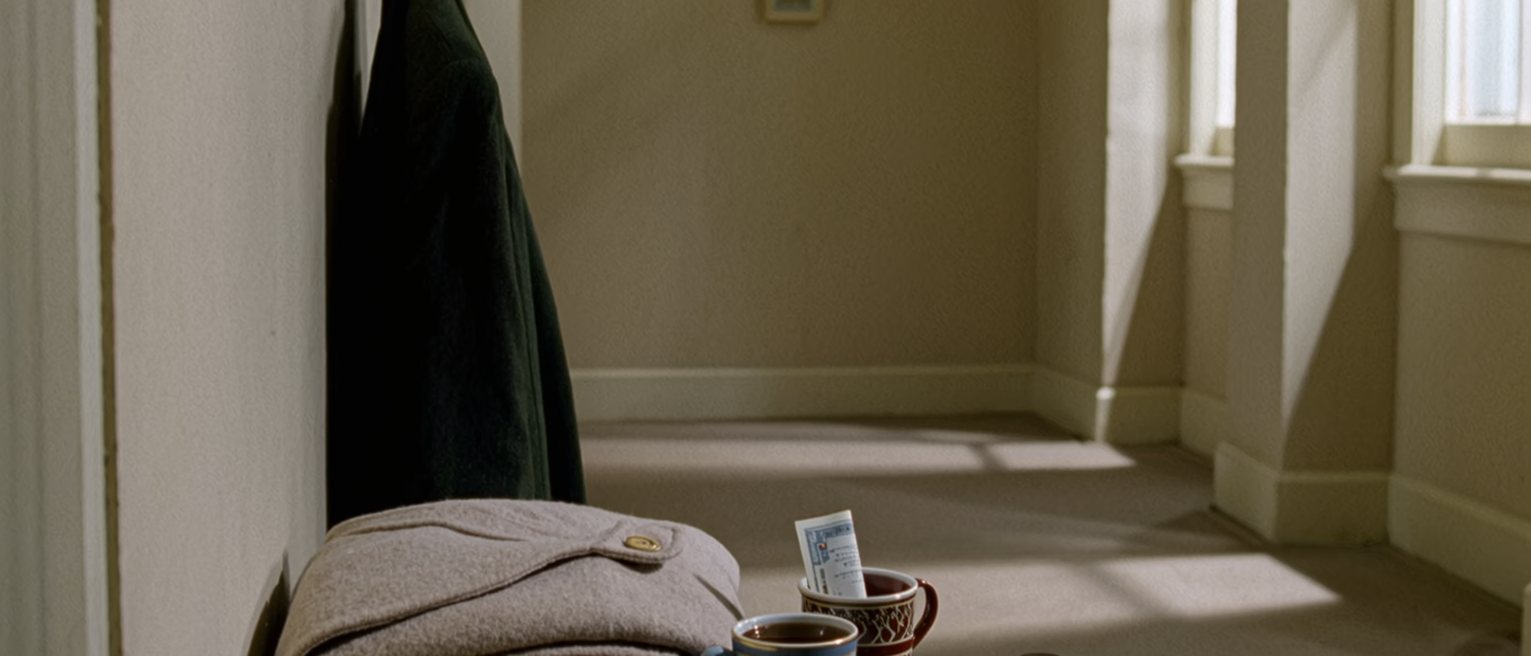
The reconstruction is doubled in a way that would be a joke if it were not so exact. Hogg built the flat as a set for Part I. In Part II, Julie builds the flat as a set. The audience is watching a director film a student building the thing the director built, which makes the point about retrospective construction structurally rather than by stating it.
And it is the clearest available reply to the question. If knowing had been an event, Part II would have no subject. The existence of a second film, largely occupied with the effort of assembling an account, is an argument that assembling the account is the work — and that it happens long after the period in which somebody might have been expected to know.
What this house sells, and what that does to this argument
This has to be said here rather than in a footnote, and stated against our own interest first.
This house sells bounded private companionship: a stated number of hours, terms set in advance by the person booking, a beginning and an end that do not move with anybody’s mood. Which means that an essay arguing that harm accumulates where there is no decision point is an essay that makes our product look like the remedy. It is difficult to design a reading of a film more convenient to us than this one.
So the declaration comes with constraints on what may be claimed from it, and they are listed rather than implied.
We do not claim that a bounded arrangement protects anybody from anything. The mechanism described in this essay operates in ordinary relationships between people who owe each other a great deal, and nothing purchasable prevents it. An evening here is not a safeguard and we will not describe it as one.
We do not offer advice about anybody’s relationship. Nothing in this essay says what a reader should do, and nothing here should be read as an assessment of anybody’s circumstances. We are not qualified to make that assessment, we have not been asked to, and a publication that sells an adjacent service has no business making it.
We do not claim that the film endorses anything, or that Hogg, her cast, her distributors or the Wallace Collection know of this house or would approve of it. They do not and have not been asked.
And we do not claim that our reading is the film’s intention. Hogg has been notably unwilling to state what her films mean, which is one of the better things about her, and this essay is a reading produced by a commercial publication with an interest in a particular conclusion.
The strongest case against this essay, and against the film
Three objections are worth stating at full strength. Two of them land.
The first is about class, and it is the most frequently made. Julie has a flat in Knightsbridge paid for by her parents, a mother who can be asked for money and gives it, a film school place, and an education that supplies both her confidence and her subject. The cushion is what makes the story survivable, and the film does not interrogate it so much as furnish it. Writing in The Arts Desk in February 2022, Graham Fuller pressed a related version of this at the sequel: that Hogg applies the techniques of social realism to a subject at the top of the social order, and that Part II ends up treating a privileged character’s turn away from a working-class subject as a liberation. That is a serious charge and the reply available to it is thin. A version of Julie without the parental flat is a version who becomes homeless, and the film would then be about something else — which is another way of saying that the film’s subject is only available to a person with somewhere to fall.
The second is that the film’s sympathy for Julie leaves Anthony thin. He is opaque by construction, and opacity is generous to the person looking at him from outside. Because we are with her, he can remain a surface. A film that gave him interiority — that let the audience see the arrangement from his side, with whatever he was managing — would be harder, less coherent, and possibly more honest. Part II makes this partly worse: the parents, the friends, the other men all acquire dimension, and he stays where he was. This objection is largely correct and this essay has reproduced the fault, because it too has looked at him only as the surface Julie was reading.
The third is the one that bears directly on this essay and it is the sharpest. An argument that she could not have known is an argument that removes her agency in the course of defending her. If nothing she might have done would have made a difference, she is no longer a person who acted; she is a location where something happened. That is a poor thing to do to a woman under the banner of taking her seriously, and it is the mirror image of the condescension the essay set out to refuse.
This one is a misreading, and the correction is narrow rather than triumphant. The claim here is not that Julie had no agency. It is that she was exercising agency continuously, on the information in front of her, and that each exercise of it was reasonable. That is a stronger attribution of agency than the alternative, which holds that she was passive until a revelation arrived to activate her. What is denied is not her capacity to choose. What is denied is that the situation ever presented her with the choice in the form that the question assumes.
Which leaves the class objection standing, mostly unanswered, and the Anthony objection standing entirely. An essay that conceded neither would be worth less than one that concedes both.
What this does not claim
This is a reading of a film. It is not clinical guidance, it describes no treatment, it promises no outcome, and it diagnoses nobody. Nothing here is an assessment of any reader’s situation, and nothing here is advice about whether to remain with or leave any person.
Nothing in this essay is a claim about addiction. Anthony is a character in a film and is described here as the film renders him. No statement is made or implied about dependency as a category, about what it does to anybody, about how it should be recognised, or about what anybody living near it should do. Where the film draws on a person in Joanna Hogg’s life, this essay reports only what Hogg has said publicly and treats the rest as the film’s construction, not as biography. Hogg has herself said that she does not always know what in the film is memory, and that qualification applies to everything above.
Festival, award, release and running-time details are taken from the festival’s own published announcement, from the awards body’s published listings and from encyclopaedic and distributor records read in September 2026, not from attendance at any screening or ceremony. On the first film’s nomination count the sources do not agree — one record gives eight nominations at the 2019 British Independent Film Awards and the awards body’s own listing yields nine on a count of its categories — so no number is stated in the body, only that there were many and that none of them converted.
Statements about how the films were made come from what Hogg and Honor Swinton Byrne have said in published interviews. They are accounts given afterwards by people with an interest in how the work is understood, they are not a production record, and the phrase without a script is the cast’s; Hogg has resisted the word improvised and the essay says so.
The bibliographic details of the Fragonard are from the Wallace Collection’s own catalogue record. The identification of the young woman in it as Rousseau’s Julie is attributed by that record to a sale catalogue of 1792 and is a matter of art-historical attribution rather than settled fact. No dialogue from either film is quoted at length; the exchange in front of the painting is characterised in outline.
The central reading — that the film’s subject is accumulation rather than blindness, and that the question of how she did not know is malformed — is this Library’s interpretation. Hogg does not state it in those terms and has generally declined to state what her films mean. A reader may hold that the film is more critical of Julie than this essay allows, and the counter-reading above gives the strongest versions of the case against.
This house sells private companionship and therefore has a commercial interest in an argument of this shape. That is stated in the body rather than here. No figure about relationships, harm or prevalence appears anywhere in this essay, because none was needed and none would have been honest.