Cinema
Wife of a Spy, and What She Agrees to Know
A merchant comes back from Manchuria with something he has seen, and begins acting on it. His wife decides she will not go on being an audience for her own marriage. A reading of Kurosawa Kiyoshi’s 2020 film as an argument about the price of admission: that being let into what another person knows is not a reward for love but a liability, and that a marriage in which one party holds the material facts cannot be made equal on any cheaper terms.
Kobe, 1940. A trading house still does business with foreigners, a wife still wears Western clothes and drinks imported liquor, and the military police have begun to take an interest in both. The husband goes to Manchuria on business, stays two weeks longer than planned, and comes home with a woman he does not mention, a notebook, and a reel of film. From that point the marriage is not the same arrangement, and the reason is not jealousy.
This essay is about スパイの妻, Wife of a Spy, directed by Kurosawa Kiyoshi and released in 2020. It discusses the premise, the central situation and developments late in the film, including what the husband brought back and how the story ends. A reader who wants to meet the film cold should stop here.
The usual description of the film is that a wife chooses love over country. That description is available, the film supplies it, and it is not what this essay thinks the film is doing. What Satoko does is narrower and stranger. She stops being a spectator of her husband’s inner life and demands entry to it. She does not ask to be reassured, she asks to be told. And the film’s cruelty — the thing that makes it a hard watch rather than a stirring one — is that entry turns out not to be a reward. It is a liability, transferred to her in full, attached to consequences she did not choose and cannot now decline.
That is the argument here. Her declaration is not devotion. It is a bid for standing. And standing, once granted, is not a feeling. It is exposure.
What the film is, and the odd fact of how it was made
Wife of a Spy was produced by NHK and first went out as television. It was broadcast on NHK BS4K and NHK BS8K on 6 June 2020, running 114 minutes. A theatrical version was then prepared with a different aspect ratio and different colour grading; that version had its world premiere in competition at the 77th Venice International Film Festival on 8 September 2020, and opened in Japan on 16 October 2020 through Bitters End at 115 minutes.
At Venice, the official record of the Biennale lists the Silver Lion for Best Direction to Kurosawa Kiyoshi for Spy no Tsuma. The Golden Lion that year went to Nomadland. This is worth stating precisely because the sequence is unusual: a film commissioned for an ultra-high-definition broadcast platform, aired domestically to a small audience with the hardware to receive it, then regraded and reframed and sent to a competition where it won a directing prize. It is a television programme that became a festival film, in that order, and the essay returns to the consequences of that order later.
The screenplay is credited to Hamaguchi Ryusuke, Nohara Tadashi and Kurosawa. The project began from Nohara, a former student of Kurosawa’s, who brought him the idea of an 8K NHK drama set in Kobe; Nohara and Hamaguchi built the plot together. The period streets were shot on an existing open set. A scene from Yamanaka Sadao’s 1936 film appears within the film. It is Kurosawa’s first work that is not set in his own present.
Kurosawa’s body of work is longer and stranger than the label that follows him. His international reputation began with Cure in 1997, which the Criterion Collection describes as his arresting international breakthrough and as a leading work of an emerging wave of Japanese horror. The Cannes record shows Kairo in Un Certain Regard in 2001, Akarui Mirai in Competition in 2003, Tokyo Sonata in Un Certain Regard in 2008 where it took the Jury Prize of that section, Kishibe no Tabi in Un Certain Regard in 2015 where he took the Best Directing prize of that section, and Sanpo Suru Shinryakusha in Un Certain Regard in 2017. Tokyo Sonata is a film about a household arrangement — about a man who loses his job and keeps leaving the house each morning anyway. This one is not about an arrangement. It is about knowledge, and about who is allowed to hold it.
What the husband saw, and what the record establishes
These are two different things and this essay keeps them apart.
What the film depicts is this. Yusaku travels to Manchuria with his nephew Fumio. He returns with a woman, Kusakabe Hiroko, who is dead shortly afterwards. He also returns with a notebook taken from a doctor, an English translation of it made by Fumio, and a short film shot inside a facility. When Satoko finally gets the account from him, he describes biological experiments carried out on civilians, including the deliberate spreading of plague. The short film, when it is finally watched, contains the facility, corpses, a vivisection and the burning of bodies. The unit responsible is not named on screen. The film gives it no acronym, no number and no title card.
What the historical record establishes is separate, better documented, and not the film’s to soften. A biological warfare programme was run by the Japanese Kwantung Army in occupied north-east China under an innocuous cover designation, and it conducted large-scale human experimentation on captive people. A review published in Medical History in 2026 by Yang Yanjun and Wang An, surveying seven decades of scholarship on the subject, describes it in those terms: secret, large-scale, inhumane and unethical human experimentation in China, and one of the most serious medical atrocities and crimes against humanity of the Asia-Pacific war. A 2022 article by Kathryn Johnson in the Journal of the History of Medicine and Allied Sciences works from the testimony given at the Soviet Khabarovsk war crimes trial and argues that the inoculation and airborne-dispersal experiments on prisoners were methodologically rigorous rather than crude, and that their results were carried through to operational use during the war in China.
And there is the part that the film gestures at through Yusaku’s plan and does not follow to its end. Jing-Bao Nie, writing in the American Journal of Bioethics in 2006, sets out that the United States government secretly granted immunity from war crimes prosecution to those involved, in order to monopolise the data, withheld material from the International Military Tribunal for the Far East, and publicly disparaged evidence produced elsewhere, including at Khabarovsk. Nie’s article is an argument, with proposals attached, and it is cited here as an argument. But the immunity arrangement is the reason a viewer should not read Yusaku’s scheme as a plan that would obviously have worked.
One thing must be said plainly before this essay goes any further, because the rest of it is about a marriage. The people in that facility were people. They are not a device for raising the stakes of a Kobe household, they are not a metaphor for what a husband hides from a wife, and nothing in the argument that follows is offered as a reading of them or of what was done to them. A film may choose to look at an atrocity through the small aperture of two people in a drawing room. An essay about that film inherits an obligation not to pretend the aperture is the subject.
Before: a wife with excellent seats
The marriage the film opens with is not unhappy and is not equal, and the film is very exact about the shape of the inequality.
Satoko has everything a viewer would list as evidence of a good marriage. She is adored, indulged, spoken to warmly. She has a beautiful house, imported things, a husband who is amused by her and takes her seriously as company. She acts in the amateur film he shoots with his nephew, playing a glamorous thief. She is, in every scene of the first stretch, the most attended-to person in the room.
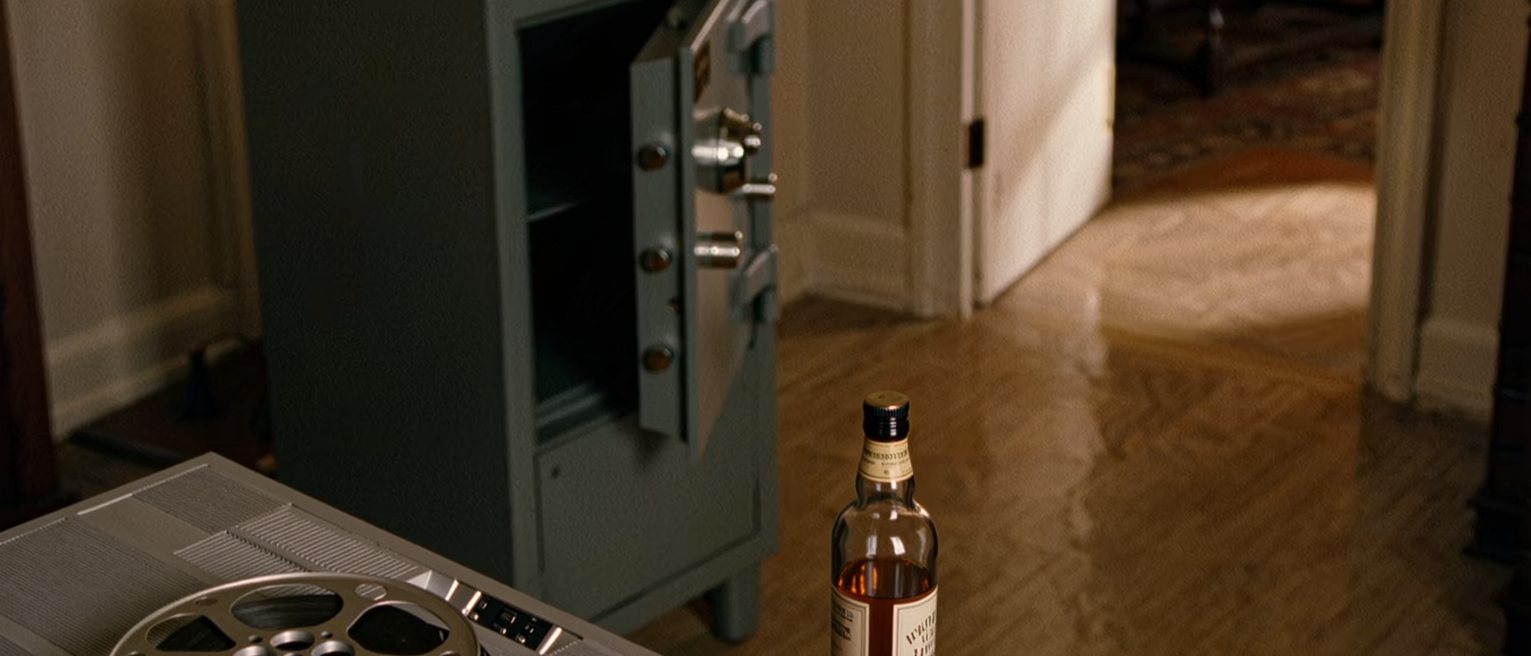
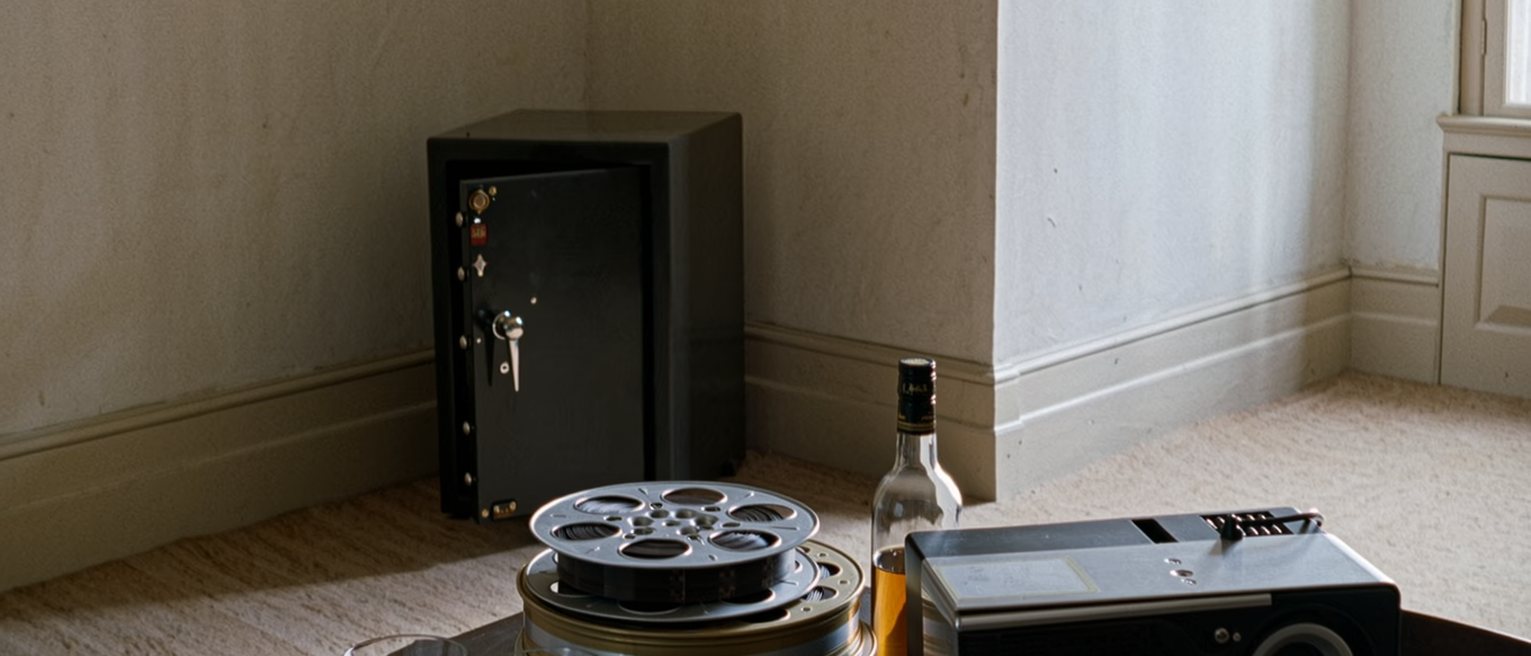
What she does not have is access. Her husband has a business, associates, a nephew he confides in, travel she does not share, and an interior life she experiences as a performance staged for her benefit. The film makes this almost too neat in one detail: she learns the combination of his office safe because it is used as a prop while they are shooting. She holds the key to the most private object in his working life, and she holds it as an actress holds a line. The information reaches her as entertainment.
This is the condition the essay wants to name, because it is not rare and it does not look like a problem. A person can be loved, consulted, enjoyed and materially cared for, and still be positioned as the audience for the other person’s life rather than a party to it. Nothing is being refused. There is simply no offer, and the absence of an offer is invisible while nothing is at stake.
Then something is at stake, and the seating arrangement becomes intolerable.
What she actually demands, which is not reassurance
Watch what Satoko asks for once she begins to suspect. She does not ask whether he loves her. She does not ask him to choose her. She asks to be told what happened, and she keeps asking until she is told.
The distinction matters more than it looks. A request for reassurance leaves the structure of the marriage exactly as it was: one person holds the facts, the other is managed. A demand to be told dismantles that structure, because information cannot be given back. Reassurance is renewable. Knowledge is not.
And the film is unusually clear-eyed about why she wants it. The scene with Fumio at the inn is the hinge. He is wrecked, and he turns on her, and what he accuses her of is not disloyalty but unseeing comfort — the charge that her pleasant life is underwritten by a refusal to look. Whether or not that is fair to her, it lands, because it names her position rather than her character. She is not being told she is a bad person. She is being told she is a spectator.
When she finally confronts Yusaku, she puts to him the worst construction she can find: that he is spying for a foreign power and does not care what becomes of them. His answer is that he is not spying for anyone and that he intends to make what he saw public in the name of justice. Whatever a viewer makes of that answer, notice what it does to her. It admits her to the account. It does not make her safe.
This Library has argued elsewhere, in its reading of The Souvenir, that the question how did she not know is usually the wrong question, because what holds a person in an arrangement is rarely stupidity and is usually the absence of any single moment at which refusal would have been obviously correct. Wife of a Spy runs the other experiment. It gives its heroine the moment. It lets her refuse the arrangement, out loud, in a room, in one conversation. And then it spends the rest of its running time showing what that costs.
The ledger of admission
From the moment she knows, every subsequent event in the film is a consequence she has to carry, and the film is scrupulous about not letting her off any of them.
She opens the safe using the combination she learned as a prop, and takes the Japanese notebook. She knocks the chess pieces out of position and cannot restore them, and that is how he discovers her. She gives the notebook to Tsumori Taiji — the childhood friend who is now leading the military police unit watching her husband — on her own reasoning that Fumio will not break. Fumio is arrested and tortured. He confesses to acting alone. The reasoning holds, and it holds at a price she set for someone else.
That is the sequence a first viewing tends to move past quickly, and it is the heart of the film. Satoko does not act badly because she is foolish or jealous. She acts on partial information at speed, in a situation with no reversal, and she does it precisely because she has been let in. Spectators are not in a position to make errors of this kind. Only parties are.
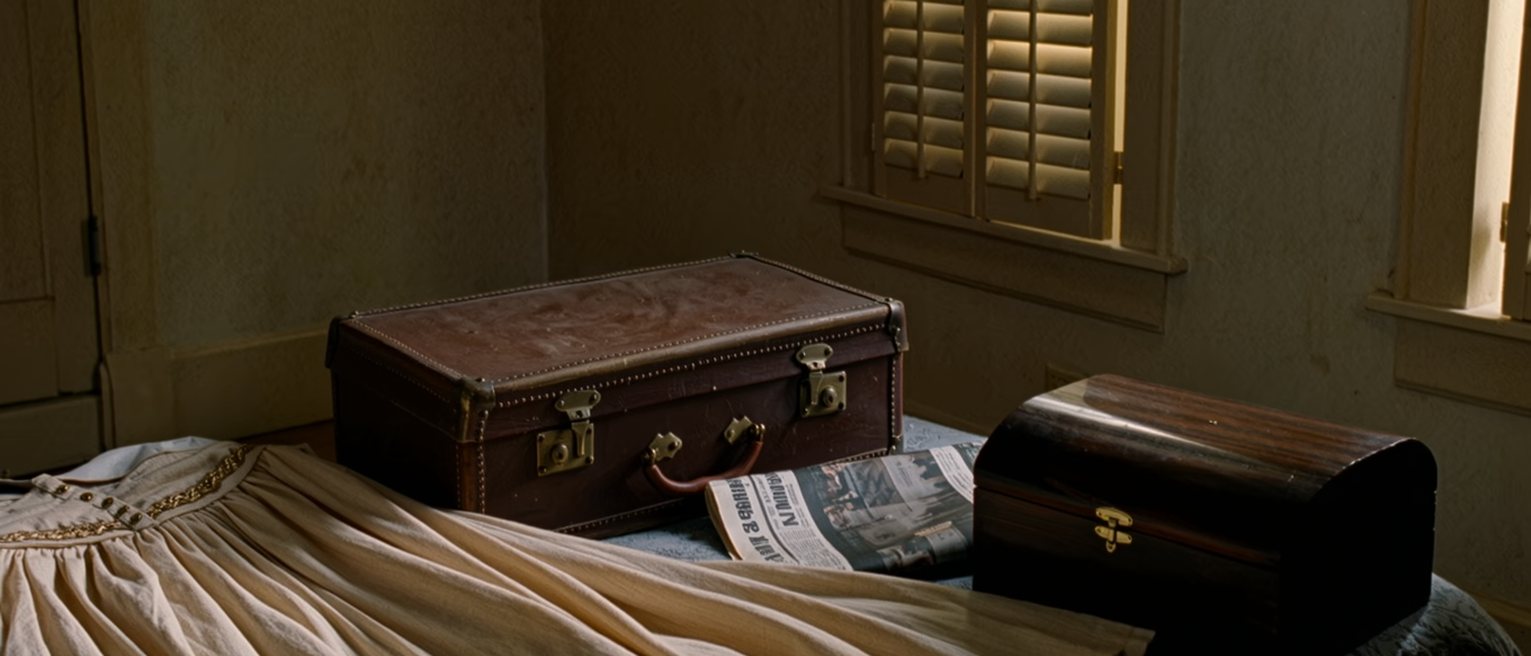
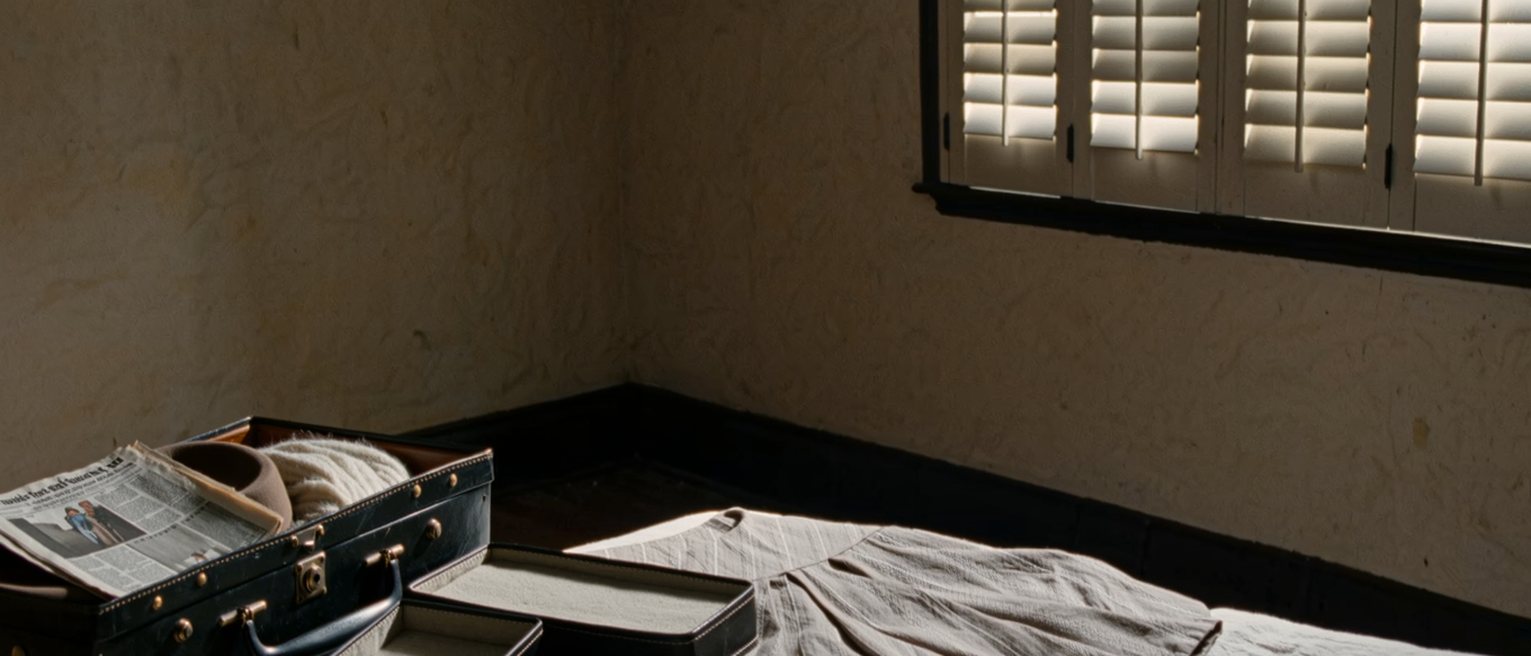
What follows extends the ledger. They convert money into watches and jewellery. They plan the passage. He proposes they split up: she will go in a shipping crate on a freighter with the film of the experiments, he will go from Shanghai. She is betrayed by the man paid to smuggle her, found in the crate, and brought before Tsumori, who strikes her and tells her she deserves to die for treason. Then the police screen the reel she was carrying, and it is the amateur heist film. He swapped it. There is no evidence against her, and she is released.
She spends much of the remaining war in a hospital, confined. In March 1945 a doctor who knows them both tells her he has heard a rumour: Yusaku was seen boarding a ship for Los Angeles, and the ship is believed to have gone down. That night the hospital is destroyed in an air raid on Kobe. She walks out barefoot, goes to the shore and breaks. The closing captions state that Yusaku was declared dead in 1946 with signs of forgery on the certificate, and that Satoko left for the United States some years later.
Being let in is not the same as being a partner
The swapped reel is where this essay’s argument becomes unavoidable, so it is worth being slow about it.
By the time of the crate, Satoko has been told everything. She knows what he saw, why he is doing it, what the notebook is, what the film contains. She has acted on that knowledge, at cost, including one action that sent another person to a cell. By any ordinary account she is now inside the enterprise. And at the last moment he substitutes one reel for another without telling her, so that the thing she believed she was carrying — the proof, the reason, the whole point — was never in the crate.
It is possible to read that as protection, and the film leaves the reading open. It is possible to read it as the operationally correct move. But it is not possible to read it as partnership. A partner is a person who knows what is in the box. What Yusaku grants Satoko is access to the account and not authorship of it. She is admitted to the knowledge and still handled within it.
This is the thing the film knows that most films about loyal wives do not. Admission and standing are different goods. Admission can be given as a gift, withdrawn as a kindness, and revised without notice. Standing would mean that her judgement enters the plan and can change it. She never receives that, and one of the reasons the ending is unbearable rather than tragic is that it is not clear she ever asks for it either.
Two critics writing together in Ultra Dogme in May 2021, Patrick Preziosi and Ryan Swen, put it in a phrase that this essay has not been able to improve on: after watching the reel she becomes what she perceives as an equal partner in his mission. The perception is hers. The film does not confirm it.
So the usable proposition, stated as plainly as it can be: in a relationship where one person holds the material facts, being told is necessary and is not sufficient. The inequality is not closed by disclosure. It is closed, if at all, by the other person accepting the exposure that the facts carry — and by the holder giving up the right to decide, unilaterally and afterwards, how much of that exposure the other is permitted to run. Disclosure without that second half is not equality. It is a better-informed audience.
Where this differs from two earlier essays of this Library
This house has been circling this territory for a while, and honesty requires saying where the new ground is.
In its essay on 45 Years, this Library argued that Kate’s crisis is epistemic rather than romantic: one new fact is admitted and forty-five years of accumulated evidence becomes available to a second reading, so that nothing in the marriage changes and everything in it changes. The subject there is the meaning of a past that is already finished. The fact is old, verified, and cannot be acted on. What is in dispute is what it made the marriage.
In its essay on Anatomy of a Fall, this Library argued that what a court actually examines is not a death but a marriage, and that the terrible thing about the recorded argument is that it is an ordinary fight played in a room where being recognisable is read as motive. The subject there is an account surrendered to a third party that has a procedure and will rule. What is in dispute is a description, and the dispute is settled by an institution.
Wife of a Spy is neither. Nothing here is being contested after the fact, because the fact is still in motion. The account is being written while Satoko asks to read it. That is what makes the admission expensive: she is not being asked to accept a revised story about a life already lived, she is being asked to accept liability for a course of action that has not finished happening. In the two earlier cases the woman is trying to settle what a marriage was. Here she is trying to obtain a share in what it is about to do, and the share she obtains is real enough to convict her and partial enough to leave her carrying the wrong reel.
That is the differences stated without inflating them. All three films are about the asymmetry of description inside a couple. Only this one attaches a price list.
The part that is portable
A reading is only worth writing down if some of it can be taken out of the cinema, so here is the portable part, stated without instruction and without any claim about any particular reader.
First, that wanting to be told is not the same as wanting to be comforted, and the two requests are frequently confused by both parties. The person asking often cannot tell which they are doing. The person asked usually assumes the second, because the second is cheaper and preserves their position. A great many conversations fail at exactly this substitution.
Second, that knowledge in a relationship is not inert. It is not a token of closeness which, once handed over, sits there being reassuring. It changes what the recipient is responsible for, what they can be asked, what they are exposed to, and what a third party could one day compel from them. That is not an argument for secrecy. It is an argument for describing accurately what is being handed over.
Third, that a person who holds the facts retains a form of authorship even after disclosing them, and that this residue is where inequality survives. The holder decides the order, the framing, the timing and the omissions. Satoko is told the truth and still does not know which reel is in the crate. Being inside an account does not automatically mean being able to alter it.
And fourth, an observation the film earns and this essay will not soften: the point at which she gains standing is also the point at which she begins to be punished for it. Nothing in the film suggests she was wrong to want in. It suggests, with some ruthlessness, that wanting in and being safe were never available at the same time, and that no amount of love on either side was going to make them available.
What this house sells, and what it may not claim
A publication should state its interest before it has finished persuading, not after.
This house sells private companionship. What a person buys here is, among other things, a period of somebody’s undivided attention. So an essay arguing that admission to another person’s inner life is scarce, valuable and expensive is an essay that runs in our commercial direction, and a reader is entitled to weigh it accordingly.
The constraints that follow are worth setting out as refusals rather than as a disclaimer. This house does not claim that a paid evening supplies what Satoko was asking for. It does not, and the film is a fairly brutal illustration of why: what she wanted was standing inside a shared life with consequences, and an arrangement that is bounded, scheduled and paid for is the opposite of that by design. Nothing offered here carries the liability that makes admission worth having in the film.
This house does not claim any outcome. Nothing above says that an evening improves a marriage, repairs a silence, or teaches anybody how to ask to be told. It would be easy to write that sentence and it would not be true.
This house does not diagnose the reader. Nothing here says that a person whose partner keeps their working life at a distance is in a damaged relationship. Many people prefer that arrangement, and the film is not evidence about anybody’s marriage but the one it invents.
And this house has no relationship with the film. Neither the director, the writers, the performers, NHK, Bitters End nor any critic named above knows of this house or endorses it, and the film is discussed here as a published work, which anybody may do.
The strongest case against this reading
Four objections, each stated at full strength before any answer is offered.
The first is that this essay flatters a character the film deliberately keeps opaque. Kurosawa gives Satoko a stylised, period-inflected register — the deliberately old-fashioned speech was the writers’ idea — and shoots her in a way that refuses interiority almost throughout. A reader is free to see, instead of a woman making an epistemic demand, a woman who barely understands what she has entered, whose reasoning about Fumio is self-serving, and whose famous resolve is a romantic gesture the film then punishes. Calling that a bid for standing is an upgrade the text may not authorise. The honest answer is a narrowing rather than a rebuttal: this essay is a reading of what her actions accomplish, not a claim about what she is thinking, and the film withholds the second so completely that anybody asserting it is inventing. The argument stands on the structure of the situation. It does not stand on Satoko’s inner state and does not pretend to know it.
The second is that the melodrama and the historical subject sit badly together. The film is, in the end, a story about a beautiful couple, a coastal city, a doomed voyage and a scream on a beach, and it uses an atrocity as the engine of that story. Critics registered the discomfort in different ways. Writing in Film Threat in September 2021, Swapnil Dhruv Bose observed that Kurosawa had the opportunity to examine the visceral impact of Japan’s war crimes and adopted another approach, focusing on the memory of war rather than the spectacle of human depravity, which Bose treats as a missed opportunity even while rating the film highly. Writing in In Review Online in September 2021, M. G. Mailloux described the film as an uneasy melodrama pitting romantic and political passion against each other. This objection is not answerable by pointing out that the film is tasteful about what it shows. A story can be restrained and still be borrowing weight. The most that can be said in the film’s favour is that it declines to dramatise the experiments as spectacle and keeps the reel mostly off our screen, and the most that can be said against it is that the decision not to look is also a decision that keeps the marriage in the foreground. Both of those are true at once.
The third is about the image. Because the film was made for an ultra-high-definition broadcast, it looks like a very expensive television production, and several critics said so. Reviewing it for Deep Focus Review in September 2021, Brian Eggert wrote that it was initially made for Japanese television, that the interiors and street scenes appear stagey and the performers look like they are wearing costumes, and compared the effect to Masterpiece Theatre. Mailloux described the 8K cinematography as crisp and stately and credited it directly to NHK. Preziosi and Swen discussed the frame rate as a formal problem, noting the existence of versions at thirty and at twenty-four frames per second and the frisson of a period piece shot at the higher rate. Kurosawa himself told Filmmaker Magazine in October 2021 that he automatically had to work this way because the television version was in 8K, that few people were able to see that version because of the hardware, and that the film version has a calmer sense to it, closer to the tone of his past work. A reader who finds the image sterile is not missing something. They are noticing the production history.
The fourth objection is the one aimed here. A business that sells a woman admission to someone’s attention has an obvious interest in the proposition that admission is precious and costly. If being let in were cheap and ordinary, this house would be selling something less interesting. The objection is correct as far as it goes and there is no clever reply to it. What can be done is to keep the interest visible, to refuse the outcome claims that would make it profitable, and to say clearly that the film’s own verdict is not flattering to the proposition at all: in Wife of a Spy, admission is granted, it is real, it is expensive, and it does not save anybody. That is not a sales pitch. It is closer to a warning, and it is left standing.
What this does not claim
This essay is a reading of a film. It is not history, not guidance, not therapy, and not a description of any reader’s marriage.
Every statement about what happens in Wife of a Spy is a statement about the film. Satoko, Yusaku, Fumio, Tsumori and Kusakabe Hiroko are characters. No claim is made about any real person, and no inner state is attributed to a character as established fact; where the essay says what an action accomplishes, that is a reading and is marked as one.
The historical material is treated separately from the film throughout, and deliberately so. The film does not name the unit responsible on screen. The record of the Japanese Kwantung Army’s biological warfare programme, its human experimentation in occupied China, and the post-war grant of immunity is taken from three peer-reviewed sources named in the body — Nie in the American Journal of Bioethics in 2006, Johnson in the Journal of the History of Medicine and Allied Sciences in 2022, and Yang and Wang in Medical History in 2026 — and each is reported as what it is, an article making an argument from documented material rather than a settled tally. No number of victims is asserted anywhere in this essay, because the figures in circulation vary by definition and by source and this Library has not audited them. The people who were killed are not a metaphor, not a device, and not part of the argument about a marriage.
On the production and awards record: the 6 June 2020 NHK BS4K and BS8K broadcast, the 8 September 2020 Venice premiere, the 16 October 2020 Japanese release through Bitters End and the running times are taken from the film’s published records and from the festival’s own listings. The Silver Lion for Best Direction is taken from the official awards of the 77th Venice International Film Festival. Wins and nominations are distinguished: the Kinema Junpo Best Ten named it the best Japanese film of 2020 and gave its screenplay award to Hamaguchi, Nohara and Kurosawa; the 15th Asian Film Awards gave it Best Film, Best Actress to Aoi Yu and Best Costume Design; the ELLE Cinema Awards 2020 gave Best Actress to Aoi Yu and Best Director to Kurosawa. At the 75th Mainichi Film Awards, where the film led the field with ten nominations, Aoi Yu was nominated for Best Actress and the prize went to Mizukawa Asami, and Kurosawa was nominated for Best Director and the prize went to Kawase Naomi. The film does not appear in the 44th Japan Academy Film Prize at all, in any category, on that ceremony’s own published list; this essay records that absence without explaining it, because the reason is not documented anywhere this Library has read.
Critical opinions are attributed to the critic and the publication, and appear because they state the counter-case, not because this Library endorses them. Where Kurosawa’s own view of the 8K production is reported, it is reported from a published interview.
No dialogue from the film is reproduced at length. This house’s commercial interest in the essay’s central proposition is declared in the body rather than only here, and nobody involved in the film is implied to know of this house or to approve of it.