Moonlight Journal
A Room With No History Is the Only Room Where She Is Not the Host.
The inquiry form asks where an evening should happen, and the question looks logistical. It is not. Every room a woman can choose already has a role waiting for her in it: at home she is the one who keeps the house, in a city hotel she is the name at the front desk, in the other kind of hotel she is whatever the street decides she is. The room that lets her stop being any of those is the one that carries no history of her, and choosing it is not a detail. It is the first decision of the evening.
Near the bottom of the inquiry form there is a field that asks where the evening should happen, and it offers three answers: a hotel she books, a hotel the house suggests, her own home. It sits among the practical questions — the day, the hours, the distance — and it looks like one of them. A woman filling in the form for the first time tends to leave it until last, and then tends to sit with it longer than she sat with anything else on the page.
This essay is written from her side, on the row the workbook names for venues and hotels, and it argues that her hesitation is not indecision about logistics. It is the correct response to a question that is not logistical at all. Each of the three answers is a different room, and each room already has a role in it waiting for her to walk in and take it up. The choice she is being asked to make is which role she can bear to occupy for the length of an evening — and whether there is any room in which she can occupy none.
This house has a page that answers the practical half of the question: what each option changes in a quotation, how distance is measured, what late-night transport does to the shape of a return. This essay does not restate it. It takes up the half that page leaves to her — why the room matters more than the two lines it moves — and it reads the two works seeded for it, a film that takes place almost entirely inside one hotel room and a book about why desire suffocates in the rooms we live in, for what they know about that.
The room she cannot stop keeping
The book seeded for this essay is a therapist’s account of why eroticism and long domestic partnership are so often at odds, and its central observation applies well beyond couples. Desire and ease, it argues, need a certain distance — a space that is not entirely administered by the person who is supposed to relax in it. The domestic room is the room where everything is administered by her. She knows which cupboard sticks. She knows what is in the fridge and what is running out. She knows what the neighbours can hear through which wall, and at what hour the person upstairs comes home.
That knowledge does not switch off because a guest has arrived and the evening has begun. It is not a thought she is having; it is the mode she is in, the one that keeps a household running, and it is the mode in which she has been for most of her adult life. In it, she is the host. The host notices the cup that has been left out. The host hears the door. The host is, at every moment, faintly responsible for how the room is going, and a person who is responsible for how the room is going is not in the room. She is above it, managing.
The book’s argument is that this managing self and the self that can be touched are not the same self, and that the first crowds out the second wherever the two share a floor. At home they always share a floor. She can dim the lights and put the phone in a drawer and still be, underneath, the person who will tidy up afterwards. Choosing her own home for an evening is choosing the one room in which the host is never off duty — and the reasons she would choose it anyway are real, and this essay comes to them.
One room, booked by her
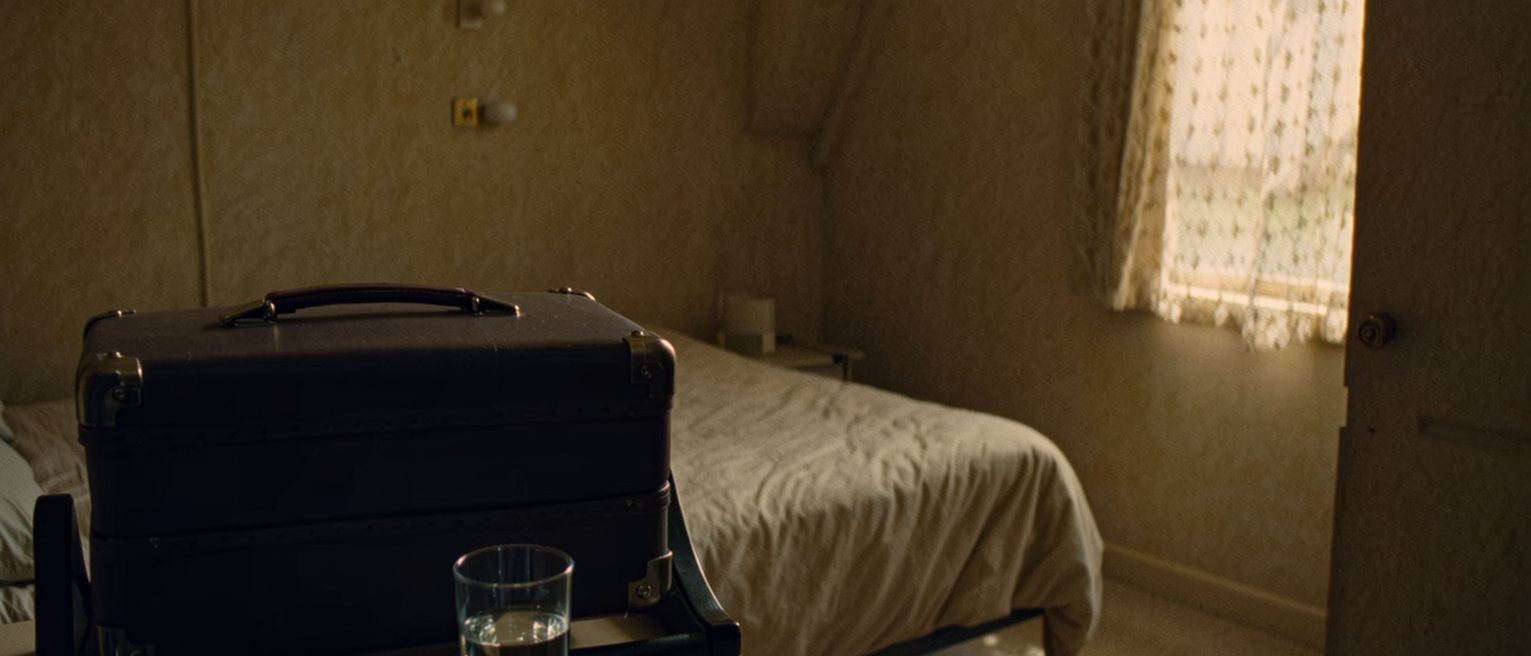
The film seeded for this essay is almost a single set. A retired teacher, widowed, books a hotel room and a young man to come to it, and nearly everything that happens over its four meetings happens inside that room. It is easy to read the confinement as a budgetary choice by the filmmakers. It is better read as the film’s actual subject. The room is the only place in her life where she is not who everyone knows her to be.
Notice what the room lets her do. She uses a name that is not hers. She sets the agenda with a printed list, and then abandons it. She says things she has never said in a room that contains anyone who knew her husband, taught beside her, or was raised by her. None of that would be available to her in her own flat, where the photographs are, and where the furniture has thirty years of her in it. The hotel room has no history of her at all. Nothing in it can contradict the person she is trying, for the first time, to be.
And she booked it. The film is specific about this, and it matters. The room is hers by arrangement — her card, her name at the desk, her key. The young man arrives as a guest in a space she holds. That is the reverse of the usual arrangement, in which a woman is received in a space a man has chosen, and the film’s argument is that the reversal is what makes everything else possible. She is not the host, because the room is nobody’s home. But she is not the guest either. She is the one who holds the key, and a person who holds the key can leave, and a person who can leave can stay.
Two kinds of hotel, two kinds of gaze
In Japan a hotel is not one thing. There is the city hotel, with a lobby, a front desk, a name on a form, a lift that anyone in the lobby can watch two people step into. And there is the other category, the one the language has a word for and the law has a category for, which was built over decades to do one thing the city hotel cannot: let two people enter and leave without being seen by anyone at all. Separate entrances. A room chosen from a panel rather than a person. Payment through a slot. A cultural history of the type, published in English, reads it as a piece of privacy infrastructure — architecture designed around the single problem of the gaze.
A woman deciding between the two is not comparing prices. She is deciding which gaze she can bear. The city hotel’s gaze is the front desk’s: polite, recorded, indifferent, and inescapably a gaze. The other hotel’s gaze is the street’s: nobody inside sees her, but anyone outside who watches her turn in through that particular entrance draws one conclusion, and it is a conclusion about her and not about the evening. The first hotel knows her name and does not care. The second hotel does not know her name and the pavement does.
The house’s venue page says that a station name is enough for an inquiry and that a hotel the house suggests is one option among three. This essay adds the thing the page is too practical to say: the reason a woman asks the house to suggest a hotel is very often that she does not want to be the one who chose which gaze. If the house names the building, she is a guest of an arrangement rather than the author of a decision, and the difference is one she may need on a first evening. That is a legitimate reason and it deserves to be said plainly rather than left as a preference on a form.
The walk from the street to the door
This chamber has argued that safety on a first evening is not the absence of danger but what happens after the first small no — that a woman learns whether she is safe by watching how a refusal is received. The venue question has its own version of that. The part of the evening she is actually afraid of is rarely the room. It is the distance between the street and the door: the lobby, the lift, the corridor, the few seconds in which she is visibly a woman going somewhere with a purpose she has not announced.
Everything about how an arrangement handles that walk tells her what kind of arrangement it is. Whether she is met at the door or in the lobby. Whether she is asked to arrive first, or second, or together. Whether the room is already in her name or in someone else’s. Whether there is a plan for the corridor at all, or whether she is left to improvise the one part she cannot rehearse. A house that has thought about the corridor has thought about her; a house that has thought only about the room has thought about the evening.
This chamber has also argued that a secret changes the terms of a marriage while privacy never did — that the two are different in kind and not in degree. The walk from the street to the door is where that difference lives in the body. A woman who is keeping something private walks it with her head up. A woman who is keeping something secret walks it watching for faces. The room cannot fix which of the two she is. But the arrangement can decline to make it worse, and the first way it declines is by never leaving her alone in the corridor with a decision.
Her own home, and the cost of not leaving
The reasons a woman chooses her own home are good ones, and the venue page names two: she does not want to travel afterwards, and she is more herself in her own room than in a borrowed one. Both are true, and this essay does not argue against either. It only asks that the choice be made knowing what it costs, because the cost is not the one she will have counted.
The first cost is the one the previous section named: the host is never off duty at home, and an evening that asks her to be touched without managing anything is being asked of her in the one room where managing is what she does. The second cost is quieter and arrives later. A room remembers. The sofa she was on is the sofa she will be on tomorrow evening with the television. The bedroom is the bedroom. There is no door she closes behind the evening, because the evening happened on the near side of every door she has. A hotel room ends when she leaves it. Her own room does not end. It absorbs.
Against this stands the third cost, which the hotel carries and the home does not: the journey back. This chamber has written about the woman whose working life sends her home mid-cycle — arriving before her body has finished what it started — and the journey home from a hotel is that arrival in miniature. Transport around the house’s home ground stops shortly after midnight, the venue page says, and the house looks at the return during the consultation rather than pretending it away. A woman weighing home against hotel is weighing a room that will not let her stop being the host against a journey that will not let her stay in the body she just found. There is no option without a cost. There is only the honest comparison.
A place that belongs to nobody for three hours
An American sociologist gave a name, decades ago, to the places that are neither home nor work — the café, the bar, the barber’s, the corner where people gather without being on duty anywhere — and argued that a life without such places is thinner than its inhabitants realise. The argument was civic, about conversation and neighbourhoods. This essay borrows the shape of it for something the sociologist did not have in mind, because the shape holds.
A woman’s life in this country is very often two places. There is the workplace, where she is competent and watched, and there is the home, where she is responsible and needed, and there is a great deal of transit between them in which she is neither but is also not anywhere. What she does not have is a third place — a room in which she is not on duty, not known, not the person any of the furniture expects. The hotel room, booked for an evening, is the closest thing available to her: a place that belongs to nobody, that will forget her by morning, and in which for a few hours there is no one to be except whoever she turns out to be.
This is why the room matters more than the two lines of a quotation it moves. It is not that a hotel is nicer than a flat. It is that a room with no history of her is the only room in which the host can take the evening off, and the host taking the evening off is most of what she came for. The book seeded for this essay says eroticism needs a space that is not administered by the person in it. The film says a woman can only be nobody’s in a room that is nobody’s. Between them they say the same thing, and the form field at the bottom of the page is asking her whether she knows it.
What the house does with the room, and what it owes
It should be said first that the house has an interest in this question, and that the interest is not neutral. Of the three options, the one the house suggests is the one the house knows: the building it has used, the entrance it has thought about, the corridor it has already solved. It is also, not by coincidence, the option that is easiest for the house. A house with a preferred building has a standing reason to steer a woman toward it, and to describe that steering as care.
So the obligations are recorded. The suggested hotel is one option among three and is never the default. A woman who books her own room is not treated as having made the difficult choice, and a woman who chooses her home is not treated as having made the naive one. The house says which building it would suggest and why, and the reasons given are about the corridor and the entrance and not about the house’s convenience. And the venue page’s rule stands: a station name or a city is enough, and nobody is asked for an address in order to be told which option is open to her.
The house also owes her the thing this essay has been arguing, which the venue page cannot say without sounding like a sales case: that the room is a decision and that it is hers. Not because the house is indifferent to where the evening happens — it is not — but because a room she chose is a room she holds, and the film is right that the woman who holds the key is the woman who can stay. The house’s job with the room is to make every option safe to walk to and easy to leave, and then to take its hands off the choice.
What this essay does not claim
This essay makes no claim about any particular hotel, chain, building or district, and describes no hotel’s policies, entrances or practices. The two categories discussed are read as cultural facts of this country — one built around the front desk, one built around the absence of one — and the reading of them is the essay’s own. Nothing here is legal guidance about either category, and a woman with a question about her own circumstances should ask it of someone qualified to answer it.
The book seeded for this essay is a therapist’s argument about desire in long partnerships; its central claim about administered space is borrowed and extended here to ease as well as desire, and the extension is stated as the essay’s own. The film is read as a film, for the room it is set in and what its protagonist does there, and nothing is claimed about its makers or its performers. The sociologist’s concept is borrowed for its shape and applied to a use its author did not intend, which is recorded in the ledger. No figure, statistic, price, distance or duration appears anywhere in this essay.
The section on the house states first that the house has an interest in the answer and names it, and then records the obligations: the suggested option is never the default, no choice is treated as the wrong one, the reasons given for a suggestion are about her walk and not the house’s convenience, and the decision is hers to hold. Nothing about safety is promised. The house can decline to make the corridor worse; it cannot make the street stop looking.