Cinema
House of Hummingbird, and the Year the Terms Were Explained
Seoul, 1994. A fourteen-year-old is hit by her brother and the household files it as children quarrelling. She wants things and the wanting is an inconvenience. Then one adult treats her as a person, and the treatment is not a rescue — it is a demonstration that the arrangement she has been living under is an arrangement rather than the weather. What a woman later calls her own difficulty asking for things may not be a trait she has. It may be a course she completed.
The film opens with a girl hammering on a door. She is calling for her mother, she is carrying bags, and she is becoming tearful, and nobody comes. Then she looks up at the number on the door and understands that she is one floor below her own apartment, in an identical corridor of an identical tower, shouting into somebody else’s home.
It is a joke about tower blocks and it is also the entire film in ninety seconds. She is not being refused. She is not being punished. She has simply arrived at a door where her needs are not the business of the people inside, and she will not find out for some time that this is her situation almost everywhere, including one floor up.
House of Hummingbird, written and directed by Kim Bora, follows Kim Eunhee through most of 1994. She is fourteen, in her second year of middle school, the youngest of three children in a family that runs a small rice-cake shop and lives in a large apartment estate in southern Seoul. She has a boyfriend, a best friend, a younger girl at school who is in love with her, an older sister who breaks rules, an older brother who hits her, and parents who are tired. Very little happens, in the sense that reviewers mean when they say very little happens.
What is actually happening is instruction. This essay argues that the film is not principally a portrait of a sad adolescence, and not principally a national allegory either, although it has been read as both. It is an unusually precise account of the age at which a girl is shown the terms on which she will be offered a life — and of what one adult, behaving differently, is able to do about that. Not rescue her. Something smaller and more consequential.
The record, stated before the reading
House of Hummingbird, Korean title Beolsae, is Kim Bora’s first feature. It runs 138 minutes. It had its world premiere in the New Currents competition at the 23rd Busan International Film Festival on 6 October 2018, where it took the NETPAC Award and the KNN Audience Award. It opened in Korean cinemas on 29 August 2019 and in Japan on 20 June 2020 as Hachidori.
At the 69th Berlin International Film Festival in February 2019 it won the Grand Prix of the Generation 14plus International Jury for the best film in that competition. That is a specific prize and it is worth being exact about it: the Generation section also awards Crystal Bears chosen by juries of young people, and in 2019 the 14plus Crystal Bear went to a different film. The prize this film won is the one decided by the section’s international jury of adults.
At the Tribeca Film Festival in April 2019 it won three awards in the International Narrative Competition: Best International Narrative Feature, Best Actress for Park Ji-hu, and Best Cinematography for Kang Gook-hyun. The jury’s published citation for the feature award described a seemingly unexceptional girl being truly seen by another person for the first time, and said that through that chance connection her view of herself and therefore her life is transformed. That citation is quoted here because it is the shortest available statement of what the film is about, written by people who were not trying to make an argument about it.
Park Ji-hu plays Eunhee. Kim Sae-byuk plays Youngji, the teacher at the hanmun academy — a cram school for classical Chinese characters — where Eunhee is sent. Kim Bora has said publicly that the film is, in her words, partially autobiographical but not her own story, and that in the beginning she was very true to the emotions she went through in middle school. Elsewhere she has said that at the very start she felt the film was her, totally her, and that by the time of its festival run she no longer felt it was about her. Those are her characterisations and this essay does not go past them into her life.
The household is an arrangement, not a mood
The parents run a rice-cake shop. They work. They are not cruel and they are not absent; they are occupied, and occupied in a way that means the household’s attention is a scarce resource requiring triage. The triage has a criterion. The elder son is studying for university entrance, and the household’s hopes, its quiet, its budget and its tolerance are organised around that project. Eunhee’s father repeats the ambition. A teacher at school has the girls chant that they will go to Seoul National University instead of to a karaoke room. The same teacher has the class nominate its two worst delinquents, defined as those who smoke or go on dates rather than study, and Eunhee is nominated first.
So there is a hierarchy of legitimate claims, and it is not secret. A claim connected to the son’s examination is legitimate. A claim connected to the shop is legitimate. A claim connected to a fourteen-year-old girl’s interior life is not illegitimate exactly; it is unscheduled. It arrives at a moment when something else is happening, which is every moment.
This is why the film keeps returning to small domestic requests and their fate. Eunhee asks for things and the asking lands badly, not because anyone objects to the thing but because the request itself is the wrong shape for the room. A child learns from that faster than from a refusal. A refusal is information about one request. A request that is simply absorbed into the noise is information about the category.
What the brother’s violence teaches, which is not about the brother
Eunhee’s older brother, Daehoon, hits her. Not once. The film shows it as a pattern with its own rhythm, and it shows the household’s response, which is the part that matters.
The response is classification. When Eunhee reports it, her mother looks away and tells them not to fight. The event has been filed. It is now a quarrel between siblings, a category that carries no consequence, requires no action, and has no complainant and no accused. The brother is not defended. He is not accused either. He has simply been placed inside a description that dissolves the question.
Kim Bora has said publicly that she did not want to present Eunhee as merely a victim of patriarchy or the father and brother as merely assailants, and that her aim was to show that nobody wins in such a system. That is a director’s account of her intention and it is worth respecting, because it correctly identifies where the pressure is. The son is being crushed by the same arrangement that licenses him; he is carrying an examination that stands for the family’s entire future and he discharges it downward onto the person with the fewest means of complaint. Late in the film he weeps at the table, and the film does not tell you what the weeping is for.
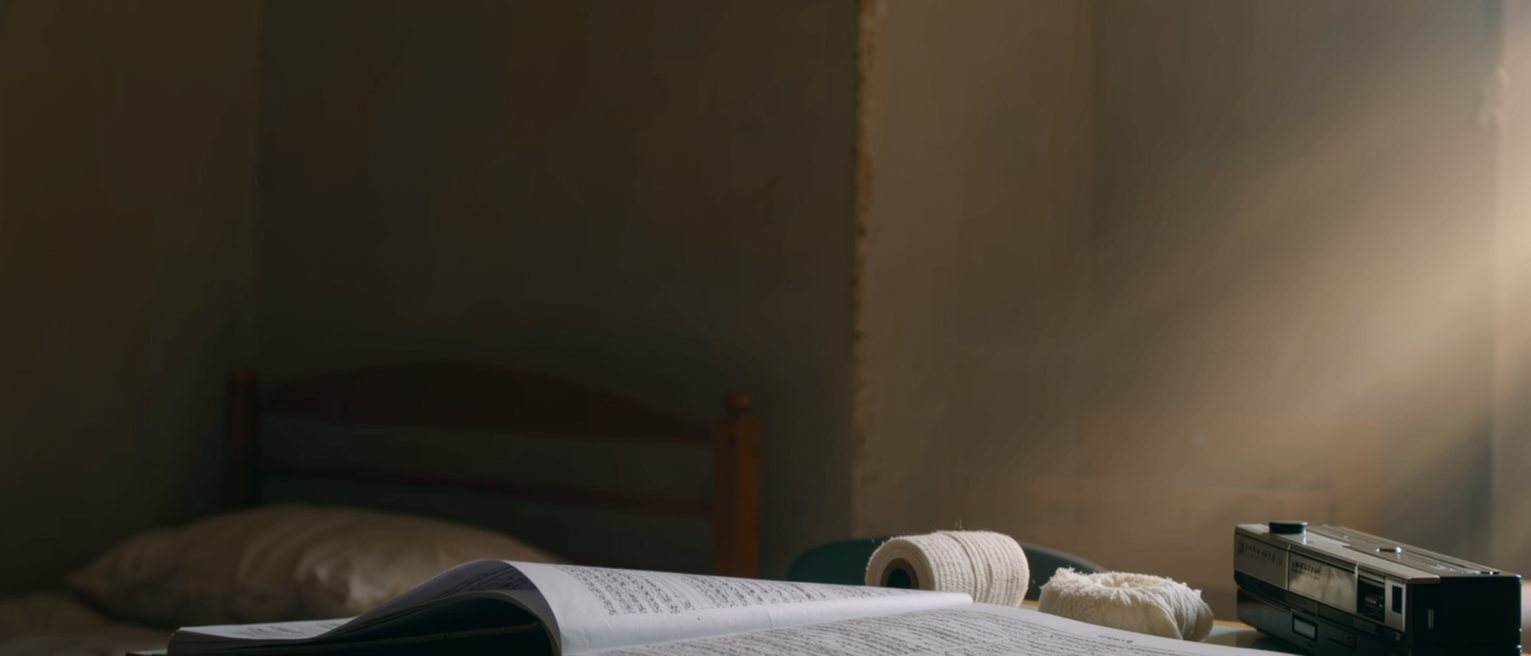
But the lesson Eunhee receives is not a lesson about her brother’s inner life. It is a lesson about the reporting system. She has now run a test. She submitted an account of something that happened to her body to the authority responsible for her, and the authority declined to register it as an event. What she learns is not that violence is acceptable. It is something more portable and more durable: that her account of her own experience is not, in this house, the kind of thing that changes what happens next.
That is the first term. Your report is not an input. It is a noise the household will route around.
Attention, and the discovery that it is conditional
She has a boyfriend, Jiwan. He is warm and then he is not. When Eunhee is caught shoplifting and is in trouble, he becomes unavailable, and his eventual withdrawal is not framed by the film as a betrayal so much as a reallocation. She has a best friend, Jisuk, and the friendship survives a rupture, which is one of the few things in the film that does. She has a younger girl at school, Yuri, who is openly in love with her and later, with visible embarrassment, tells her that was last semester.
The film does not rank these. It is not interested in which one hurt most. It is interested in the fact that they rhyme. In each case attention arrives, is real while it lasts, and is withdrawn for reasons that are not about anything Eunhee did and are never fully explained to her. A girl running that experiment three or four times in a year does not conclude that these particular people were unreliable. She builds a general theory, because a general theory is what a person builds when the same result keeps arriving through different doors.
The theory goes roughly like this. Attention is a weather system. It is not caused by you and it cannot be requested; it can only be waited for, enjoyed, and survived when it goes. And the practical rule that follows from the theory is the one that will still be operating in twenty years: do not build anything that depends on it. Do not ask for more of it, because asking cannot produce it and asking reveals that you wanted it.
That is the second term. Attention is conditional, withdrawable, and not answerable to your request.
Youngji does one thing, and it is not rescue
Into this arrives Youngji, the new teacher at the hanmun academy, played by Kim Sae-byuk. She is a university student, she smokes, she is quiet, and she is the only adult in the film who is not administering something to Eunhee.
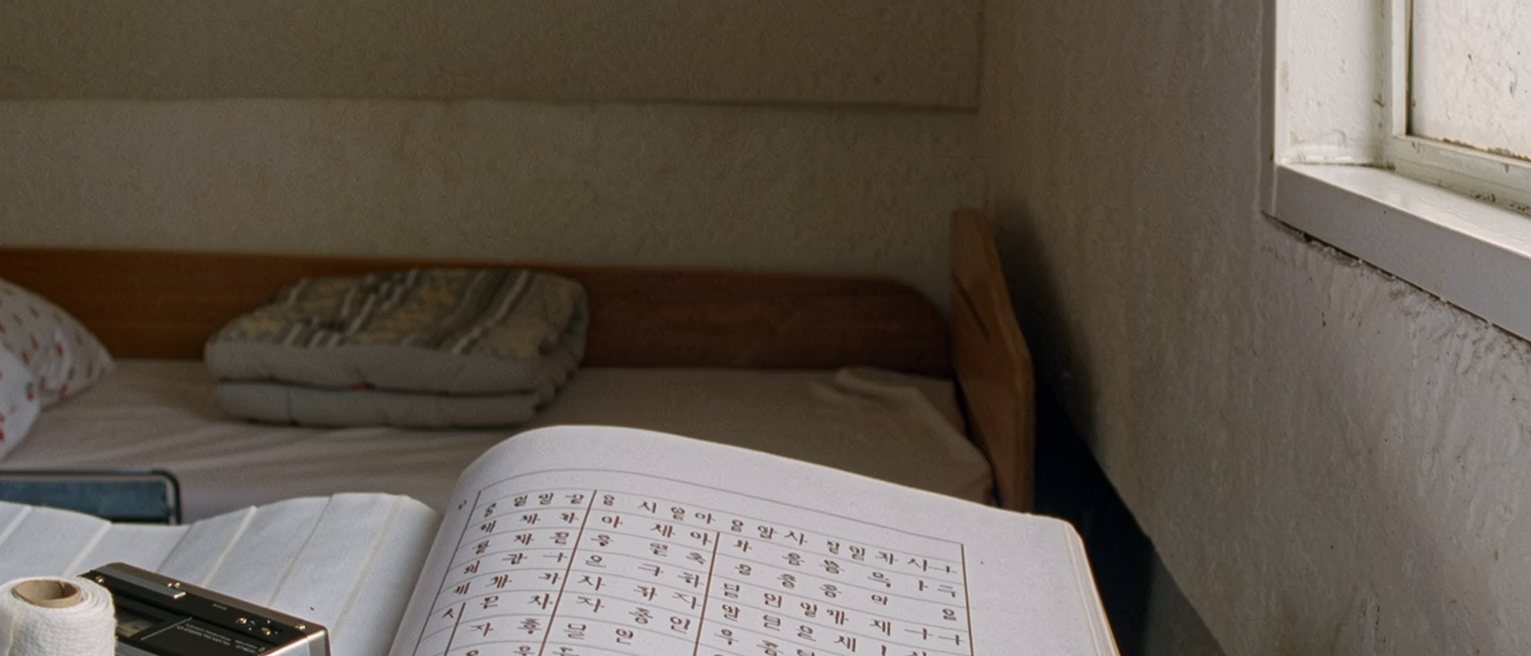
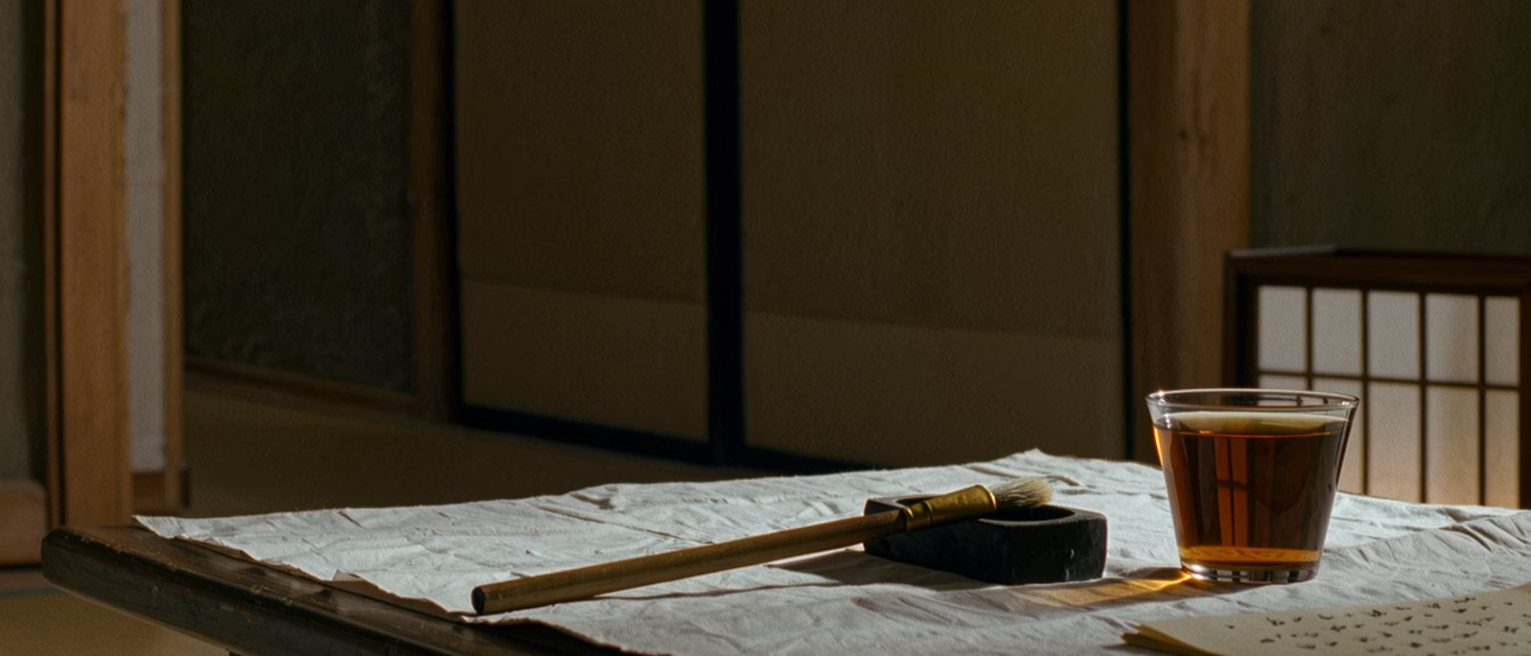
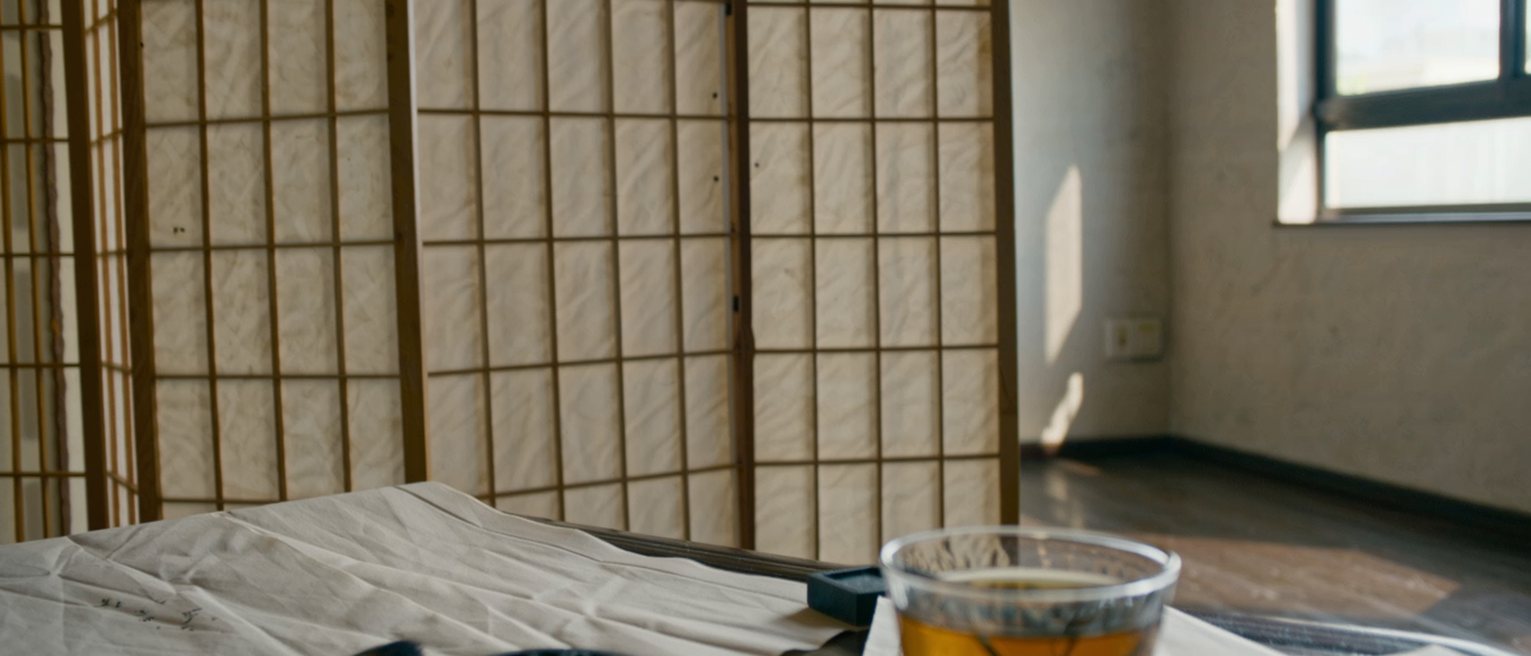
The scenes between them are mostly undramatic. She writes a classical phrase on the board about how many faces one knows and how few hearts. She asks questions and then waits for the answers, which is rarer behaviour than it sounds. She drinks tea with Eunhee in silence and the silence is not awkward. Eunhee brings her rice cakes from the family shop, which is the only currency she has, and Youngji accepts them.
There is one instruction. When Eunhee tells her that her brother hits her, Youngji does not look away and does not reclassify it. She tells her, in substance, not to be hit — to resist somehow, to fight back. Reported flatly that sounds like inadequate advice, and as advice it probably is; a fourteen-year-old cannot out-fight an older brother and the film does not pretend she can. But it is not functioning as advice. It is functioning as a ruling. An adult has heard the same report the mother heard and has reached the opposite finding: that this is a thing being done to you, that it is not a quarrel, and that you are entitled to object.
This is the whole of Youngji’s structural function, and it is worth being precise about how limited it is. She does not remove Eunhee from the house. She does not confront the family. She does not solve the brother, or the school, or the money, or the loneliness. She changes nothing about the conditions. What she does is constitute a second data point — one adult, behaving otherwise — and a single second data point is enough to convert a constant into a variable.
Before Youngji, the terms are simply what there is. They have the status of gravity: unpleasant, universal, not worth complaining about because complaint is not the sort of thing gravity responds to. After Youngji, the terms have a competitor. They are revealed to be somebody’s choices, which means they are the sort of thing that could have been otherwise, which means the girl living under them is not simply a person who is wrong to want.
A curriculum is not the same thing as a wound
A great many adult women can describe, without difficulty, a specific incapacity: that asking for things is hard, that stating a need feels like an imposition, that they will absorb a considerable amount rather than say that something is not working, and that they are more comfortable being useful than being wanted. It is usually described as a trait. It is described with the grammar of personality: I am the kind of person who. And traits, once named that way, are held to be either endured or worked on privately.
This film proposes a different grammar for the same material. What it shows is not a wound being inflicted — there is no single scene that could be pointed to as the injury — but a course being taught, module by module, in an ordinary year, by people who are not trying to teach it and would be surprised to hear that they did. Your report is not an input. Your wants are unscheduled. Attention is weather. Being useful is the only reliable way of being noticed. None of these is a trauma. Each is a finding, and each was arrived at by a competent person correctly reading the evidence available to her.
The difference between the two grammars is not academic and it is the whole reason for writing this. A trait is something you are. A finding is something you concluded, on evidence, in a setting. A trait has to be accepted or fought. A finding can be re-examined — not by deciding to feel differently, which nobody can do, but by noticing that the evidence base was one household in one decade and that it has not been updated since.
It has to be said very clearly what this does not mean. It does not mean that a reader who recognises any of this had a childhood like Eunhee’s. It does not mean that difficulty asking for things has a single cause, or that it is a problem, or that it is common, or rare. This Library is reading a film and proposing a structure; it is not examining anybody. A person can find the structure interesting and conclude that nothing in it applies to her, and that conclusion is as likely to be correct as any other.
Nineteen ninety-four is specific, and the question of whether the mechanism travels
On the morning of 21 October 1994, at about 7.38, a forty-eight-metre section of the Seongsu Bridge over the Han River in Seoul fell roughly twenty metres into the water. Thirty-two people were killed and seventeen injured. Among the dead were students from Muhak Girls’ Middle and High School, on their way to class, and a bus driver, and a foreign national who had been living in the country without papers. The subsequent investigation identified defective welding at the structure’s connections, corroded hinges and inadequate maintenance; a government white paper recorded defects in nearly every connection on the bridge. Seventeen people — officials of the Seoul Metropolitan Government and of the construction and maintenance contractors — were convicted and received sentences ranging from six months to three years.
Those facts are set down here in that order, with the cause and the convictions attached, because it matters that they are not atmosphere. Thirty-two people were killed by a maintenance failure that was known about in the record and acted on too late. They are not a mood for a film to borrow and they are not a metaphor for a girl’s interior life, and a film that used them that way would deserve the objection. House of Hummingbird does not quite use them that way, and this essay tries not to either.
What the year gives the film is a household under a particular pressure. Kim Bora has said publicly that 1994 was the period when her country was trying very hard to be recognised, to move from underdeveloped to developed, and that this is why things were built so fast and why the bridge came down. She has also said that her own elder sister crossed that bridge to school each day and was late on the morning it fell; that her family was relieved and also grieving, because a great many girls from her sister’s school were killed. The film gives Eunhee an elder sister who takes that bridge and survives it, and gives Youngji the other outcome.
The wrong move is to treat the film as a report from one country to another: Korea explaining Korea, with Japan reading over the fence and drawing conclusions about the neighbours. That move is wrong in both directions and it is wrong even when it is flattering. There is no claim anywhere in this essay about Korean families, Korean fathers, Korean daughters, or about how any of those compare with anyone else’s. The 1994 setting is specific and the essay has tried to honour the specificity rather than dissolve it into a general Asian adolescence.
But the mechanism the film shows is not made of anything national. Look at what it actually requires. It requires a household with more legitimate claims than attention to satisfy them. It requires a rule, any rule, for deciding whose claim counts. It requires that violence within the family have an available description that dissolves it. And it requires that the child be competent — able to read evidence and generalise from it, which every fourteen-year-old is. Those four conditions are not culturally exotic. They are available in any country, in any decade, at any income, and they were available in the childhoods of a great many people who have never been to Seoul.
That is a claim, and a claim with no possible failure condition is not worth making, so here is what would show it to be wrong. If the difficulty this essay describes were caused by something narrower than the four conditions, it would not appear where those conditions held but the narrower cause did not. So the reading fails if adults who grew up in households with a different allocation rule — a different favoured child, a different criterion, no favoured child at all — turn out never to arrive at the same findings; and it fails if the findings turn out to track one national setting rather than the structure. This essay has not run that test. Nobody has run it in the form stated. What it has is one film, read closely, and a structure that appears in it. That is what is on offer and it should not be mistaken for more.
What this Library has already argued, and what is new here
An earlier essay in this Library asked why it is easier to ask for a gift than for what you actually need, and located the answer in the present tense: a gift terminates, a need recurs, and a stated need contains an accusation the other person has to accept before they can act on it. Another argued that asking does not make a desire less valuable, and that what is genuinely lost when a thing must be requested is a piece of evidence about the other person rather than any part of the thing’s worth. A third, examining a body of survey data about household inequality, argued that what looks like acceptance is often the absence of an expectation that was never installed, and that resentment requires having expected something else in the first place.
All three are arguments about the mechanics of a grown woman’s present. This essay is about where the equipment came from. Its addition to the earlier work is a claim about origin and timing: that the difficulty is not only sustained by present costs but was taught, at a specific age, by a specific arrangement, and taught well enough that it now feels like character rather than conclusion.
And this Library has written before about the life a person did not choose, reading a film in which almost nothing happens and a woman is nonetheless altered by it. House of Hummingbird belongs beside that, with one difference worth stating. In the earlier case the unchosen life is a road not taken by an adult who could see the fork. Here there is no fork and no adult. There is a child being told what is on offer, by people who do not know they are telling her, in a year she will remember for other reasons.
This house sells attention, which makes the argument convenient for us
The declaration belongs here, before the objections rather than after them, because a disclosure that arrives once the argument has done its work is not a disclosure.
This house sells private companionship: an evening in which a woman is listened to, asked questions, and attended to without having to earn it by being useful. The essay above has just spent several thousand words arguing that attention is a thing many people were taught not to ask for, and that being treated as a person by one adult can change how a person reads her own situation. It would be difficult to construct an argument more flattering to what we sell. That is true whether or not the argument is also correct, and it is stated here rather than left for a reader to notice.
So the declaration comes with constraints on what may be claimed, and they are these.
We do not claim to be Youngji. Youngji is a teacher who is not paid to be interested in Eunhee and who is under no obligation to her. An evening here is booked, bounded and paid for, and that difference is not a detail. A paid hour of attention is a real thing with real value and it is not the same category as an adult who chose you for nothing, and anyone in our position who blurs the two is selling a story rather than an evening.
We do not claim any outcome. Nothing here says that an evening repairs a childhood, resolves a difficulty with asking, or does anything at all beyond what happens during it. We are not in a position to know, the claim would be unfalsifiable, and unfalsifiable promises are the standard instrument by which people in exactly this position are taken advantage of.
And we do not claim that any reader needs this. The essay describes a structure in a film. A woman who reads it and recognises nothing is not in denial, and a woman who recognises everything is not thereby in need of a service. Those are not the only two options and we have no interest in a page on which they are.
The strongest case against this essay and against the film
Four objections, taken at their strongest rather than at their most answerable.
The first is against the film. It is very beautiful. The light through the apartment windows, the trampoline, the textures of concrete and fabric, the long held shots: the film is a pleasure to sit inside, and what it is depicting is a child being hit, ignored and taught that she does not count. Beauty of that order performs a conversion. It turns a painful childhood into a good evening at the cinema, and it lets an audience finish the film feeling that they have honoured something when what they have mostly done is enjoy it. The objection is not that the film is dishonest. It is that aesthetic pleasure is an unreliable guide to whether a hard thing has actually been confronted, and this film supplies a great deal of aesthetic pleasure.
The second is against the reading offered here. If Youngji’s importance is structural — a second data point, a demonstration, a competitor to the terms — then this essay has described a device, not a person. And a film in which the one kind adult exists in order to make the protagonist’s situation legible, and is then removed by a disaster at the exact moment the lesson has landed, is a film using a character as an instrument. The counter-reading is that the essay has not discovered this structure in the film so much as ratified the film’s own machinery and called it insight.
The third is the largest. Reading a coming-of-age film as a curriculum may over-explain a work whose achievement is that it declines to explain. The film is notably unwilling to tell you what anything means. The brother weeps and is not accounted for. The ending is a held shot of a girl’s face among her classmates and it resolves nothing. Against that, this essay has supplied numbered terms, a mechanism, a set of findings and a theory of how they were acquired — which is precisely the tidiness the film refused. It is possible that what is on screen is an adolescence, mysterious in the ordinary way, and that the curriculum is a structure this Library brought with it and laid over the film because it is the structure this Library finds interesting.
The fourth is aimed at the previous section but one. An essay that says a mechanism is not confined to one country, and then supplies no test by which that could be shown false, has made a claim that costs nothing. The failure conditions offered above are real conditions, but nobody has checked them, including the authors of this page, and a falsifiable claim that has never been exposed to falsification is in practice not much better than an unfalsifiable one.
What is left after all four have taken what they are owed is narrower than what was set out, and it is this. In one film, read closely, a girl is shown how her wants will be treated and by whom, and one adult behaving differently is enough to make that showing visible to her as a set of choices rather than as the nature of things. Whether that reading illuminates anything beyond the film is a question this essay has raised and has not settled, and a reader is under no obligation to take the extra step.
What this does not claim
This essay is film criticism and cultural analysis. It is not clinical or psychological guidance, it describes no condition, it promises no outcome, and it diagnoses nobody. Nothing here is an assessment of any reader’s childhood, family or capacities, and the argument is compatible with a reader concluding that none of it describes her.
No prevalence is claimed anywhere. This essay does not say how common the difficulty it describes is, how many people have it, or what proportion of any group anything applies to. Where it says that many adults describe something, that is a description of a familiar way of speaking and not a measurement.
The festival record is stated as verified: the Busan premiere in October 2018 with the NETPAC and KNN Audience awards, the Grand Prix of the Generation 14plus International Jury at the 69th Berlinale in 2019, and three wins at Tribeca in 2019. The Generation 14plus Crystal Bear awarded by the youth jury in 2019 went to another film and is not claimed here. Awards not listed are not implied.
Kim Bora’s account of the film’s autobiographical basis is reported only in the terms she has used publicly, including her own qualification that it is partially autobiographical but not her own story. Nothing here presents her childhood, her family or her inner life as established fact, and nothing beyond her published remarks is asserted about her.
The Seongsu Bridge collapse of 21 October 1994 is a matter of public record, and the casualty figures, the finding of defective welding and inadequate maintenance, and the convictions that followed are stated from that record. Thirty-two people died in a preventable structural failure. They are named here as people killed by a maintenance failure, not as background for a work of fiction, and no claim is made about any individual victim or any individual bereaved family.
Nothing here is a claim about national character in any direction. The film is Korean and its 1994 setting is specific, and no comparison is drawn or implied between Korean families and Japanese families, or between either and anywhere else. Where the essay argues that a mechanism is not confined to one country, that is a structural argument about four stated conditions, offered with the terms on which it would be wrong.
Plot details, dialogue and scene descriptions are drawn from published synopses, festival materials, reviews and interviews rather than from a shot-by-shot transcription, and all dialogue is paraphrased in description rather than quoted; no passage of the film’s script is reproduced. The one direct quotation in the essay is from the Tribeca jury’s published citation. Neither the director, the cast, the producers, the distributors nor any festival has any connection to this house, knows of it, or endorses it, and no endorsement should be inferred from the fact that this Library admires the film.