Moonlight Journal
Wanting to Be Wanted Is Not the Same as Wanting.
Ask a woman what she wants and listen to the grammar of the answer. To be wanted. To be chosen. To be held, to be seen, to be healed. Every verb is in the passive voice, and she is the object of all of them. That is not the absence of desire. It is desire that has only ever been practised in one voice, and the other voice — the one in which she is the subject and the verb goes outward — is not missing from her. It has simply never been rehearsed in a room where nobody had a stake in the answer.
Ask a woman, gently and in private, what she wants. Not what she wants for her children or her marriage or her week — what she wants. The question is harder than it sounds, and the difficulty shows in the answer before the content of the answer does. She wants to be wanted. To be chosen, for once, rather than settled for. To be held without having to ask. To be looked at as though she were still worth looking at. To be understood. To be healed.
Every one of those is a real want, and this essay takes none of them away from her. But listen to the grammar. Each verb is in the passive voice. In each sentence she is the object — the one to whom the wanting, the choosing, the holding is done — and the subject is somebody else, unnamed, whose desire is the thing she is describing. She has answered a question about her desire with a description of someone else’s. That is not evasion. It is fluency in the only voice she was ever taught.
This essay is written from her side, on the workbook row named for female desire, and it argues one thing. The desire she cannot find when she looks for it in the active voice is not absent. It is unrehearsed. This chamber has already published the two standard accounts of how women’s desire works — that it is more often responsive than spontaneous, and that it runs on a brake as well as an accelerator — and it credits them here without restating them. What it adds is a third account that is not physiological at all: that a desire conjugated only in the passive has never been given a room in which to be practised in the transitive, and that the practice is the whole of what is missing.
The grammar she was taught
The passive-voice wants are not a personal failing and they were not invented by her. They are the sentences a girl learns first. To be liked. To be picked for the team, asked to dance, chosen from the row. The child’s wants about other people are almost all in the passive, and that is ordinary; a child does not yet have the standing to want outward. What is not ordinary is that for many women the grammar never changes. The wants become adult — to be desired, to be married, to be treated well — and the voice stays where it was.
The passive voice has a structural property that matters here: it does not require the speaker to know what she would do. To be wanted is a complete want with no object. To want is not; it demands a direct object, a something or someone the verb lands on, and to supply one is to expose a preference. The passive is therefore safe in a way the active never is. Nobody can be disappointed in what she wanted if what she wanted was only to be wanted. Nobody can refuse it, because it made no request. And nobody can be shocked by it, because it described no appetite.
That safety is exactly the cost. A want that names no object cannot be met by anyone, including her. It can be answered only by being wanted, which is to say by another person’s desire arriving, which is to say by luck. A woman who has spent thirty years wanting to be wanted has spent thirty years waiting for a verb that someone else has to conjugate. And when it does not arrive, or arrives from the wrong person, or arrives and turns out not to be the thing after all, she concludes that her desire has gone. It has not gone. It has never once been the subject of its own sentence.
A list in a handbag
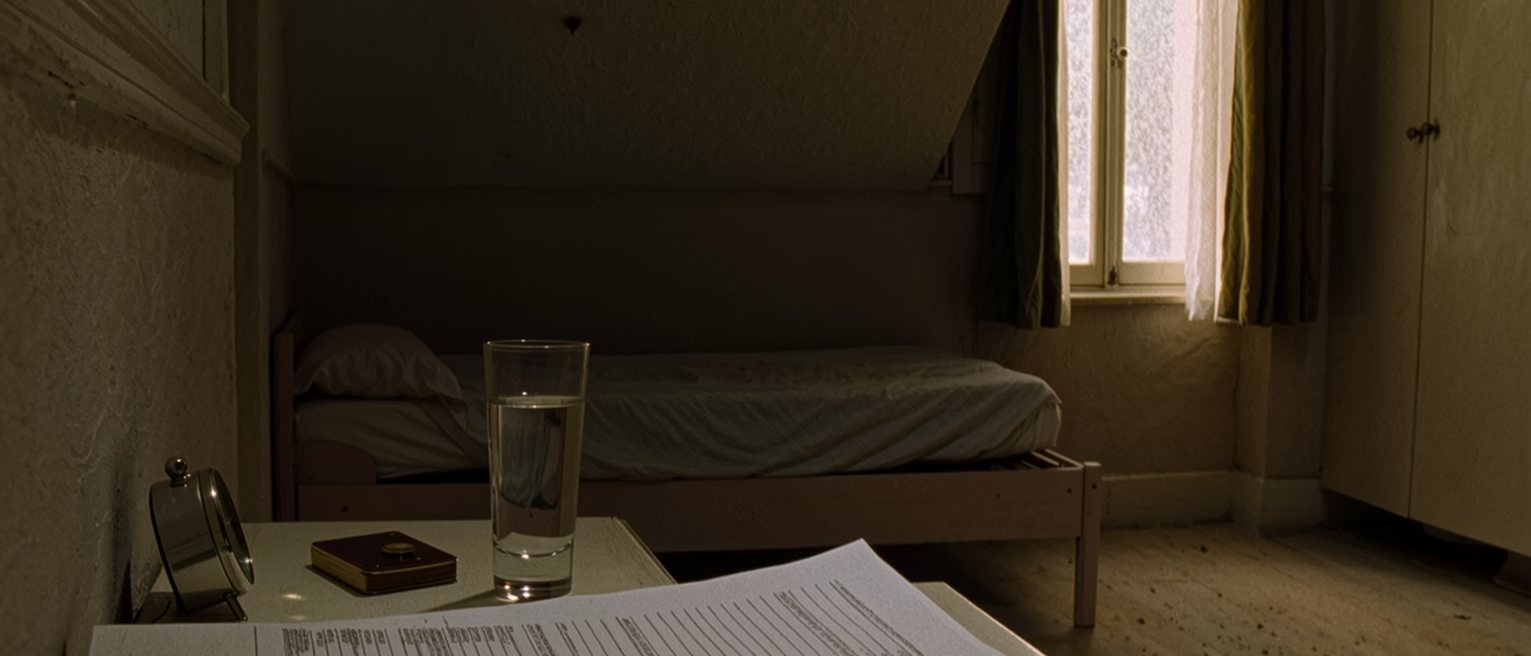
The film seeded for this essay knows this exactly. Its protagonist, a retired teacher and a widow, arrives at a hotel room having booked a young man to come to it, and she has brought a list. She has written down, in advance, in order, the things she wants to do. It is the most transitive document in the film — a page of active verbs with objects — and for most of the running time she cannot read it aloud. She talks around it. She asks about him. She apologises. She reverts, again and again, to the passive: whether she is still attractive, whether he is only being kind, whether a man could want her.
The list is the proof that her desire exists. It was there before the room, before him, specific enough to write down. What she does not have is any practice at saying it in the transitive to another person — and the film’s real drama is not whether she will do the things on the list but whether she can get a single active sentence out of her mouth in front of someone. When she finally does, the film treats it as the event it is. Not the act; the sentence. The moment the verb goes outward from her for the first time.
It matters who is in the room. He has no stake in what she wants — not in the sense that he does not care, but in the sense that her answer costs him nothing and asks him for nothing he has not already agreed to give. He will not be hurt if she wants something he is not. He will not be flattered into a story if she wants something he is. That absence of stake is what makes the sentence sayable. A woman rehearses the active voice most easily with someone whose feelings are not the audience, and for most women in most of their lives there has been no such person in the room.

Desire as one of the aims of a life
The book seeded for this essay is a scholar’s survey of the Tantric traditions, and it belongs here for one structural reason. In the classical Indian scheme those traditions grew from, desire — kāma — is not a lapse to be forgiven or an appetite to be managed. It is listed as one of the four legitimate aims of a human life, beside duty, prosperity and liberation. A person is meant to want. The Tantric turn the book traces is the further step of treating the body and its wanting not as the obstacle to the deepest aim but as a path toward it, to be walked with discipline and attention rather than renounced.
That is a different starting place from the one most women were handed. In the scheme she grew up in, wanting outward was at best undignified and at worst dangerous, and the respectable form of desire was to be the object of someone else’s. The book’s traditions, whatever else they are, begin from the opposite premise: that her wanting is a legitimate aim, that it is hers, and that the work is to attend to it rather than to be attended to. Attention, in that frame, is not something that is paid to her. It is something she does.
This chamber has argued before that Tantra is not a technique but a way of paying attention, and this essay does not reopen that. It borrows only the grammar of the older frame. In it, the verb is active by definition. One attends, one wants, one practises. The passive-voice woman is not wrong by that frame; she is simply standing at the start of it, holding a want that has never been conjugated, in a tradition that would tell her the conjugation is the path.
Unrehearsed is not absent
Here the two accounts this chamber has already published come back, and they support the third rather than competing with it. If most women’s desire is responsive — arising in the presence of the right context rather than out of nowhere — then desire is something that becomes findable under conditions, and a woman who has never been in the conditions has never had the chance to find it. And if the brake is the pedal that varies most, then a woman in a room where wanting outward would be exposed, judged or refused has the brake pressed by the room itself, and will read the silence as absence.
Both accounts describe a desire that is present and unavailable. The grammatical account says why it stays unavailable even when the conditions improve: because availability is not enough if the skill of wanting in the transitive has never been practised. A woman can be in the right room with the brake released and still have nothing to say, because the sentence has never been formed. She does not lack desire. She lacks rehearsal — and rehearsal is not a metaphor here. It is the ordinary, repeated, low-stakes practice of noticing a preference and saying it.
The practice begins far below anything erotic. Warmer or cooler. More pressure or less. This side or that. A hand here rather than there, slower, stop. Each is a complete active sentence with a direct object, spoken by her, landing on something. None of them is a confession and none of them can be refused in a way that costs her anything, which is what makes them rehearsable. A woman who has said forty small transitive sentences in an evening has done more practice in the active voice than most women are given in a decade, and the larger sentences are made of exactly the same grammar.
Why healing is the licensed word
This country has a word under which a woman is permitted to want without the appetite word appearing anywhere. The word is healing. She can want to be healed. She can book something for healing, tell a friend she went somewhere for healing, be seen entering a place that sells healing. A whole market exists under the word, and this house’s own offerings are among the things sold under it. The word is real and the wanting under it is real. But listen to the grammar once more: to be healed is passive. It is the one socially fluent want, and it is conjugated exactly like all the others.
The licence works because healing implies a damage that is not her fault and a repair that is done to her. It lets her want at length without ever having to be the subject of a sentence, and it keeps the appetite word — the one with greed and hunger in it — out of the room entirely. This is not a criticism of the word or of the women who use it. It is an observation about what the word does: it gives desire a passive form that the culture will accept, at the price of never letting it take the active one.
No claim is made here about the language or about national character. Other languages have their own licensed words and their own passive forms, and this chamber has already argued that some desires become easier to say in a second language precisely because the first language’s licensed forms are absent from it. The observation is only that in this country the fluent word for wanting is a passive one, and that a woman who has learned to want fluently under it has learned fluency in exactly the voice this essay is about.
Wanting in the active voice before there is an object
The fair objection is that the transitive verb needs an object, and she does not have one. She does not know what she wants; that is the whole trouble. Asking her to want in the active voice before she knows what to want seems to ask for the conclusion before the premise. But that gets the order wrong, and the film seed shows how. The list existed before the room. The wanting came first and the objects were found by writing them down, one at a time, without anyone watching.
This house’s front page says a woman does not need to know the right category before she begins, and this essay agrees for a grammatical reason. The active voice can be practised on a placeholder. I want — something. I want — more of that, whatever that was. I want — not this. The object is discovered by the verb’s going outward and landing, not chosen beforehand from a menu. A woman who starts each sentence in the active and lets the object arrive is not being vague. She is doing the thing in the only order it can be done.
And she can do it without a partner, before any room and before any house. The map this house asks a woman to fill in before anything is arranged — what she wants, might want, does not want, in her own words — is a rehearsal of exactly this, and it was designed as one. But the plainer rehearsal is private and free: to notice, several times a day, a preference of her own, and to say it in a sentence in which she is the subject. Not to be warm. To want the window closed. The difference is small in a kitchen and enormous in a life.
What the house sells, and what it owes
It should be said first that this house has an interest in the passive voice, and that the interest is not small. What the house sells is attention — a woman attended to, held, listened to, touched with care — and every one of those is a passive-voice want fulfilled. A house that profits from being the subject of her sentences has a standing reason to leave her in the object position, because a woman who only ever wants to be wanted will keep coming back to be wanted, and a woman who has learned to want outward may find, in time, that she does not need the house to do it.
So the obligations are recorded. The house does not sell being wanted, and it does not describe any Experience as the cure for not being wanted. The map asks her for her wants in her own words and in the active voice, and no category is filled in for her. In the room, the small transitive sentences — warmer, less, there, stop — are asked for and acted on, because that is the rehearsal, and the house does not fill the silences with its own reading of what she would want if she could say it. And no woman is told her desire is low, missing or in need of repair. The house sells under the word healing, like everyone else in this market, and it owes her the honesty that healing is a passive word and that what she came for may be the active one.
The house also owes her the thing this essay has been arguing. Her desire is not gone. It has never once been the subject of its own sentence, and an evening whose whole design is that nobody in the room has a stake in her answer is one of the few places the sentence can be practised. That is what an evening here is for, when it is for anything: not to want her, which is easy and which she has had, but to be the room in which she finds out what the verb does when she conjugates it.
What this essay does not claim
This essay is not clinical guidance and describes no treatment. Where a woman’s low or absent desire is a source of distress to her, or where it coincides with pain, illness, medication or a change she cannot account for, the question is clinical and this essay is not the reading that applies. The Experiences discussed are offered within a stated non-medical scope, and nothing here extends it. The word healing is read as a cultural licence, not as a claim that anything here heals.
The two physiological accounts of women’s desire — responsive desire and the dual-control model — are credited to this Library’s earlier essays and to the research they rest on, and are not restated. The grammatical account is this essay’s own and is a reading, not a finding: no linguistic claim is made about the Japanese language, no claim about national character, and no claim that any woman’s grammar causes her desire. The classical scheme of the four aims and the Tantric traditions are taken from the book seed and described at the level of that survey; no doctrine is asserted. The film is read as a film, for its list and its one sentence, and nothing is claimed about its makers or performers.
The section on the house states first that the house profits from the passive voice and names how, and then records the obligations: being wanted is not sold, the map is in her words and her voice, the small sentences in the room are asked for and acted on, no desire is called low or missing, and the healing word is used with its passivity acknowledged. Nothing is promised. A rehearsal is a rehearsal; the verb, when it goes outward, is hers, and where it lands is not for this house to say.